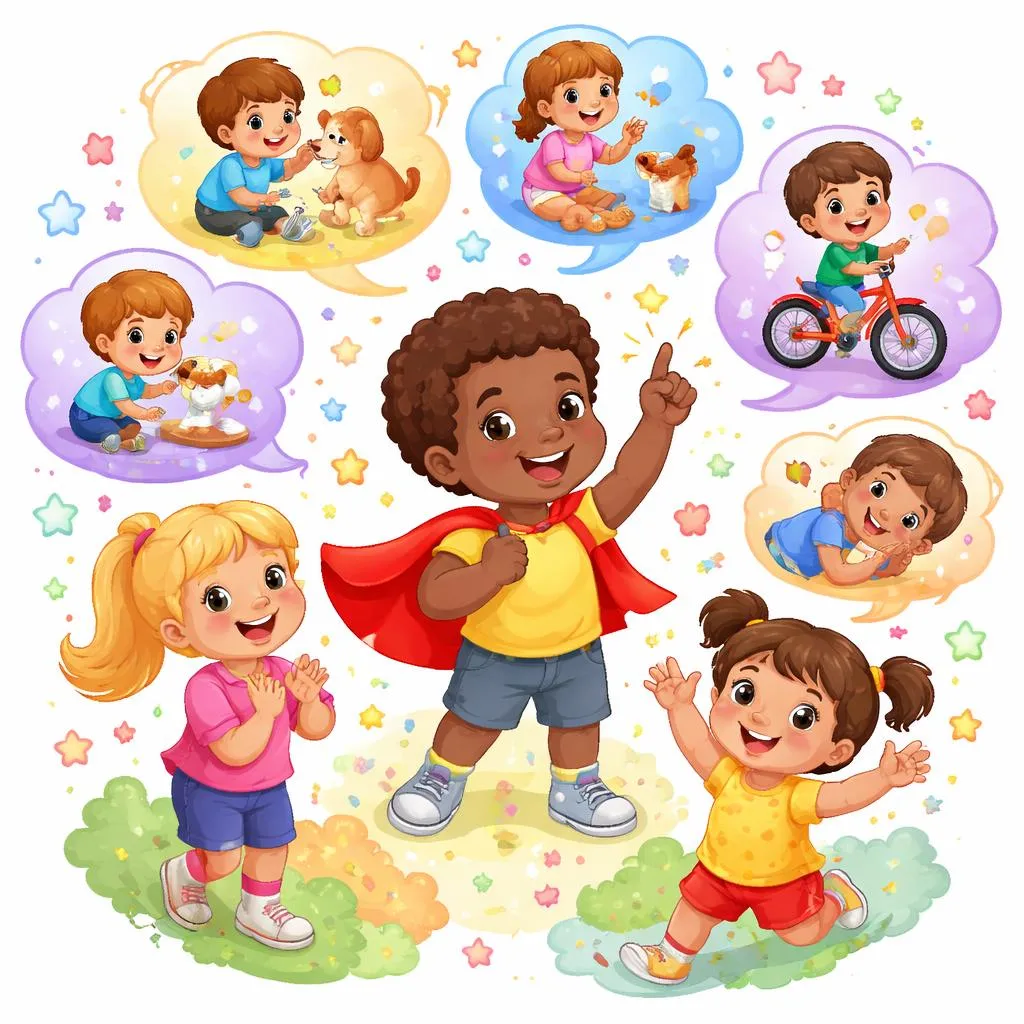

Hello, little word superhero! Do you know about superpowers? Superheroes can fly, lift heavy things, and see far away. Words can have superpowers too! These special word superpowers are called modal verbs. Modal verbs are helper words. They go with main verbs to show special meanings. They show if you can do something, if you may do something, or if you must do something. Today, we will learn forty wonderful sentences with superpower words. Our guide is Captain Can. He is a superhero who loves to show what is possible! He will show us modal verbs at home, the playground, school, and in the city. Let's find our superpowers!
What Is a Modal Verb? A modal verb is a superpower word. It is a special helper verb. It gives extra meaning to the main action verb. It shows ability, permission, possibility, or necessity. The main modal verbs are: can, could, may, might, must, shall, should, will, would. For 3-year-olds, we start with the most common: can, may, must, will. At home, you say "I can jump." The word "can" shows you are able to jump. At the playground, you ask "May I swing?" The word "may" asks for permission. At school, you say "I must listen." The word "must" shows it is necessary. In nature, Captain Can says "Birds can fly." "Captain Can will help." The word "will" shows future action. Learning these must-know modal verbs lets you express your powers of ability and polite requests.
Why Do We Need Superpower Words? Modal verbs are your expression tools! They help your ears listen. You can hear if someone is able, allowed, or required to do something. They help your mouth speak. You can ask politely for what you want. "May I have that?" They help your eyes read. You will see them in stories about characters who can do amazing things. They help your hand write. You can write about what you will do or what you can do. These superpower words make your talking precise and polite.
What Are the Main Superpowers? Each modal verb gives a different kind of power. Let's meet the main ones.
First, the ABILITY power: CAN, COULD. This shows what someone is able to do. "I can run." "I could sing when I was two."
Next, the PERMISSION power: MAY, CAN, COULD. This is for asking politely. "May I go?" "Can I play?" (While "can" is often used, "may" is extra polite.)
Here is the POSSIBILITY power: MIGHT, MAY, COULD. This shows something maybe will happen. "It might rain."
The NECESSITY power: MUST, HAVE TO. This shows something is very important to do. "I must sleep."
The FUTURE power: WILL, SHALL. This shows what is going to happen. "I will eat."
The ADVICE power: SHOULD. This shows what is a good idea. "You should share."
How Can You Spot a Superpower Word? Spotting a modal verb is easy! Look for a small word before the main verb. The main modal verbs are: can, could, may, might, must, shall, should, will, would. They are almost always followed by the simple form of another verb. Look at Captain Can's sentence. "I can see far." The word "can" comes before the main verb "see". You found a modal verb! Another trick: Modal verbs do not change form. They do not add 's' for he/she/it. "He can go." Not "He cans go."
How Do We Use Our Superpower Words? Using modal verbs is simple. Put the modal verb right before the main verb. The formula is: Subject + Modal Verb + Base Verb. "I can swim." "You must wait." The modal verb never changes. It is the same for I, you, he, she, we, they. For questions, put the modal verb at the beginning. "Can I go?" "May I have one?" Captain Can shows us. "You can be brave." Subject: You. Modal: can. Base verb: be. Start with "can" to talk about what you are able to do. It is the most common and useful superpower.
Let's Fix Some Power Short-Circuits. Sometimes our superpower words get mixed up. Let's fix them. A common mix-up is using "can" when "may" is more polite. A child might say "Can I have juice?" This is common. For extra politeness, we say "May I have juice, please?" Another mix-up is adding "to" after a modal. We say "I want to go." But with a modal, we don't use "to". We say "I can go." Not "I can to go." Also, don't forget the main verb! "I can" is incomplete. What can you do? "I can jump."
Can You Be a Superpower Trainer? You are a great trainer! Let's play a game. The "Power Up" game. I will say a sentence without a superpower. You add "can" to give it ability. "I run." You say: "I can run." "She reads." You say: "She can read." Great! Here is a harder challenge. Change a statement into a polite question. Statement: "I have a cookie." Question: "May I have a cookie?" You are using must-know modal verbs.
Your Superpower Guidebook of 40 Must-Know Sentences. Ready for the guidebook? Here are forty fantastic sentences with modal verbs. Captain Can uses them every day. They are grouped by the type of power they show. These are your must-know examples.
CAN & COULD (Ability and Polite Questions). I can see. I can hear. I can talk. I can walk. I can clap. I can sing. I can count. I can try. Could you help me? Could you please come?
MAY & MIGHT (Permission and Possibility). May I come in? May I have some? May I play now? May I use this? It may rain soon. I might go later. He might be sleepy. She might like it. They might come. We might see a rainbow.
MUST & HAVE TO (Necessity). I must sleep. I must eat. I must listen. I must be kind. I must wash my hands. I have to go. You have to wait. We have to share. He has to be careful. They have to line up.
WILL & WOULD (Future and Polite Requests). I will go. I will play. I will help. I will try. It will be fun. Would you like some? Would you please sit? Would you help me? Would you open this? Would you read to me?
SHALL & SHOULD (Suggestion and Advice). Shall we go? Shall we play? Shall I help? Shall we read? You should listen. You should share. You should say please. You should try. We should be quiet. I should clean up.
Mixed Powers in Everyday Talk. I can and I will help. You may go if you can wait. I must go to bed so I can sleep. Would you like a cookie if you may have one? You should ask if you may leave. Can you see what I can do? May I have what you will share? I must try so I can learn.
These forty sentences are your must-know modal verb examples. Practice giving your sentences these superpowers!
Using Your Word Superpowers Every Day. You did it! You are now a modal verb expert. You know modal verbs are superpower words like can, may, must, and will. They show ability, permission, necessity, and the future. You know how to spot them before a main verb. You can use them in sentences and polite questions. Captain Can uses modal verbs to explain his heroic actions. Now you can too! You can talk about what you are able to do. You can ask for things politely. You can explain what is necessary. Your talking will be powerful and polite.
Here is what you can learn from our superhero adventure. You will know what modal verbs are. You will understand the basic meanings of common modals. You can form sentences using the Subject + Modal + Base Verb pattern. You can ask polite questions with "may" and "can". You have a guidebook of forty essential modal verb sentences.
Now, let's do some life practice! Your mission is today. Use your word superpowers. Use "can" for ability: "I can put on my shoes." Use "may" for a polite request: "May I have a banana, please?" Use "will" for the future: "I will put my toys away." You just used three modal verb superpowers! Keep practicing your word superpowers every day. Have fun, little superhero!