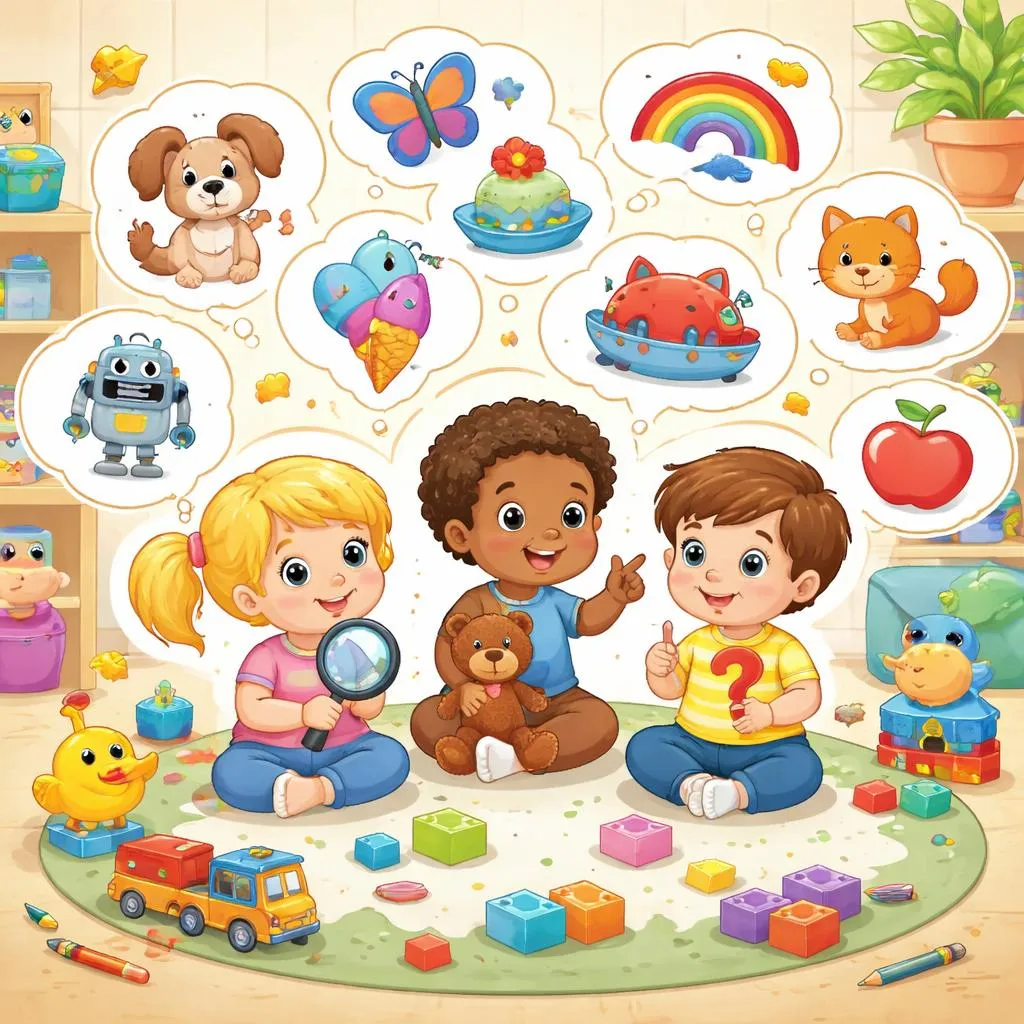

Hello, little idea maker! Do you know about a magic name tag? A name tag tells you a name. "My name is Sam." But what if you could have a bubble that holds a whole idea, and that bubble acts like a name? That bubble is a noun clause. A noun clause is a group of words that acts like a noun. It can be the subject or the object in a sentence. It names an idea, a thought, or a question. Today, we will play with forty wonderful idea bubbles. Our guide is Idea Bear. Idea Bear loves to think big thoughts and put them in bubbles! He will show us noun clauses at home, the playground, school, and in the woods. Let's make some idea bubbles!
What Is a Noun Clause? A noun clause is an idea bubble. It is a group of words that has a subject and a verb, but it works like a noun. A noun is a person, place, or thing. An idea bubble can be the thing that you talk about. It often starts with words like that, what, who, where, when, why, how, or if. At home, you might say "I know that you love me." The part "that you love me" is an idea bubble. It is the thing that you know. At the playground, you say "I see what you built." "What you built" is the thing you see. At school, you say "Tell me who your friend is." The idea bubble is "who your friend is". In nature, Idea Bear says "I wonder where the bird lives." "Where the bird lives" is the idea bubble. "Idea Bear thinks that honey is yummy." The part "that honey is yummy" is a noun clause. It is the thing he thinks. Learning about these must-know noun clauses helps you talk about your ideas and questions.
Why Do We Need Idea Bubbles? Noun clauses are your thought-sharing tools! They help your ears listen. You can understand the ideas and questions inside someone's sentence. They help your mouth speak. You can tell people your thoughts and what you wonder about. "I think that it's fun." They help your eyes read. You will see them in sentences that talk about knowing, thinking, or saying. They help your hand write. You can write down your ideas and stories. Idea bubbles let you put a whole thought in the place where you would usually put a simple word like "ball" or "Mom".
What Do Idea Bubbles Start With? Idea bubbles often start with special starter words. These words introduce the idea.
First, the fact starter: THAT. This introduces a thought or fact. "I know that you are here."
Next, the question starters: WHAT, WHO, WHERE, WHEN, WHY, HOW. These turn a question into an idea. "I see what you have. I know who you are. I wonder where it is. Tell me when we go. I know why you are happy. Show me how you do it."
We also have the choice starter: IF or WHETHER. This introduces a yes/no idea. "I don't know if it will rain."
These starter words are the beginning of your idea bubble.
How Can You Spot an Idea Bubble? Spotting a noun clause is about finding the idea inside the sentence. Here is a trick. Look for the starter words: that, what, who, where, when, why, how, if. Then, see if that group of words is acting like a thing. Can you replace the whole group with "it" or "something"? If yes, it might be a noun clause. Look at Idea Bear's thought. "I think that berries are tasty." Can we replace "that berries are tasty" with "it"? "I think it." Yes! So "that berries are tasty" is acting like a thing, an idea. It's a noun clause. Another trick: The noun clause is often the object of a verb like think, know, see, say, wonder.
How Do We Use Idea Bubbles? We use noun clauses to complete our thoughts. They often come after verbs that are about thinking, sensing, or saying. The formula is often: Subject + Verb + Noun Clause. "I know that the sky is blue." The noun clause can also be the subject of a sentence, but that is harder. "What you said is nice." For 3-year-olds, we'll focus on noun clauses as objects. Idea Bear uses them. "I wonder where the bees are." Subject: I. Verb: wonder. Noun Clause (object): where the bees are. Start by using noun clauses after "I know" or "I think."
Let's Fix Some Leaky Bubbles. Sometimes our idea bubbles have a leak. Let's fix them. A common leak is forgetting the starter word. A child might say "I know you are my friend." This is actually correct, and the word "that" is understood. But to see the clause, we can say "I know that you are my friend." Another leak is using the wrong word order inside the clause. In a question, we say "Who are you?" In a noun clause, we say "I know who you are." Not "I know who are you." Also, remember that the noun clause itself is not a complete sentence. "What you did" is not a sentence. But "I saw what you did" is a sentence.
Can You Be an Idea Maker? You are a great thinker! Let's play a game. The "Complete the Thought" game. I will start a sentence. You finish it with an idea bubble. "I know " You say: "I know that you are smart." "I see " You say: "I see what you drew." Great! Here is a harder challenge. Change a question into an idea bubble. Question: "Where is the toy?" Idea bubble: "where the toy is". Now put it in a sentence: "Show me where the toy is." You are using must-know noun clauses.
Your Idea Jar of 40 Must-Know Noun Clauses. Ready to fill your idea jar? Here are forty wonderful noun clauses. Idea Bear has thought of them all. They are grouped by their starter word. Remember, these are clauses, not full sentences by themselves. They need to be part of a bigger sentence.
THAT Clauses (Facts and Thoughts). that you are my mom. that I am three. that the sun is hot. that I love you. that it is time. that I can do it. that you are funny. that dogs bark. that birds fly. that we are friends.
WHAT Clauses (Things and Stuff). what I want. what you see. what he said. what she did. what we eat. what they play. what is in the box. what happened. what you like. what I have.
WHO Clauses (People). who you are. who my friend is. who is there. who has the toy. who I see. who helps me. who sings the song. who drew this. who is coming. who I love.
WHERE Clauses (Places). where I live. where you are. where the ball is. where we go. where the park is. where my sock went. where the cat hides. where the sun sets. where babies sleep. where flowers grow.
WHEN Clauses (Time). when we eat. when you come. when it is night. when I sleep. when the story starts. when we can play. when school ends. when I wake up. when the bell rings. when it is my birthday.
WHY Clauses (Reason). why I am happy. why you are sad. why the sky is blue. why we share. why babies cry. why I laugh. why it is important. why we say please. why I help. why we love.
HOW Clauses (Way or Method). how you do that. how I walk. how it works. how we play. how to draw a circle. how to say hello. how the car goes. how birds build nests. how to be kind. how to tie shoes.
IF Clauses (Yes/No Idea). if you are okay. if I can go. if it is red. if we have milk. if she is here. if they will come. if the door is open. if the toy is broken. if it will rain. if I am big.
These forty clauses are your must-know noun clauses. They are your idea bubbles. Use them to share your thoughts and wonders.
Sharing Your Wonderful Ideas with the World. You did it! You have learned about noun clauses. You know a noun clause is an idea bubble. It acts like a noun in a sentence. It often starts with words like that, what, who, where. You know how to spot them and use them to complete sentences. Idea Bear uses noun clauses to share his thoughts about honey, friends, and the world. Now you can too! You can tell people what you know, see, and wonder. Your sentences will be full of interesting ideas.
Here is what you can learn from our idea adventure. You will know what a noun clause is. You will understand that it acts as a thing (noun) in a sentence. You can identify common starters for noun clauses. You can use noun clauses after verbs like "know" and "think". You have an idea jar of forty essential noun clauses.
Now, let's do some life practice! Your mission is today. Share three idea bubbles with your family. Say: "I know that you love me. I see what you are cooking. I wonder if we can go to the park." You just used three noun clauses! Keep making your idea bubbles and sharing your thoughts. Have fun, little idea maker!