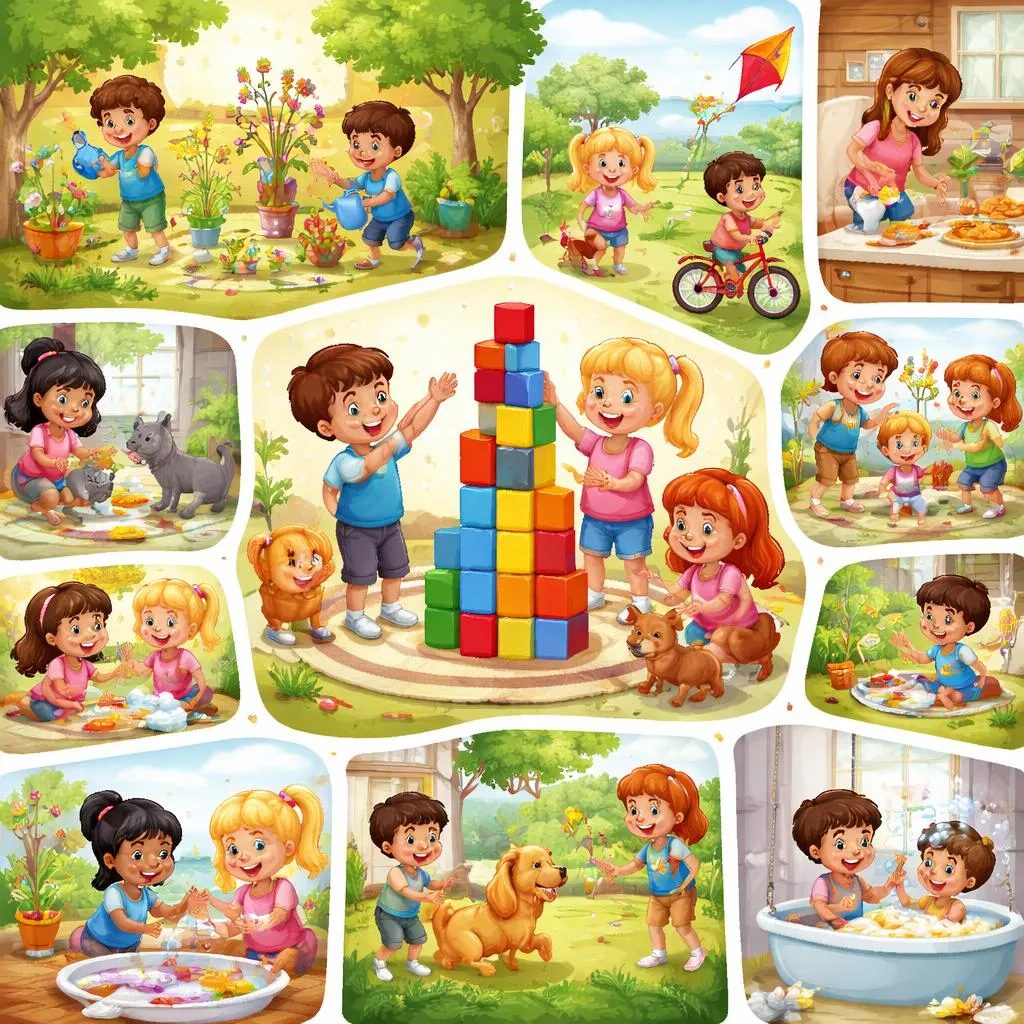

Four-year-olds love to talk about what they do. They tell you about their actions. "I eat." "I run." "I play." These are active voice sentences. In active voice, the subject does the action. It is the most natural way for children to speak. Active voice is clear and direct. Teaching your child common active voice sentences helps them express themselves confidently. This article shares the 50 most common active voice sentences for 4-year-olds. These will help your child talk about their world in a natural way.
What Is Active Voice for a Four-Year-Old? Active voice means the subject performs the action. The sentence follows a simple pattern. Someone does something. "The dog runs." The dog is doing the running. "Mommy cooks dinner." Mommy is doing the cooking. Four-year-olds use active voice almost all the time. It is how they learn to speak. They say "I want milk" not "Milk is wanted by me." Active voice is direct and easy to understand.
Meaning and Explanation of Active Voice Active voice puts the doer first. It tells us who is acting. Then it tells us the action. Sometimes it tells us what receives the action. "The boy kicks the ball." The boy does the kicking. The ball receives the action. This pattern is natural for young children. They think in terms of who does what. Active voice matches their view of the world. Things happen because someone or something makes them happen.
Categories of Active Voice Sentences for Preschoolers We group these active voice sentences into categories. This helps children learn different kinds of actions. Here are the main groups:
Self-Action Sentences: What the child does.
Family Action Sentences: What family members do.
Animal Action Sentences: What animals do.
Play Action Sentences: What happens during play.
Daily Routine Sentences: What happens every day.
Nature Action Sentences: What happens in nature.
Daily Life Examples of Active Voice Sentences Active voice fills every conversation. In the morning, a child says "I wake up." At breakfast, they say "I eat cereal." During play, they say "I build a tower." At the park, they say "I go down the slide." At bedtime, they say "I brush my teeth." Parents use active voice too. "I make dinner." "I read a story." Active voice is how we talk about what we do.
Self-Action Sentences I eat my food.
I drink my milk.
I run outside.
I jump up high.
I draw a picture.
I build with blocks.
I throw the ball.
I catch the ball.
I sing a song.
I dance around.
I brush my teeth.
I wash my hands.
I put on my shoes.
I take off my coat.
I open the door.
I close the book.
I climb the stairs.
I slide down.
I swing high.
I love my family.
Family Action Sentences Mommy cooks dinner.
Daddy drives the car.
My sister plays with dolls.
My brother rides his bike.
Grandma bakes cookies.
Grandpa tells stories.
The baby cries loudly.
Mommy reads books to me.
Daddy fixes my toys.
My family eats together.
Mommy sings to me.
Daddy works at the office.
My sister shares her toys.
My brother helps me.
Grandma hugs me tight.
Grandpa takes me to the park.
The baby sleeps in her crib.
Mommy washes the dishes.
Daddy mows the grass.
My family loves me.
Animal Action Sentences The dog barks loudly.
The cat sleeps on the bed.
The bird sings in the tree.
The fish swims in the tank.
The bunny hops around.
The cow eats grass.
The horse runs fast.
The duck quacks by the pond.
The squirrel climbs the tree.
The butterfly flies away.
The bee makes honey.
The frog jumps in the water.
The mouse hides in the wall.
The elephant sprays water.
The lion roars loudly.
The monkey swings on vines.
The bear catches fish.
The turtle walks slowly.
The rabbit digs a hole.
The spider spins a web.
Play Action Sentences I build a tall tower.
I push the toy car.
I roll the ball to you.
I color with crayons.
I put together puzzles.
I dress up my doll.
I swing on the swings.
I go down the slide.
I dig in the sandbox.
I splash in the water.
I ride my scooter.
I fly my kite.
I blow bubbles.
I catch fireflies.
I play hide and seek.
I chase my friends.
I share my toys.
I take turns on the swing.
I make sandcastles.
I play with my friends.
Daily Routine Sentences I wake up in the morning.
I get dressed by myself.
I eat breakfast at the table.
I brush my hair.
I put on my backpack.
I go to school.
I play with my friends.
I eat lunch at school.
I take a nap.
I come home with Mommy.
I have a snack.
I watch a show.
I play in my room.
I eat dinner with my family.
I take a bath.
I put on my pajamas.
I listen to a story.
I say goodnight.
I give hugs and kisses.
I go to sleep.
Printable Flashcards for Active Voice Sentences Flashcards help children see and read active voice sentences. Create cards with one sentence on each. Use pictures on the back that show the action. For "I eat my food," draw a child eating. For "The dog barks," draw a dog with sound lines. Show the card and read the sentence. Have your child act out the action. This connects words to meaning.
Another idea is to make action cards. Write the subject on one card. Write the verb on another. Write the object on a third. Your child puts them in order. "I" + "eat" + "pizza." This builds sentence structure.
Learning Activities with Active Voice Sentences Activities help children use active voice naturally. Try these at home:
Action Charades: Act out an action. Your child guesses and says the active voice sentence. "You are jumping!"
Who Does What?: Look at pictures. Ask "What is happening?" Your child answers with active voice. "The boy is running."
Morning Routine: Talk through the morning using active voice. "I wake up. I get dressed. I eat breakfast."
Story Actions: Read a story. Pause and ask "What did the character do?" Your child answers with active voice.
Follow the Leader: One person does an action and says it. "I am hopping." Everyone follows and says "I am hopping too."
Learning Activities for Specific Active Voice Types For self-action sentences, make a "What I Can Do" book. Draw pictures of yourself doing things. Write the sentence under each. "I can jump." "I can run." For family action sentences, make a family album. Write sentences about each person. "Mommy cooks." "Daddy works." For animal action sentences, visit a pet store or zoo. Talk about what the animals do. "The fish swims." "The bird sings."
Educational Games Using Active Voice Sentences Games make learning active voice fun. Here are some favorites:
Action Bingo: Make bingo cards with pictures of actions. Call out active voice sentences. "The boy jumps." Your child covers the matching picture.
Sentence Match: Write active voice sentences on cards. Draw pictures on other cards. Your child matches each sentence to its picture.
Action Cube: Make a cube with pictures of actions on each side. Roll it. Your child says the active voice sentence. "I jump." "I eat."
Story Chain: Take turns adding active voice sentences to make a story. "Once a dog ran." "The dog saw a cat." "The cat climbed a tree."
Who Am I?: Describe an action without saying who. "I am something that barks and wags my tail." Your child guesses "The dog!" and says an active voice sentence. "The dog barks."
Game Ideas for Different Settings In the car, play "I See Actions." Look at people and animals. Say active voice sentences. "That man walks his dog." "That bird flies." Your child joins in. At the park, play "Park Actions." Describe what people are doing. "The girl swings." "The boy slides." At mealtime, play "Table Actions." Talk about what everyone does. "Mommy pours milk." "I eat my peas."
How to Teach Active Voice Naturally You are the best model. Use active voice throughout the day. Narrate your actions. "I am making lunch." "I am folding clothes." Your child hears the pattern.
When your child speaks, they already use active voice. Reinforce it. If they say "ball," you say "You threw the ball!" This expands their language while keeping active voice.
Why Active Voice Matters for Four-Year-Olds Active voice is the foundation of English. Most sentences we speak are active. Children need to master it to communicate clearly. Active voice is direct and easy to understand. It leaves no confusion about who did what.
Active voice also builds writing skills. When children learn to write, they start with active voice. It is the simplest sentence structure. Mastering it prepares them for school.
Tips for Parents to Support Active Voice Learning Talk about actions constantly. Name what you see people and animals doing. "Look, the dog is running." "See the bird flying?" This builds action vocabulary.
Read books with lots of action. Many picture books are full of active sentences. Point to the pictures and name the actions. Ask "What is the bear doing?"
Play action games. Simon Says is perfect for active voice. "Simon says touch your nose." Your child does the action and learns the verb.
The Power of Repetition with Active Voice Children learn through repetition. They will use the same action sentences again and again. This is how they master verb forms. Each repetition strengthens the pattern.
Sing songs with actions. "If you are happy and you know it" has many actions. "The wheels on the bus" has actions too. Singing makes repetition joyful.
Create routines around actions. At bath time, name the actions. "I wash my face." "I splash the water." This builds natural practice.
Connecting Active Voice to Books and Media Choose books with clear action pictures. Point to each picture and name the action. "The bear eats honey." "The bird flies away." Ask your child to name actions too.
Educational videos can also help. Watch together and pause to name actions. "What is the character doing?" "She is jumping." This builds active viewing.
Making an Active Voice-Rich Environment Label actions around your home. On the refrigerator, put a sign that says "Open me." On the door, put "Close me." Read these with your child. They connect words to actions.
Create an action chart. List daily routines as active sentences. "I wake up." "I eat breakfast." Check them off together. This builds language and routine.
Encouraging Your Child to Use Active Voice Ask questions that invite action answers. "What are you doing?" "What did you do today?" These questions naturally get active voice responses.
When your child tells you something, show interest. "You built a tower? Tell me about it!" This encourages longer action sentences.
Celebrating Progress with Active Voice Keep a list of new action verbs your child uses. Notice when they start using past tense. "You said 'I ran' today instead of 'I run'!" Celebrate these milestones.
Remember that every child develops at their own pace. Some use many action verbs early. Others take more time. Both are normal. Your support and encouragement make the difference.
By teaching your child these 50 most common active voice sentences, you give them the most natural way to speak. They can tell you what they do, what others do, and what happens in their world. Active voice is the voice of action and life. Enjoy each new action sentence together. Every "I jump" and "The dog runs" shows a child engaged with the world.