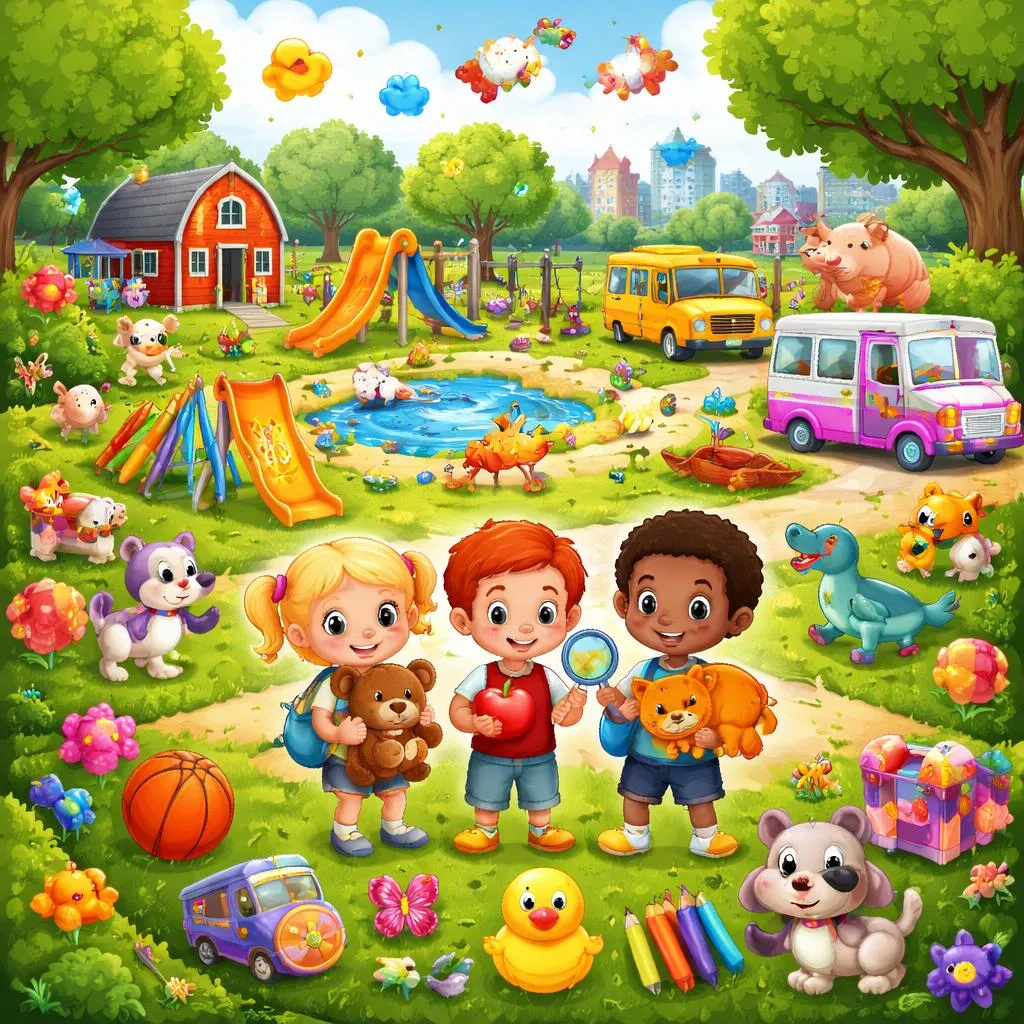

Hello, little word explorer! Welcome to Noun Neighborhood. This is a very special place. Everything you can see, touch, and name lives here. Every person, every place, every animal, and every thing has a name. These names are called nouns. Nouns are the building blocks of our talking and our stories. Today, we will take a tour and meet sixty of the most important nouns in the whole neighborhood. Our guide is Ned the Noun, a friendly gnome who knows every name! Ned will show us nouns at home, the playground, school, and in the park. Let's start our naming adventure!
What Is a Noun? A noun is a naming word. It is a word that gives a name to something. A noun can be a person. A noun can be a place. A noun can be a thing. A noun can be an animal. Think of nouns as the stars of your sentence. They are the main characters. In your home, "mom" is a noun. "Bed" is a noun. At the playground, "friend" is a noun. "Swing" is a noun. At school, "teacher" is a noun. "Book" is a noun. In nature, "dog" is a noun. "Tree" is a noun. Ned the Gnome is a noun! Learning these must-know nouns gives you the power to name your whole world.
Why Are Nouns So Important? Nouns are your naming tools! They help your ears listen. When you hear a noun, you can picture exactly what someone is talking about. They help your mouth speak. You can tell people exactly what you see, want, or love. "I want the red ball." They help your eyes read. Nouns are the most common words in your storybooks. They help your hand write. You can write lists, labels, and stories about all the nouns you know. Knowing lots of nouns makes you a clear and confident communicator.
What Are the Main Types of Nouns? Nouns can be sorted into a few main groups. This helps us organize them.
First, we have nouns for people. These are the names of you, your family, and everyone you know. "girl", "brother", "doctor", "firefighter".
Next, we have nouns for places. These are the names of where you are or where you go. "house", "store", "city", "beach".
Then, we have nouns for things. These are the objects all around you. "toy", "chair", "water", "idea".
Last, we have nouns for animals. These are the names of all our furry, feathery, and scaly friends. "cat", "bird", "fish", "butterfly".
Some nouns are special names for one particular person, place, or thing. These are called proper nouns, and they start with a capital letter, like "Ned" or "Monday". But for now, we'll focus on the regular, everyday nouns.
How Can You Spot a Noun? Spotting a noun is a fun game. Here is the best trick. Ask these two questions about a word: First, ask "Can I see it, touch it, or point to it?" Second, ask "Is it a person, a place, a thing, or an animal?" If you can answer "yes" to one of these, you have found a noun! Look at what Ned is doing. He points and says, "Look at that tall tree!" Ask: Can I see and touch a tree? Yes. Is a tree a thing? Yes! "Tree" is a noun. Another trick: Nouns often come after words like "the", "a", or "my". "The dog", "a cookie", "my shoe".
How Do We Use Nouns in a Sentence? Nouns are usually the main characters in a sentence. They can be the subject (who or what the sentence is about) or the object (who or what receives the action). A simple sentence often starts with a noun. The formula is often: Noun + Verb. "The sun shines." You can add more words to describe the noun. "The bright sun shines." Ned uses nouns all the time. "Ned loves his garden." The nouns are "Ned" and "garden". Try to use a noun every time you want to talk about something or someone.
Let's Fix Some Naming Mix-ups. Sometimes we forget to use a noun when we need one. Let's fix that. A common mix-up is using a pronoun (like "it" or "that") without first saying the noun. A child might point and say, "I want that!" This is okay, but it's clearer to use the noun. "I want that red truck." Another mix-up is confusing a noun with a verb. "I like to swim." Here, "swim" is an action, a verb. The noun would be "swimming" as in "I like swimming." Also, remember that some words can be both a noun and a verb! "I play a game." (Game is a noun). "I game with my friend." (Game is a verb). The trick is to look at the word's job in the sentence.
Can You Be a Noun Detective? You are a great detective! Let's play a game. The "Noun Hunt" game. I will give you a room. You find and name three nouns in that room. Room: Kitchen. You might say: "sink", "spoon", "apple". Great! Here is a harder challenge. Look at a page in a picture book. Can you find and point to all the nouns (people, animals, things) on the page? Say their names. You are collecting must-know nouns.
Your Noun Neighborhood Directory of 60 Key Nouns. Ready to meet the neighbors? Here are sixty wonderful nouns. Ned the Gnome has sorted them by where you might find them. These are your key nouns. Practice saying them, pointing to them, and using them in sentences.
Home Sweet Home (15 Nouns). These are the people and things in your house.
- Mom
- Dad
- Baby
- Sister
- Brother
- House
- Room
- Bed
- Chair
- Table
- Toy
- Book
- Cup
- Door
- Window
Playground Pals (15 Nouns). These are the friends, places, and things at the park.
- Friend
- Teacher
- Swing
- Slide
- Sandbox
- Ball
- Park
- Grass
- Bench
- Tree (in the park)
- Dog (at the park)
- Bird (at the park)
- Game
- Ladder
- Fence
School Time (15 Nouns). These are the people and things in your classroom.
- Teacher
- Student
- Friend
- Desk
- Chair
- Book
- Pencil
- Crayon
- Paper
- Backpack
- Clock
- Door
- Board
- Rule
- Number
Nature and Animals (15 Nouns). These are the wonders of the outside world.
- Sun
- Tree
- Flower
- Grass
- Water
- Dog
- Cat
- Bird
- Fish
- Butterfly
- Bear
- Rabbit
- Sky
- Cloud
- Rock
These sixty nouns are your must-know naming words. They are the most important neighbors in Noun Neighborhood. Say hello to them every day!
Naming Your Wonderful World. You did it! You are now a noun expert. You know a noun is a naming word for a person, place, thing, or animal. You know why nouns are the stars of our sentences. You can spot a noun by asking if you can see, touch, or point to it. You can use nouns to start your sentences and tell your stories. Ned the Gnome is proud to have you in Noun Neighborhood. Now you can name everything you see. Your world is full of amazing nouns waiting to be talked about.
Here is what you can learn from our neighborhood tour. You will know what a noun is. You can tell the difference between a person, place, thing, and animal noun. You can find nouns all around you. You can use nouns as the subject of a simple sentence. You have a directory of sixty essential nouns to use every day.
Now, let's do some life practice! Your mission is today. Be a noun detective in your own home. Walk into one room. Find and point to ten different nouns. Say their names out loud. "I see a table. I see a lamp. I see a carpet." You just used ten nouns! Keep exploring Noun Neighborhood every day. Have fun, little word explorer!