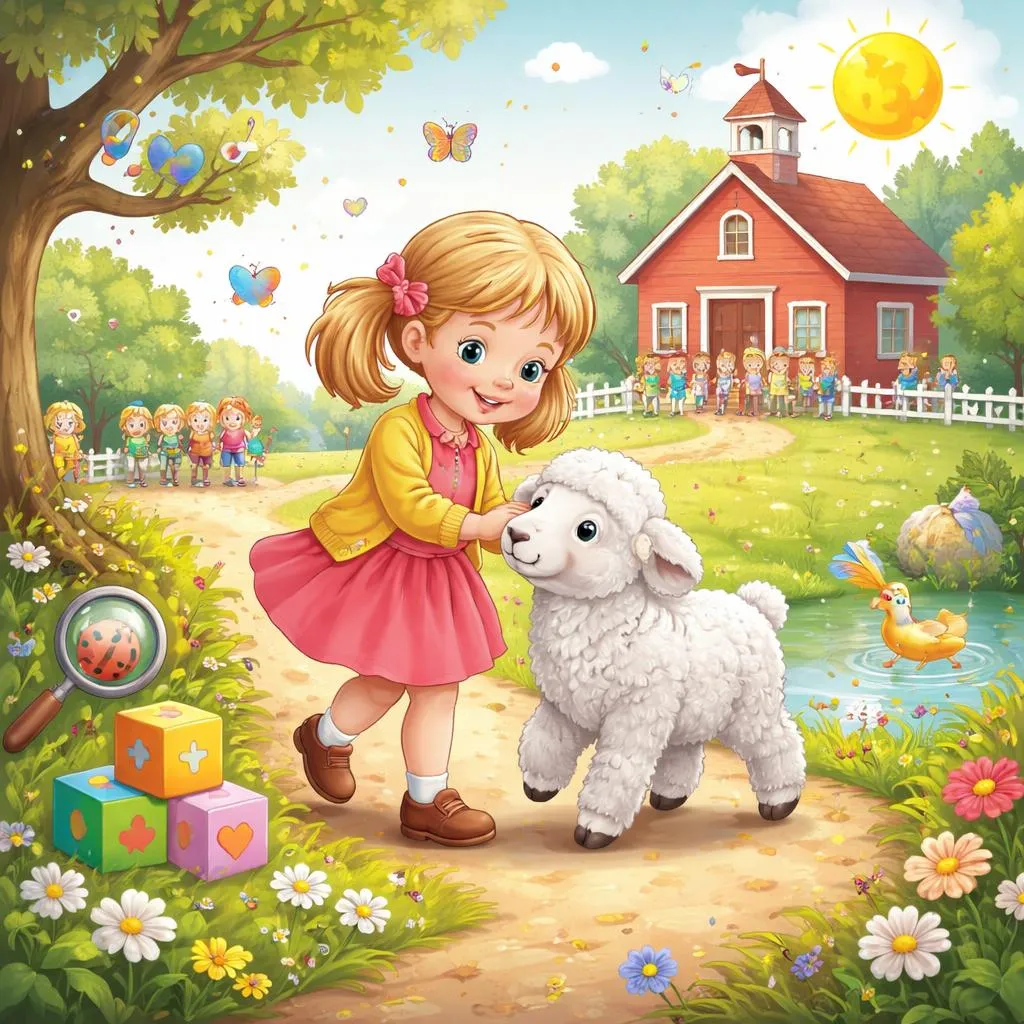

Welcome, everyone, to a charming lesson from the countryside! Today, we are exploring one of the most beloved children's songs. We will study the "lyrics to mary had a little lamb". This simple story teaches us about friendship, animals, and past actions. It is a wonderful tool for building English vocabulary and understanding simple sentence structure. Let's begin our musical story time.
What is the story? The story we are learning is a classic nursery rhyme and song. It is based on a true event from early 19th-century America. The poem was written by Sarah Josepha Hale. It tells a gentle tale about a girl named Mary and her loyal pet lamb. The lamb's fleece is as white as snow. It loves Mary so much that it follows her everywhere. One day, it even follows her to school, which causes a delightful and rule-breaking surprise. The story is told in a clear, sequential way, perfect for young learners to follow a narrative from beginning to end.
The lyrics of nursery rhymes Let's read through the traditional lyrics to mary had a little lamb. Knowing the words helps us see the story's pattern.
Mary had a little lamb, Its fleece was white as snow; And everywhere that Mary went, The lamb was sure to go.
It followed her to school one day, Which was against the rule; It made the children laugh and play, To see a lamb at school.
And so the teacher turned it out, But still it lingered near, And waited patiently about, Till Mary did appear.
"Why does the lamb love Mary so?" The eager children cry; "Why, Mary loves the lamb, you know," The teacher did reply.
Vocabulary learning This story is rich with useful and descriptive vocabulary for young learners.
We meet the characters: Mary and the lamb. A lamb is a baby sheep.
We learn the word fleece. This is the woolly coat of a sheep. The simile "white as snow" teaches how to compare two things.
Key action verbs tell the story: had, was, went, go, followed, made, laugh, play, turned out, lingered, waited, appear, cry, reply.
Other important words include everywhere, school, rule, teacher, children, patiently, eager, why. These words help build the setting and express the characters' feelings.
Phonics points The rhyme offers excellent practice for specific vowel sounds and consonant blends.
The long /eɪ/ sound in "Mary," "made," and "wait" is prominent. The short /æ/ sound in "lamb," "had," and "laugh" provides a clear contrast.
We hear the /ɛ/ sound in "went," "everywhere," and "yes." The /aʊ/ sound in "out" and "about" is another distinct vowel sound.
Consonant blends like /fl/ in "fleece" and "followed" and /st/ in "still" and "patiently" are great for practice. The rhyming pairs (snow/go, rule/school, near/appear, cry/reply) beautifully highlight common English rhyme patterns.
Grammar patterns This story is a masterclass in using the simple past tense to narrate a complete event.
Almost every verb is in the simple past: had, was, went, followed, made, laughed, played, turned out, lingered, waited, did appear, cry (present in dialogue), did reply. This shows children how we tell completed stories.
It uses the structure "was sure to go" to express certainty in the past. The conjunction "and so" clearly shows cause and effect. "The lamb was at school, and so the teacher turned it out."
The dialogue section introduces question formation: "Why does the lamb love Mary so?" and a simple answer explaining reason: "Mary loves the lamb, you know." This models a conversation within a story.
Learning activities We can bring this classic story to life with engaging extension activities.
-
Story Sequencing Cards: Create cards with illustrated key events (Mary with lamb, lamb following, lamb at school, children laughing, teacher turning lamb out, lamb waiting, teacher explaining). Mix them up and have learners put the story back in order, narrating each step.
-
"Why?" Question Game: The teacher's reply teaches about cause and effect. Play a "why" game about the story. "Why did the children laugh?" "Because the lamb was at school." Then, ask "why" questions about classroom objects or daily routines to practice this important word.
-
Act It Out! This story is perfect for a simple play. Assign roles: Mary, the Lamb, the Teacher, and several Children. Act out the story while a narrator reads the lyrics. This builds speaking confidence and comprehension.
-
Create a New Verse: What happened next? Did the lamb ever go to school again? Brainstorm and write a new verse together. "Mary took her lamb back home, / And gave it hay to eat. / It curled up by the fireplace, / Upon its woolly feet." This encourages creative language use.
Printable materials Printable resources can help solidify the story's language and sequence.
A "My Storybook" template lets children create their own book. Each page has a line from the song to trace and a space to illustrate that part.
Character puppets for Mary, the lamb, the teacher, and a child are fun for retelling. Attach them to popsicle sticks. Use a simple cardboard schoolhouse as a backdrop.
Design a "Past Tense Verb Match" worksheet. List present tense verbs from the song (have, is, go, follow) in one column. Have learners draw a line to their past tense forms (had, was, went, followed) in another column.
Create a "Rhyming Word Pairs" coloring sheet. Pictures of snow and a bow (that you go to) can be colored, reinforcing the rhyme from the first verse.
Educational games Structured games can deepen understanding of the story’s language.
-
"Follow the Leader" Narrative Game: Just like the lamb followed Mary, play a game where one child is "Mary" and performs simple actions. The "lambs" must follow and say what they are doing in the past tense. "Mary jumped. I followed and jumped." This practices past tense verbs physically.
-
"Lamb at School" Sorting Game: Prepare pictures of school items (book, pencil, bell) and farm items (hay, barn, trough). The goal is to help the lamb by sorting which things belong at school and which belong on the farm. This builds categorization vocabulary.
-
The "Why?" Detective Game: Place an interesting object in the center. Have learners ask "Why" questions about it. "Why is this shell here?" The facilitator gives creative answers. This game, inspired by the children's question in the song, nurtures curiosity and question-forming skills.
Exploring the "lyrics to mary had a little lamb" shows us how a simple story can hold a wealth of language learning. We learn about narrative, past actions, questions, and answers. Most importantly, we learn about kindness and the special bond between a child and an animal. Keep telling stories, asking "why," and putting words to the world around you. You'll find that every day has its own little story waiting to be sung or told.