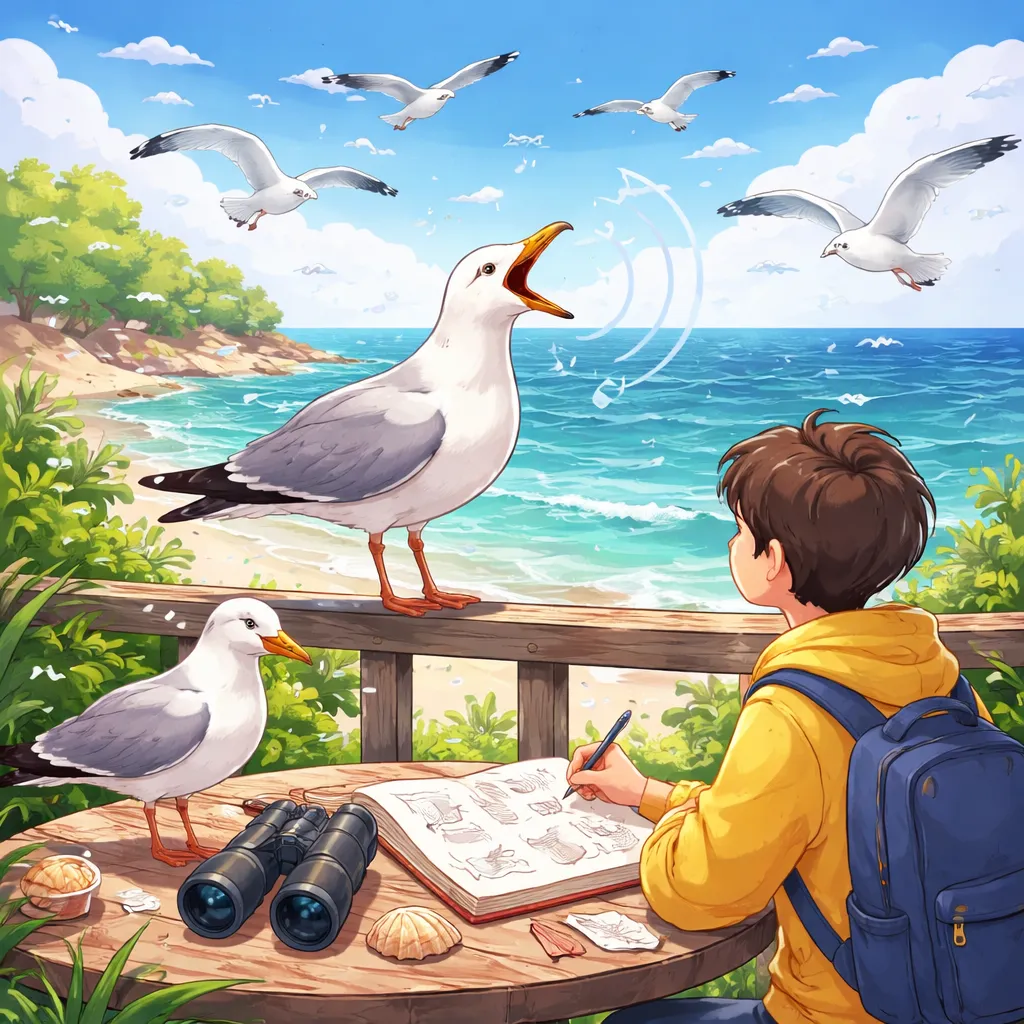

Have you ever been to the beach, a lake, or a harbor and heard a loud, familiar "keee-yah" or "caw" sound? Looking up, you probably saw a white and gray bird circling in the sky or walking on the sand. That’s a seagull! These common birds are masters of the coast and are known for their clever ways of finding food. Learning about seagulls is a breezy adventure that takes us to shorelines all over the world. Let’s begin our journey of learning about seagull life and habits.
English Language Learning
Vocabulary and Spelling Our coastal flying friend is called a seagull. The word "seagull" is a noun. A noun names a person, place, or thing. So, a seagull is a thing—a living bird. A more proper name is just gull. Spelling "seagull" is two words together: S-E-A and G-U-L-L. S-E-A-G-U-L-L spells seagull.
Sound and Pronunciation Let’s say the word correctly. It sounds like this: /ˈsiː.ɡʌl/. We can say it in two clear parts. First, say "see". It’s the same as the verb "to see". Next, say "gul". It rhymes with "hull" or "dull". Now, put it together! "See" "gul". Seagull! Great! The word "seagull" has two beats, or two syllables. Clap your hands twice: Sea-gull. It’s a crisp, clear word.
Related Words Learning about seagulls is more fun with new words! Here are some important ones. Group: A group of seagulls is called a colony or a flock. A baby seagull is called a chick. Sound: The loud call a seagull makes is a squawk or a screech. Home: The area where seagulls live and nest, like a rocky cliff or a sandy dune, is a rookery.
A Famous Saying People sometimes say: "As free as a seagull." This means feeling unburdened, independent, and able to go wherever you wish. It comes from the seagull’s ability to soar over the ocean and travel far. It reminds us of the joy of freedom and exploration. Say the saying with me: "As free as a seagull." It’s a lovely feeling, isn’t it?
Now you know the word "seagull"! Are you ready to soar into some amazing facts? Let’s fly from words to wonderful knowledge!
Animal Knowledge
Who Are They? – Family and Group What kind of animal is a seagull? Seagulls are birds. They are warm-blooded, have feathers, and lay eggs. They are part of the gull family, called Laridae. There are many species, like the Herring Gull and the Ring-billed Gull. They are closely related to terns and skimmers.
What Do They Look Like? – Amazing Bodies Seagulls are medium to large birds. They usually have white and gray feathers, sometimes with black markings. They have strong, yellow beaks and webbed feet. Their most famous features are their strong, tapered wings and their hooked beaks. Their wings are perfect for soaring and gliding on ocean winds. Their webbed feet are great for swimming. Their beaks are strong enough to break open shellfish. They are excellent fliers, swimmers, and walkers. Seagulls have special adaptations. They have a special gland above their eyes that removes salt from seawater, allowing them to drink it. They are also very intelligent and can learn and remember where to find food.
Where Do They Live and How? – Home and Habits Seagulls live all over the world, near coastlines and large bodies of water. Their homes are beaches, cliffs, harbors, and sometimes even inland lakes and parking lots. They are very adaptable. Seagulls are omnivores and scavengers. This means they eat almost anything! They eat fish, insects, worms, human food scraps, and even other birds' eggs. They are clever and will drop shellfish on rocks to break them open. Seagulls are very social and live in large, noisy colonies. They are active during the day. They spend their time flying, foraging for food, squabbling with each other, and resting. A group in flight is a flock.
A Seagull’s Life Story – Growing Up A baby seagull is called a chick. Seagulls are birds, so chicks hatch from eggs. Seagulls usually lay two or three speckled eggs in a nest on the ground or on a cliff ledge. Both parents take care of the chicks. They are very protective and will dive at anyone who gets too close to the nest. The parents feed the chicks by regurgitating (bringing up) food. Chicks are born with fluffy, camouflaged down feathers. They stay in or near the nest for a few weeks. They learn to fly after about five to six weeks. The parents continue to feed them and teach them to find food for several more weeks.
How Do They "Talk"? – Communication Seagulls are very loud and talkative! They have a variety of squawks, screeches, and mewing calls. Different calls can mean warning of danger, calling chicks, or arguing over food. They use a lot of body language. A seagull might lower its head, puff up, or chase another to communicate. They are not shy about telling others how they feel! Their best senses are their excellent eyesight and hearing. They have very good vision to spot food from high in the air. Their hearing helps them understand the calls of other gulls.
Are They Okay? – Taking Care of Them Many seagull species are common, but some are threatened or declining. This is often because of problems in their environment. The main threats are pollution (especially plastic in the ocean), loss of nesting sites, and overfishing which reduces their natural food. Eating human junk food can also make them sick. You can be a seagull friend! The best way to help is to not feed them. Human food is bad for their health. You can keep beaches and waterways clean by picking up trash, especially plastic. Support healthy oceans by choosing sustainable seafood.
Life Connections and Inspiration
How to Be With Them – Safety and Love Seagulls are wild animals. They can be bold around people, especially where food is present, but they are not pets. We must respect them and not encourage them to depend on us. The rule is: Admire from a distance and secure your snacks. Enjoy watching them fly and swim. Never try to touch or chase a seagull. Do not feed them, as it teaches them bad habits and makes them aggressive. Keep your food covered at the beach. We show our love by protecting the clean oceans and beaches they share with us. We can be responsible visitors to their coastal home.
Super Qualities We Learn from Them Seagulls teach us wonderful things. One super quality is clever adaptability and resourcefulness. Seagulls can live in many places and find food in clever ways. They teach us to be resourceful, to solve problems, and to adapt to new situations. Another quality is resilience and freedom. Seagulls face storms and changing tides but keep soaring. The image of a seagull flying freely reminds us to be resilient in the face of challenges and to appreciate our own freedom and ability to explore. Think about it: How can you be resourceful and solve a problem in a new way? What does feeling "as free as a seagull" mean to you, and how can you enjoy that feeling in a safe way?
Take Action! – Your "Seagull’s View" Project Let’s do a free and creative activity! Your project is to draw a map of your local area from a seagull’s perspective. Imagine you are a seagull flying high above your town or neighborhood. What would you see? Draw a simple map from above. Include important places like your home, school, parks, and any bodies of water. Mark where a seagull might find food or a safe place to rest. This helps you see the world from a different point of view, just like a bird.
Closing Learning about seagull adventures is a lively and eye-opening journey! We learned the word "seagull" and how to say its two-part name. We discovered amazing facts about their salt-removing glands, their clever foraging, and their life in noisy coastal colonies. We know that seagulls are adaptable, resilient birds that are a part of our coastal world. You can use your new words to share the true story of these clever birds. You can use your knowledge to be a responsible beach visitor and an advocate for clean oceans. The animal world is full of resourceful and free-spirited teachers. Always remember to respect wildlife from a safe distance, be resourceful in your thinking, and cherish your own freedom to learn and explore. Keep discovering with curiosity, soar above challenges with resilience, and be a friend to the wild. Your thoughtful actions and free spirit make you a true friend to the amazing seagull.