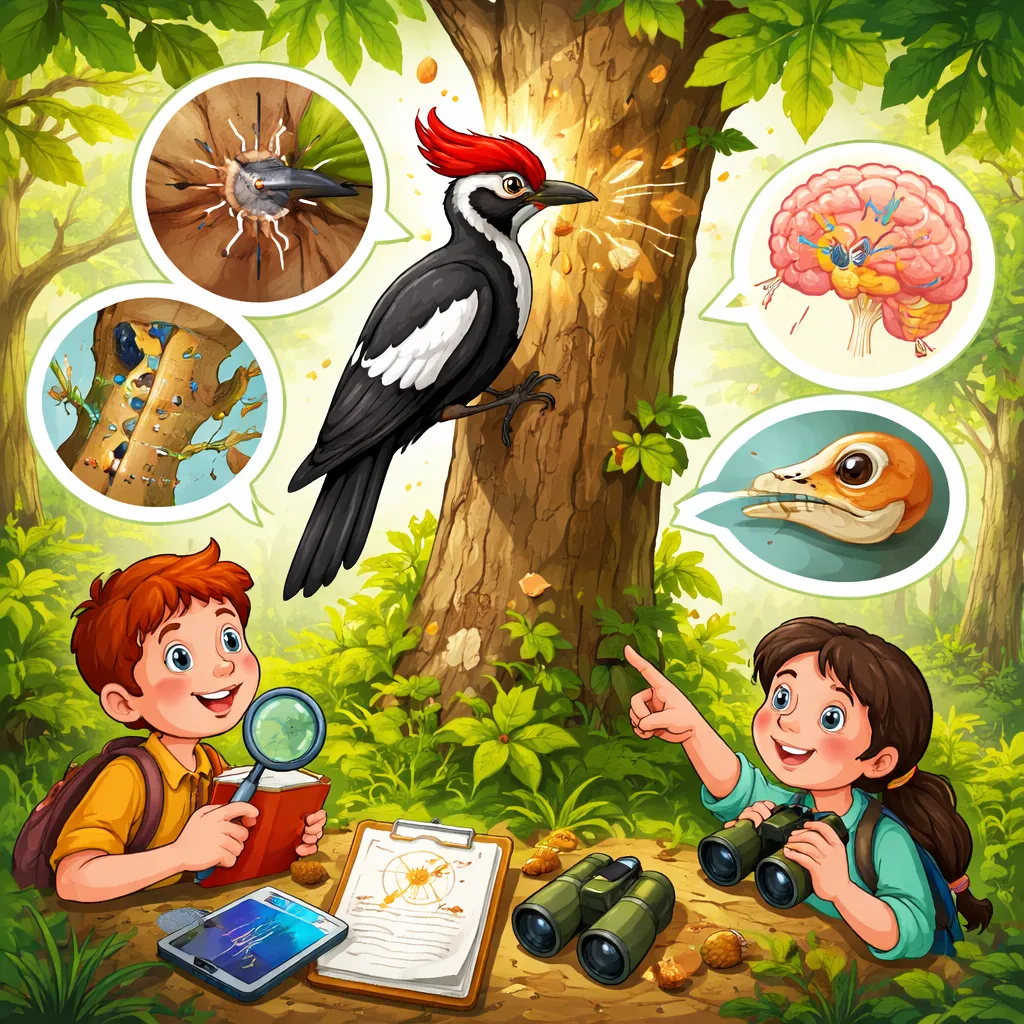

Have you ever been walking in the woods and heard a rapid tap-tap-tap-tap sound coming from a tree? That’s the sound of a woodpecker at work! These amazing birds are nature’s carpenters, using their strong beaks to find food and make homes. Learning about woodpeckers is a rhythmic adventure that takes us to forests and backyards. Let’s begin our journey of learning about woodpecker skills and sounds.
English Language Learning
Vocabulary and Spelling Our talented tree-tapping friend is called a woodpecker. The word "woodpecker" is a noun. A noun names a person, place, or thing. So, a woodpecker is a thing—a bird that pecks wood. Spelling "woodpecker" is two words together: W-O-O-D and P-E-C-K-E-R. W-O-O-D-P-E-C-K-E-R spells woodpecker.
Sound and Pronunciation Let’s say the word correctly. It sounds like this: /ˈwʊdˌpek.ɚ/. We can say it in three clear parts. First, say "wood". It rhymes with "good". Next, say "peck". It rhymes with "neck". Last, say "er". It’s a soft sound, like the end of "teacher". Now, put it together! "Wood" "peck" "er". Woodpecker! Great! The word "woodpecker" has three beats, or three syllables. Clap three times: Wood-peck-er. It’s a strong, tapping word.
Related Words Learning about woodpeckers is more fun with new words! Here are some important ones. Sound: The fast tapping a woodpecker makes on a tree is called drumming. A baby woodpecker is called a chick. Home: The hole a woodpecker makes in a tree for its nest is called a cavity. Action: The way a woodpecker hits a tree with its beak is pecking.
A Famous Saying People sometimes say: "As busy as a woodpecker." This means someone is very active, focused, and hardworking. It comes from the woodpecker’s constant tapping and searching for food. It reminds us to be diligent and stick to our tasks. Say the saying with me: "As busy as a woodpecker." It’s a compliment for being hardworking!
Now you know the word "woodpecker"! Are you ready to tap into some amazing facts? Let’s climb from words to wonderful knowledge!
Animal Knowledge
Who Are They? – Family and Group What kind of animal is a woodpecker? Woodpeckers are birds. They are warm-blooded, have feathers, and lay eggs. They are part of the Picidae family. Their cousins are sapsuckers and flickers. There are over 200 species, like the Downy Woodpecker and the majestic Pileated Woodpecker.
What Do They Look Like? – Amazing Bodies Woodpeckers come in different sizes, from as small as a sparrow to as large as a crow. They often have bold patterns of black, white, and red feathers. Their most famous features are their strong, chisel-like beak and their stiff tail feathers. Their beak is a super tool! It is very strong and sharp for drilling into wood. Their skull has special shock-absorbing bones to protect their brain from all that pecking. Their stiff tail feathers act like a prop to help them balance on tree trunks. Woodpeckers have special adaptations. They have very long, sticky tongues with barbed tips to pull insects out of holes. Their feet are zygodactyl, meaning two toes point forward and two point backward, perfect for gripping tree bark.
Where Do They Live and How? – Home and Habits Woodpeckers live in forests and woodlands all over the world, except Australia and Antarctica. Their homes are forests, groves, and even parks and gardens with lots of trees. Woodpeckers are insectivores. This means they eat mostly insects. They love beetle larvae, ants, and other bugs hiding under tree bark. Some also eat tree sap, nuts, and fruit. They are nature’s pest control! Woodpeckers are often solitary or live in pairs. They are active during the day. They spend their time climbing tree trunks, pecking and listening for insects, and drumming to talk to other woodpeckers. A group of woodpeckers is called a descent.
A Woodpecker’s Life Story – Growing Up A baby woodpecker is called a chick. Woodpeckers are birds, so chicks hatch from eggs. Parents usually lay three to five white eggs in a nest cavity they carve out of a dead or soft tree. Both parents take care of the chicks. They take turns keeping the eggs warm and then bringing insects to the hungry chicks. The nest cavity is a safe, cozy home. Chicks are born naked and helpless. They grow quickly in the safety of the tree cavity. They leave the nest after about three to four weeks. The parents continue to feed them and teach them how to find food.
How Do They "Talk"? – Communication Woodpeckers have two main ways to talk. They have calls like sharp "pik" or "churr" sounds. But their most famous "talk" is drumming. They drum on hollow trees or even metal gutters to send loud messages. Different drumming patterns can mean "This is my territory" or "I am looking for a mate." It’s like their own Morse code! Their best sense is their amazing hearing. They can hear the tiny sounds of insects moving under the bark. Their eyesight is also good for spotting insect holes.
Are They Okay? – Taking Care of Them Some woodpecker species are common, but others are threatened or endangered. They need healthy forests to survive. The main threats are people cutting down dead trees (which they need for nesting), using pesticides that kill their insect food, and loss of forests to building. You can be a woodpecker friend! You can leave dead trees (snags) in your yard if it is safe. You can put up a nest box designed for woodpeckers. Avoid using pesticides. Support groups that protect forests and wildlife.
Life Connections and Inspiration
How to Be With Them – Safety and Love Woodpeckers are wild birds. They are focused on their work and can be shy. We must always respect them and not disturb them. The rule is: Listen and watch from a distance. If you hear or see a woodpecker, stop and watch quietly from far away. Never try to touch a woodpecker or its nest hole. Do not knock on the tree it is on. Give them space to work and raise their family. We show our love by protecting the trees and forests they call home. We can be voices for keeping wild spaces full of life.
Super Qualities We Learn from Them Woodpeckers teach us wonderful things. One super quality is focused persistence. A woodpecker will tap at a tree again and again until it gets the insect. It doesn’t give up. It teaches us to stay focused on our goal and to keep trying, even if the task is hard. Another quality is using your unique strengths. Woodpeckers are perfectly designed for their job—their beak, tongue, and feet all work together. This reminds us that we all have our own unique talents. When we use them together, we can do amazing things. Think about it: What is a goal you can work on with persistence, like a woodpecker tapping a tree? What are your own unique strengths, and how can you use them?
Take Action! – Your "Woodpecker Drum" Project Let’s do a persistent and rhythmic activity! Your project is to create a model tree and practice "drumming" a rhythm. Find a thick cardboard tube (from wrapping paper) or a sturdy box. This is your "tree." Decorate it with brown paper to look like bark. Now, use a safe stick or a wooden spoon as your "beak." Tap out a simple rhythm on your model tree: tap-tap-ta-tap-tap. Can you make a pattern? This shows how woodpeckers use rhythm to communicate. Remember, real woodpeckers are much stronger!
Closing Learning about woodpecker rhythms is a fascinating and fun adventure! We learned the word "woodpecker" and how to say its three-part name. We discovered amazing facts about their shock-absorbing heads, their long tongues, and their life as forest drummers. We know that woodpeckers are persistent, specialized birds that are important for healthy forests. You can use your new words to share the story of these incredible carpenters. You can use your knowledge to help protect the trees they need. The animal world is full of persistent and talented teachers. Always remember to respect wildlife from a safe distance, approach your goals with persistence, and use your own unique strengths. Keep exploring with curious ears, listen for the drums of the forest, and be a friend to the wild. Your caring actions and persistent spirit make you a true friend to the amazing woodpecker.