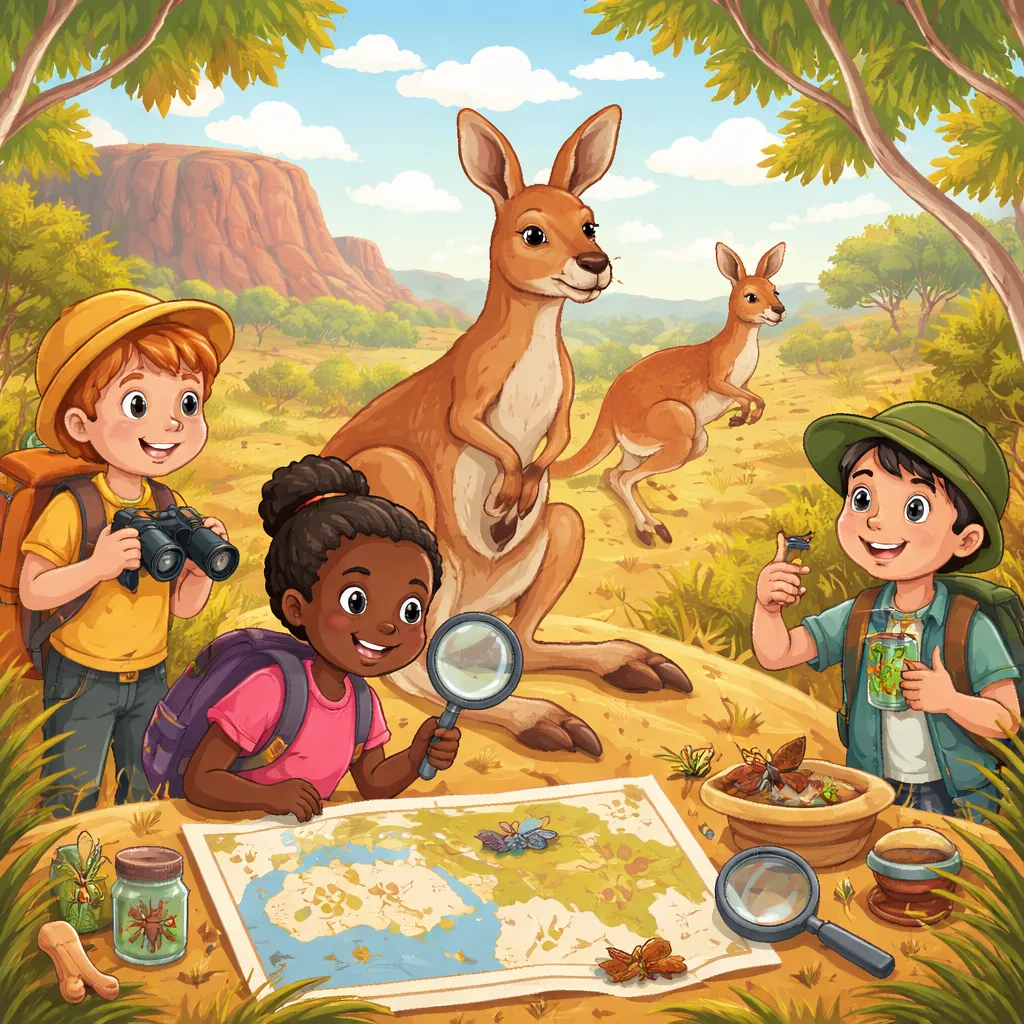

Have you ever seen a kangaroo hop across a field on TV or at a zoo? They are amazing animals that bounce on two legs and carry their babies in a pouch! Kangaroos are unique to Australia and are famous for their powerful jumps. Learning about kangaroos is a fun adventure that takes us to the dry, sunny Outback. Let’s bounce right in and start learning about kangaroo life!
English Language Learning
Vocabulary and Spelling Our hopping friend is called a kangaroo. The word "kangaroo" is a noun. A noun names a person, place, or thing. So, a kangaroo is a thing—a unique, bouncy animal. Spelling "kangaroo" is fun: K-A-N-G-A-R-O-O. It’s a long word, just like a kangaroo’s jump! It starts with a 'K' and has two 'O's at the end, like two big eyes watching you. K-A-N-G-A-R-O-O spells kangaroo.
Sound and Pronunciation Let’s say the word correctly. It sounds like this: /ˌkæŋ.ɡəˈruː/. We can say it in three parts. First, say "kan". It rhymes with "can". Next, say "guh". It’s a soft sound, like the start of "gum". Last, say "roo". It sounds just like the word for a baby kangaroo! Now, put it together! "Kan" "guh" "roo". Kangaroo! Great job! The word "kangaroo" has three beats, or three syllables. Clap three times: Kan-ga-roo. It’s a bouncy, rhythmic word.
Related Words Learning about kangaroos is more fun with new words! Here are some important ones. Body Parts: A kangaroo’s strong back legs and feet are perfect for hopping. Their long, strong tail helps them balance. Baby: A baby kangaroo is called a joey. It lives in its mother’s pouch. Group: A group of kangaroos is called a mob.
A Famous Saying There is a common and fun Australian saying: "I’ll be there in two shakes of a kangaroo’s tail." This means you will be there very soon. It’s a playful, Australian way of saying "I’ll be quick!" It reminds us of the quick, swishing tail of a hopping kangaroo. Say the saying with me: "I’ll be there in two shakes of a kangaroo’s tail." Can you think of something you can do very quickly?
Now you know the word "kangaroo"! Are you ready to hop into some amazing facts? Let’s jump from words to wonderful knowledge!
Animal Knowledge
Who Are They? – Family and Group What kind of animal is a kangaroo? Kangaroos are mammals. They have fur, are warm-blooded, and mother kangaroos feed their babies milk. They are a special kind of mammal called a marsupial. Marsupials are mammals that have a pouch. Their cousins are koalas, wombats, and opossums.
What Do They Look Like? – Amazing Bodies Kangaroos are large animals. A big male, called a boomer, can be taller than a grown-up! They have strong, muscular back legs, small front legs, and a long, thick tail. Their most famous feature is their powerful back legs and feet. They are built for hopping, which is called saltation. Their long tail is not just for show; it acts as a fifth leg for balance and support when they are moving slowly. Kangaroos have special adaptations for dry places. They can go a long time without water. Their ears can swivel to hear in all directions. Mother kangaroos have a forward-opening pouch to carry their joey.
Where Do They Live and How? – Home and Habits Kangaroos live only in Australia and on nearby islands. Their home is the Outback, which includes grasslands, bushlands, and deserts. Kangaroos are herbivores. This means they only eat plants. They eat grass, leaves, and shrubs. They are most active at dawn and dusk when it is cooler. Kangaroos are social animals and live in groups called mobs. A mob provides safety. They spend their time grazing, resting in the shade, and hopping from place to place. They can hop at high speeds and leap over obstacles.
A Kangaroo’s Life Story – Growing Up A baby kangaroo is called a joey. Kangaroos are marsupials, so the joey is born very, very tiny and underdeveloped. It crawls from the birth canal into its mother’s pouch. The joey stays in the mother’s warm, safe pouch for many months. It drinks milk from a teat inside the pouch. The mother cleans the pouch and cares for the joey. The joey grows inside the pouch. After a few months, it will peek out. Later, it will leave the pouch to hop around but will jump back in for safety and milk. It will leave the pouch for good at about 8-10 months old.
How Do They "Talk"? – Communication Kangaroos are mostly quiet, but they do communicate. They can make a soft clucking sound to talk to their joey. A loud cough or hiss can be a warning. They use their bodies a lot. They thump their big feet on the ground to warn the mob of danger. Males might box with each other to show who is stronger. Their best senses are their excellent hearing and eyesight. Their large ears can pick up the smallest sounds. Their eyes are set wide to see a broad view, which helps spot predators.
Are They Okay? – Taking Care of Them Most large kangaroo species are not endangered. There are millions in Australia. But some smaller types, like tree-kangaroos, are threatened. The main problems are habitat loss due to farming and cities. Kangaroos can also get hit by cars. Sometimes they are seen as pests by farmers because they eat grass meant for sheep and cows. We can be kangaroo helpers from afar! We can learn and teach others about them. We can support wildlife groups in Australia that work to protect all native animals. We can remember that all animals need space and respect.
Life Connections and Inspiration
How to Be With Them – Safety and Love Kangaroos are wild animals. We must admire them from a safe and respectful distance, especially in the wild. The rule is: Look, don’t touch, and keep your distance. In zoos, we watch them from the paths. In the wild, we never approach or try to feed a kangaroo. They are strong and can kick or scratch if they feel threatened. We should watch them quietly and let them be wild. We show our love by respecting their space and supporting the protection of the Australian bush, their true home.
Super Qualities We Learn from Them Kangaroos teach us wonderful things. One super quality is powerful forward movement. Kangaroos don’t walk backward; they hop forward with great energy. This teaches us to keep moving forward toward our goals, to be strong, and to make big leaps in our learning and life. Another quality is protective care. Mother kangaroos are incredibly protective of their joeys, keeping them safe in their pouch. This reminds us to care for and protect those who are smaller or need our help, like younger siblings or friends. Think about it: How can you keep moving forward on a project, even if it’s hard? How can you show protective care for someone or something in your life?
Take Action! – Your "Kangaroo Joey" Project Let’s do a fun activity! Your project is to create a kangaroo and joey puppet. Find two paper bags, some gray or brown crayons, glue, and paper. Decorate the larger bag to be the mother kangaroo. Draw a face and color the body. Cut a pocket or pouch from paper and glue it to her belly. Now, decorate the smaller bag to be the joey. Make it small enough to fit in the pouch. Put your hand in the mother bag to make her move, and use your other hand to make the joey pop in and out of the pouch. Put on a puppet show about a day in the life of a kangaroo family.
Closing Learning about kangaroo adventures is a bouncing good time! We learned the word "kangaroo" and how to say its three-part, hopping name. We discovered amazing facts about their powerful legs, their special pouches, and their life in the mob. We know that kangaroos are unique marsupials who are icons of Australia. You can use your new words to share stories about these incredible jumpers. You can use your knowledge to appreciate animals from all over the world. The animal kingdom is full of amazing movers and shakers. Always remember to respect wildlife from a safe distance, move forward with strength, and care for others. Keep exploring with curiosity, take big leaps in your learning, and be a protector of nature. Your enthusiasm and kindness make you a great friend to animals everywhere, even those hopping far away.