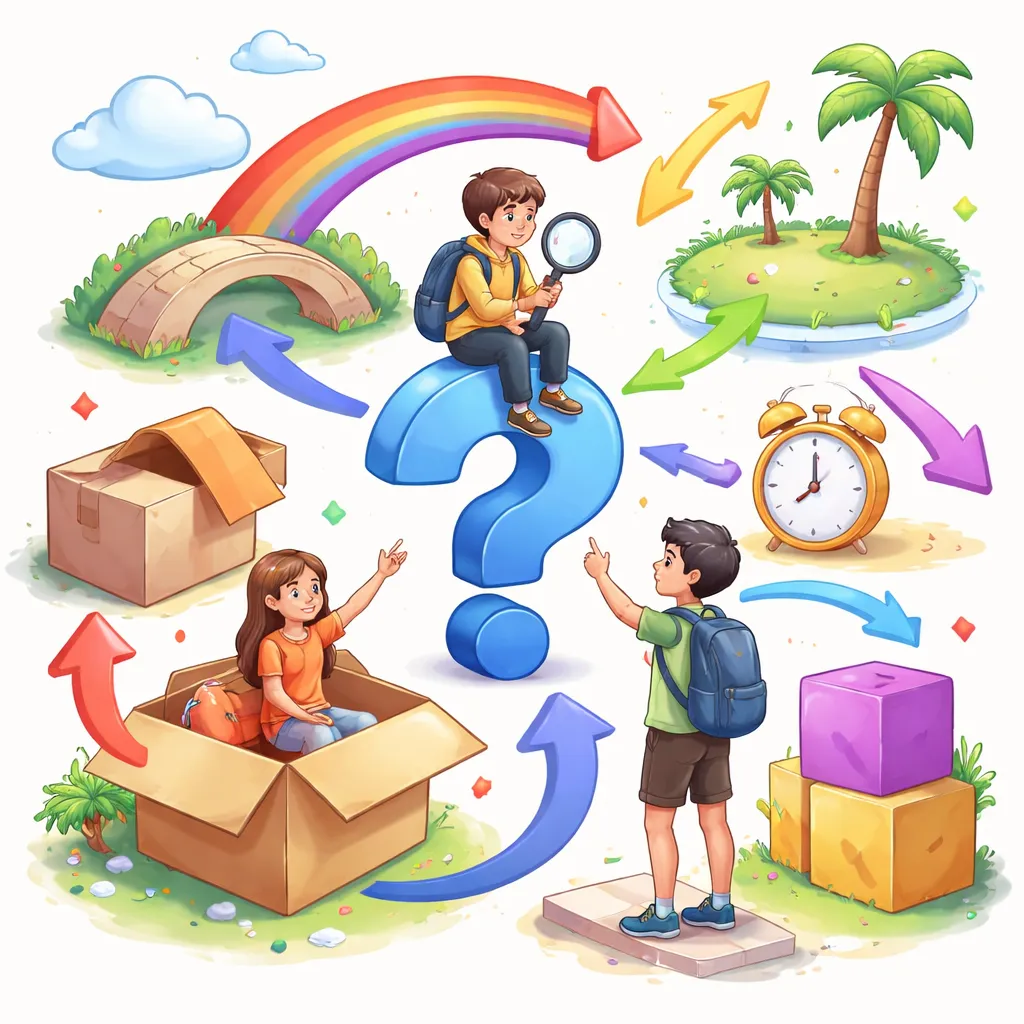

Imagine you’re giving someone directions to the coolest new spot in town. You have the destination (the noun: the café), and you have the action (the verb: is). But how do you connect them? You say it’s across from the park, next to the library, or behind the main square. Those connecting words are prepositions. A preposition is a word that shows the relationship between a noun (or pronoun) and another word in the sentence. It’s the linguistic GPS, pin-pointing where something is, when it happens, or how things are connected. Saying “I left my book” creates a mystery. Saying “I left my book on the bus, under the seat, or in my locker” solves it instantly. The words “on,” “under,” and “in” are prepositions, creating a clear mental map. For any student navigating the complexities of English, mastering a core toolkit of the 100 most important prepositions for junior high school students is essential for moving from vague statements to precise, crystal-clear communication.
Why master these small but mighty words? Their power is everywhere. In academic writing, they are the glue that holds complex ideas together, showing relationships like cause (because of), contrast (despite), and purpose (for). In everyday conversation and social media, they let you describe exactly how you feel about a trend, who you’re going with, or what you’re waiting for. Without them, your speech sounds robotic and incomplete. For reading comprehension, spotting prepositional phrases helps you quickly identify when, where, or how an action occurs, unlocking the full meaning of a sentence. When watching English content or playing games, understanding prepositions is key to following instructions (“go toward the mountain,” “the key is inside the chest”). This collection of the 100 most important prepositions for junior high school students is your guide to building sentences that are not just correct, but naturally connected and full of detail.
Prepositions cover a wide range of relationships. Let’s categorize the most essential ones.
Prepositions of Time tell us when. They are the schedule-makers. at for precise times (at 3 PM, at noon), on for days/dates (on Monday, on July 4th), in for longer periods (in May, in 2024, in the morning). Others include: before, after, during, since, until, for, from…to. Example: “The new season drops on Friday at midnight. I’ve been waiting for it since last year.”
Prepositions of Place & Location tell us where. They are the static map markers. in for inside an area (in the room, in the city), on for surfaces (on the wall, on the screen), at for specific points (at the door, at school). Others: above, below, under, over, beside, next to, between, among, behind, in front of, inside, outside. Example: “My phone is on the desk under a pile of books, next to my charger.”
Prepositions of Movement/Direction tell us where to/from. They are the dynamic pathfinders. to, from, into, out of, onto, off, through, across, along, around, toward, away from, up, down. Example: “We walked through the park toward the mall. Then we ran across the street.”
Other Relationship Prepositions show more abstract connections. of (possession, content: a friend of mine, a cup of tea), with (accompaniment, tool: go with friends, write with a pen), by (method, agent: travel by bike, a song by Taylor Swift), for (purpose, duration: used for gaming, study for an hour), about (topic: a video about science), like (similarity: sounds like fun). Example: “I need a break from studying for the test about prepositions.”
How do you spot a preposition? Use these two simple tests.
The “The Box” or “The Cloud” Test. The classic trick: A preposition is often anything a plane can do to a cloud, or a squirrel can do to a tree. Fly across, around, behind, below, beside, in front of, inside, near, off, out of, over, past, through, toward, under, up the cloud. This visual test works perfectly for physical prepositions of place and movement.
The “(Preposition) + (Noun/Pronoun)” Phrase Test. Prepositions are almost always team captains. They are followed by their “object”—a noun or pronoun—forming a prepositional phrase. Look for a small word immediately followed by a noun phrase. on (the desk), after (the game), with (my friends), about (this complicated topic), for (you). If it’s not followed by a noun/pronoun, it’s probably an adverb (“Come in,” “Go on”).
Understanding the rules of placement and partnership prevents common mix-ups.
The Golden Rule: The Prepositional Phrase. A preposition must have an object. The unit “Preposition + Noun/Pronoun (Object)” is called a prepositional phrase. This whole phrase acts as a single descriptive unit. “We met before class.” (“before” is the preposition, “class” is its object).
Position Flexibility. Prepositional phrases can often move around in a sentence for style. “After the final bell, we went to the cafe.” or “We went to the cafe after the final bell.” Both are correct, though the first emphasizes the time.
Ending a Sentence with a Preposition: It’s Okay! The old “rule” about not ending a sentence with a preposition is a myth. Natural English does it all the time. “What are you talking about?” “This is the book I was looking for.” It’s much better to sound natural than awkwardly correct.
Verb + Preposition Collocations. This is crucial. Many verbs partner with specific prepositions, and changing the preposition changes the meaning. You don’t just “wait,” you wait for someone. You “listen to” music but “hear about” news. You “depend on” someone and “apologize for” something. These are fixed partnerships you must learn.
Even with a map, it’s easy to take a wrong turn. Watch out for these common mistakes.
Confusing in, on, at for Time. This is a classic trio. Use at for clock times and specific points (at 7 PM, at night). Use on for days and dates (on Tuesday, on my birthday). Use in for months, years, seasons, and parts of the day (in August, in 2024, in the afternoon). Incorrect: “I have a test on the morning.” Correct: “I have a test in the morning.”
Confusing in, on, at for Place. In = inside a 3D space (in the car, in the world). On = on a surface (on the page, on the street). At = a specific point or location (at the door, at the concert, at school). Incorrect: “Let’s meet on the cinema.” Correct: “Let’s meet at the cinema.”
Using to instead of with for Accompaniment. “To” indicates direction toward something. “With” indicates togetherness. Incorrect: “I went to the mall to my friends.” Correct: “I went to the mall with my friends.”
Mixing up like and as for Similarity. Use like to compare nouns/pronouns (“She sings like a professional”). Use as to compare roles, jobs, or functions (“He worked as a tutor last summer”). Incorrect: “Do it like I told you.” (Here, “I told you” is a clause with a subject and verb). Correct: “Do it as I told you.”
Ready for a challenge? Let’s apply this. First, become a phrase detective. Find a short English paragraph—a social media post, a game item description, or a news headline. Underline every prepositional phrase. For each one, ask: What is the preposition? What is its object (the noun/pronoun after it)? What is the whole phrase describing—time, place, or something else? This trains you to see sentences in clear, logical chunks.
Second, play “Preposition Story.” Take five prepositions from the list below, for example: through, without, against, since, beyond. Your task is to use all five in a short, coherent paragraph (4-5 sentences) about a topic you care about, like describing a tense game moment, a personal goal, or a futuristic scene. This forces you to think about their meanings and relationships creatively.
Now, let’s build your master toolkit. Here is the curated, essential list of the 100 most important prepositions for junior high school students, ready for active use.
Core Spatial & Directional: aboard, about, above, across, after, against, ahead of, along, amid, among, around, at, before, behind, below, beneath, beside, between, beyond, by, close to, down, from, in, in front of, inside, into, near, next to, off, on, on top of, onto, opposite, out, out of, outside, over, past, through, throughout, to, toward, under, underneath, up, upon, within, without.
Core Temporal: about, after, around, as, at, before, behind, between, by, during, for, from, in, on, pending, since, through, throughout, till, until, up to, within.
Other Core Relationships: according to, ahead of, along with, apart from, as for, as of, as per, as to, because of, but (meaning except), by means of, concerning, considering, despite, down to, due to, except, except for, excluding, following, in addition to, in case of, in favor of, in lieu of, in place of, in regard to, in spite of, including, instead of, like, minus, of, off of, on account of, on behalf of, on top of, opposite, out of, owing to, per, plus, regarding, regardless of, save, than, thanks to, unlike, versus, via, with, with regard to, with the exception of, worth.
By now, you should see prepositions not as annoying little words to memorize, but as the essential connectors that give your language precision and flow. They are the digital pins on your life’s map, the logic gates in your sentences. Moving from “I’ll meet you school” to “I’ll meet you in front of the main gate at school after practice” is the difference between confusion and clarity. This mastery of the 100 most important prepositions for junior high school students equips you to build sentences that are not just grammatically sound, but rich, detailed, and effortlessly understood.
Your Core Takeaways You now understand that a preposition is a connector that shows a relationship—usually of time, place, direction, or association—between its object (a noun or pronoun) and another word in the sentence. You know the main families: prepositions of time (at, on, in), place (in, on, at), movement (to, into, through), and other abstract relationships (of, with, for, about). You can identify them using the visual “cloud/tree” test and by spotting the “preposition + noun” phrase pattern. You’ve learned they form prepositional phrases, can often move in a sentence, and commonly partner with specific verbs. You’re aware of classic pitfalls like mixing up in/on/at and confusing like and as. Most importantly, you have a powerful, practical list of 100 essential prepositions to weave into your daily English.
Your Practice Missions First, run the “Collocation Challenge.” Pick five common verbs you use often (e.g., wait, listen, talk, depend, apologize). Look them up in a learner’s dictionary or online. Your mission is to find and note down the one or two most common prepositions that partner with each verb (e.g., wait for, listen to). Create two correct sentences for each verb+preposition combo. This builds your natural “grammar sense” for how words team up.
Second, launch “Preposition Photo Description.” Take a photo of a busy scene—your desk, a view from your window, a group photo with friends. Describe the photo in 5-7 sentences, writing them down. Your goal is to use at least eight different prepositions from the list above to describe where things are, what’s happening, and the relationships between objects/people. This connects grammar directly to your visual world.