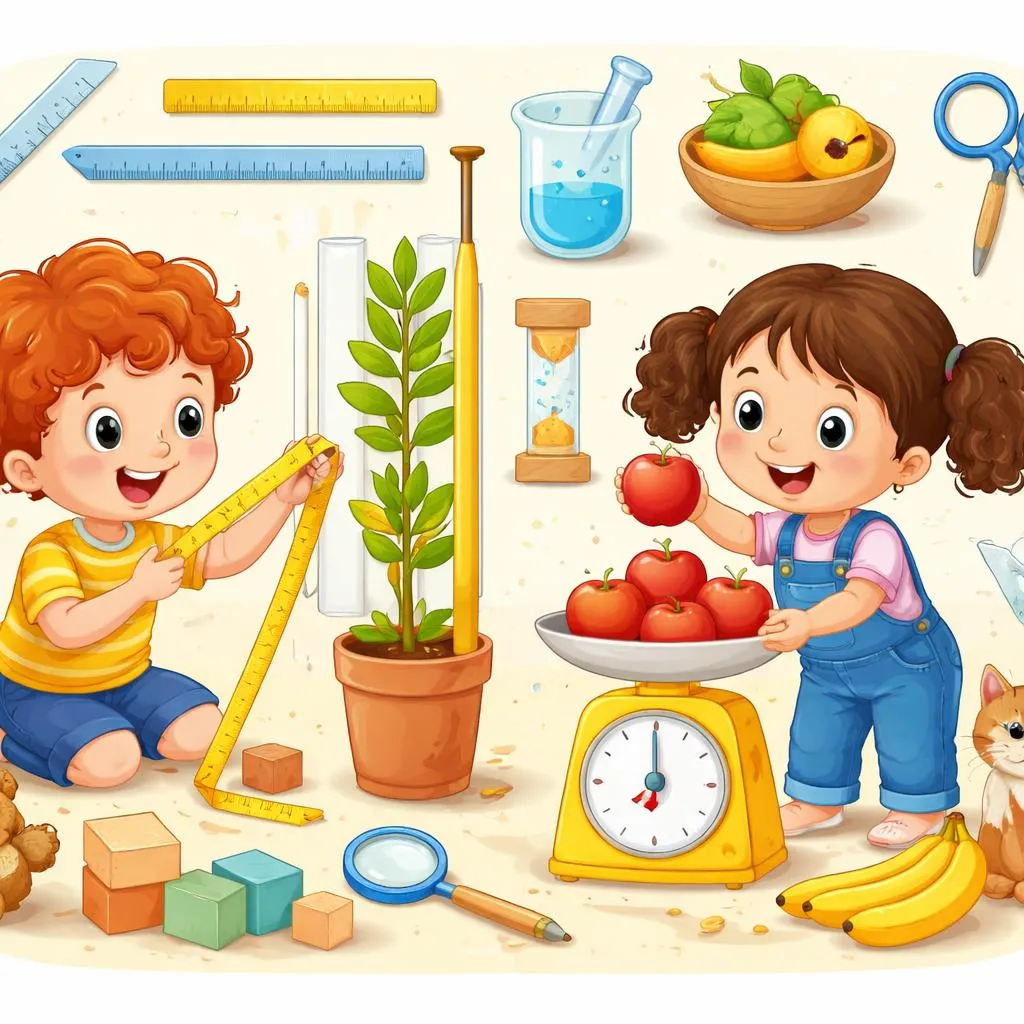

Hello, young scientist! Do you love finding out the size of things? What do you do with a ruler? What do you do with a scale? Do you measure how tall you are? Or do you weigh your backpack? They both seem to be about size. But are they the same? They are like two different detective tools. One is a flexible measuring tape. One is a special weight scale. Let's find out! Today, we explore the word friends "measure" and "weigh". Knowing their secret is a superpower. It makes you a precise detective of the world. Let's start our measurement adventure!
First, let's be Measurement Detectives. Look at home. Here are two sentences. "Can you help me measure the window for new curtains?" "We need to weigh the flour for the cake recipe." They both involve size. A window. Some flour. Do they sound the same? One feels like checking width. One feels like checking heaviness. Can you sense it? Great observation! Now, let's look closer.
Adventure! Into the World of Finding Size
Welcome to the world of size! "Measure" and "weigh" are two different detectives. Think of "measure" as a flexible measuring tape. It can find many things. It finds length, height, width, and speed. Think of "weigh" as a special weight scale. It has one job. It finds how heavy something is. Both are tools. But one is for many sizes. One is for one thing: weight. Let's learn about each one.
The Measuring Tape vs. The Weight Scale Think about the word "measure". To "measure" feels wide and open. It is the main word. You find out the size, amount, or degree of something. You can measure length with a ruler. You can measure temperature with a thermometer. You can measure time with a clock. It is for many types of size. Now, think about "weigh". To "weigh" feels specific and focused. It has one job. It finds how heavy something is. You weigh a bag of apples. You weigh yourself. "Measure" is the tape. "Weigh" is the scale. One finds many facts. One finds one fact: weight.
Finding Many Facts vs. Finding One Fact Let's compare their jobs. "Measure" answers many questions. How long? How tall? How hot? How fast? How much? You measure the room's length. You measure the water's temperature. The answers are in inches, degrees, or cups. "Weigh" answers one question. How heavy? You weigh a parcel. You weigh ingredients. The answer is in pounds, kilograms, or ounces. "Measure" is for many dimensions. "Weigh" is for one dimension. One is a multi-tool. One is a specialist.
Their Special Word Partners and Common Uses Words have best friends. "Measure" loves units of many kinds. Measure the length. Measure the speed. Measure the area. Measure a cup of milk. "Weigh" loves weight units. Weigh the package. Weigh yourself. Weigh the pros and cons (this means to think about choices). It weighs 5 pounds. Note: You "measure" how tall a plant is. You "weigh" the pot it is in. A doctor can "measure" your height. A doctor can "weigh" you.
Let's visit a school scene. In science class, you do an experiment. You need to know how much liquid to use. You take a measuring cup. You pour water to the 200ml line. You measure 200 milliliters of water. Later, you need salt for the experiment. The recipe says "5 grams". You use a small digital scale. You pour salt until it shows 5g. You weigh 5 grams of salt. The word "measure" fits the liquid volume. The word "weigh" fits the solid's mass.
Now, let's go to the playground. You and a friend are racing. You want to see who jumps farther. You use a long tape. You check the distance from the start line to your heel. You measure your jump. After playing, you find a big rock. You wonder how heavy it is. You try to lift it. You guess its weight. You are trying to weigh it in your hands. The word "measure" fits the jump distance. The word "weigh" fits the rock's heaviness.
Our Little Discovery So, what did we find? "Measure" and "weigh" both help us know about things. But they are different. To "measure" is to find the size, amount, or degree of something. It can be length, volume, temperature, speed, or time. You use tools like rulers, cups, and thermometers. To "weigh" is to find out how heavy something is. That is its only job. You use a scale or a balance. You measure how tall you are. You weigh yourself on a scale. Knowing this helps you describe your detective work perfectly.
Challenge! Become a Measurement Word Champion
Ready for a science test? Let's try your new skills!
"The Best Choice" Challenge Let's imagine a nature scene. A squirrel finds a small hole in a tree. It wants to see if a nut will fit inside. The squirrel does not care about weight. It needs to know the nut's size. It uses its paws to check the width. The squirrel is trying to measure the hole and the nut. This is about size and fit. An ant finds a large breadcrumb. It needs to know if it can carry it. The ant tries to lift it. It is testing the heaviness. The ant is trying to weigh the breadcrumb in its tiny legs. "Measure" wins for the squirrel's size check. "Weigh" is the champion for the ant's heaviness test.
"My Sentence Show" Your turn to create! Here is your scene: Helping to make a birdhouse for the garden. Can you make two sentences? Use "measure" in one. Use "weigh" in the other. Try it! Here is an example: "First, I will use a ruler to measure the piece of wood. I need to know how long to cut it." This is finding a length. "Then, I should weigh the bag of nails. I want to know if it's too heavy for the small shelf." This is finding how heavy the bag is. Your sentences will show two types of checking!
"Eagle Eyes" Search Look at this sentence. Can you find the word that could be better? Let's check a home context. "The recipe said to weigh 250 milliliters of milk into the bowl." Hmm. Milliliters are a unit for volume, like in a measuring cup. You do not "weigh" liquids in milliliters; you measure their volume. The word "measure" is the correct choice here. "Weigh" is for grams or pounds on a scale. "The recipe said to measure 250 milliliters of milk into the bowl." Using "weigh" here confuses volume with weight. Did you spot it? Excellent detective work!
Harvest and Action! Turn Knowledge Into Your Superpower
Great exploring! We started thinking "measure" and "weigh" were similar. Now we know they are two different detectives. We can "measure" many things. We "weigh" one thing. You can now talk about your science projects with perfect accuracy. This is a great skill for cooking and building.
What you can learn from this article: You can now feel that to "measure" is to find out the size, amount, or degree of something, like its length, volume, temperature, or speed, using tools like rulers, cups, or thermometers. You can now feel that to "weigh" is specifically to find out how heavy something is, and it is the only job of this word, done with a scale that shows pounds, kilograms, or ounces. You know that you measure your height with a tape, but you weigh yourself on a bathroom scale. You learned to match the word to the task: "measure" for size/amount/degree, "weigh" for heaviness.
Life practice application: Try your new skill today! Be a measurement detective. Look at a task. Do you need to measure ingredients for a recipe? Or do you need to weigh a parcel for the post office? Next time you help in the kitchen, name your action. Say, "Let me measure one cup of flour." or "Can you weigh these bananas, please?" Tell a friend about something you can measure in your room. Describe why you might need to weigh your pet. You are now a master of measurement words! Keep discovering the amazing world of size.