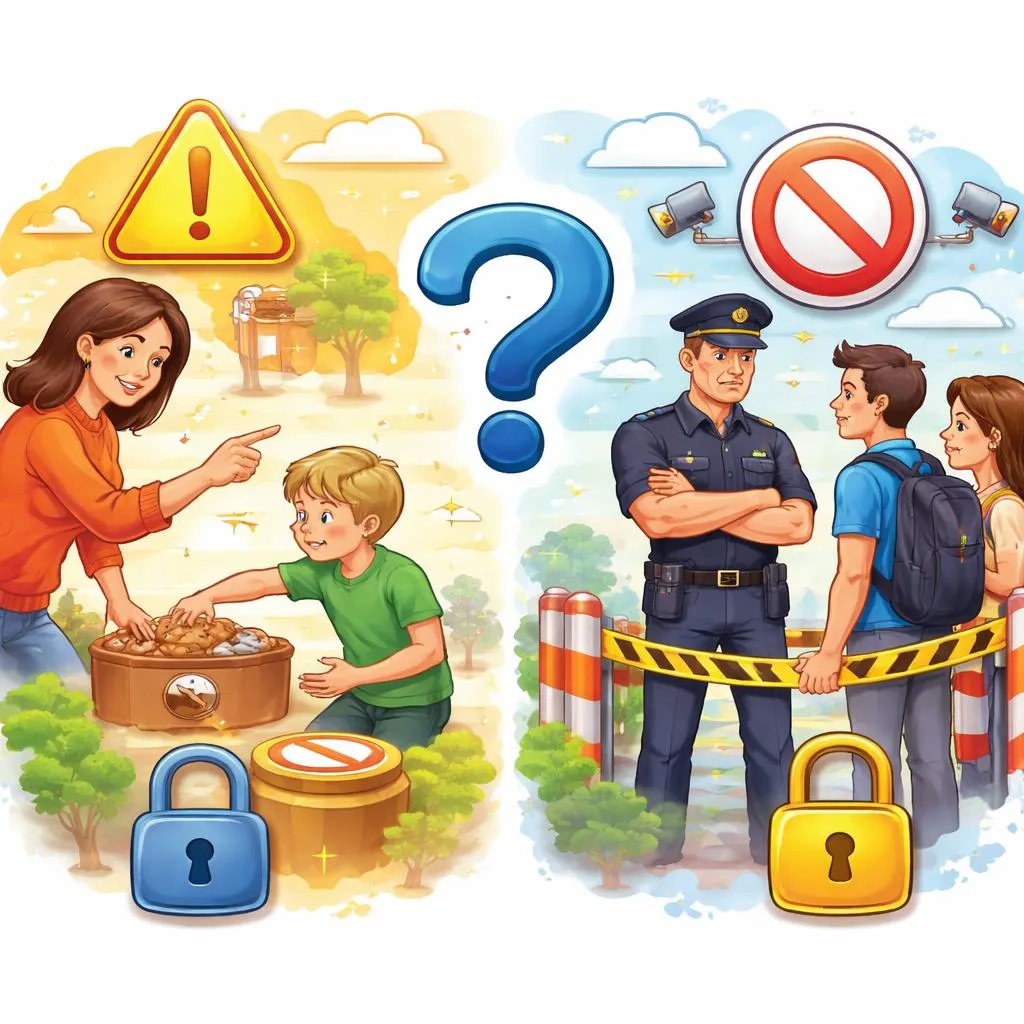

Hello, word explorer! Your parent can forbid you from eating candy. A sign can prohibit parking. Both say "you cannot do that". But do they say it the same way? They are two kinds of "no". One is like a parent's serious, direct face. One is like a cold, metal "NO" sign. Let's discover their secret! Today, we explore the stopping word pair "forbid" and "prohibit". Knowing the difference makes you a word expert. Let's begin.
First, let's be Language Listeners. Listen at home. Here are two sentences. "My dad forbids running in the house." "The sign prohibits swimming in the lake." Both talk about not allowing something. Running. Swimming. Do they sound the same? One sounds like a personal rule from a person. One sounds like an official rule from a sign. Can you sense the difference? Great listening! Now, let's look closer.
Adventure! Into the World of "Stop"
Welcome to understanding strong "no"s. To "forbid" and to "prohibit" both mean to not allow. But who says it, and how, is different. Think of "forbid" as a parent's serious, direct face. The "no" is personal and comes from a person. Think of "prohibit" as a cold, metal "NO" sign. The "no" is official and comes from a rule. Both are "stops". But one is the "serious face" of personal authority. One is the "metal sign" of official rules. Let's learn about each one.
A Person's Order vs. A Rule's Decree Think about the word "forbid". To "forbid" is personal. A person in charge says no. This "no" is to someone specific. My mom forbids loud music. The feeling is direct and from a person. Now, think about "prohibit". To "prohibit" is formal and legal. A law or a rule says no. This "no" is for everyone. The law prohibits littering. The feeling is impersonal and official. A teacher can forbid talking. A school rule can prohibit phones. "Forbid" is the person's order. "Prohibit" is the rule's decree.
Spoken Command vs. Written Rule Let's compare how we hear them. We often hear someone "forbid" something. A coach forbids unfair play. The command is spoken. We often read that something is "prohibited". A sign says "Smoking Prohibited." The rule is written. You are forbidden by your dad. Swimming is prohibited by the city. One is a spoken command from a person. One is a written rule for a place.
Their Special Word Partners and Common Uses Words have best friends. "Forbid" often partners with people and direct objects. Forbid someone from doing something. I forbid it! Strictly forbid. "Prohibit" often partners with laws, signs, and formal things. The law prohibits it. Prohibit an activity. It is prohibited. Note: You say "God forbid!" as an expression. You see "Prohibited" on warning signs. "Forbid" is personal. "Prohibit" is legal.
Let's visit a school scene. The teacher forbade us from sharing answers. This is her personal, direct command to the class. The school handbook prohibits chewing gum. The word "forbid" fits the teacher's spoken command. The word "prohibit" fits the official written rule in the handbook. One is a person's spoken "no". One is a book's written "no".
Now, let's go to the playground. The lifeguard forbids running on the wet deck. This is his spoken order to us. A big sign prohibits climbing the fence. The word "forbid" fits the lifeguard's personal warning. The word "prohibit" fits the official rule posted on the sign. One is a person's voice. One is a sign's message.
Our Little Discovery So, what did we find? To "forbid" and to "prohibit" both mean to not allow something. But to "forbid" is a personal order from someone in authority. It is a direct, spoken command. To "prohibit" is an official rule, often a law or written rule. It is a formal, often written ban. A parent can forbid a scary movie. A city law can prohibit loud noise at night. "Forbid" is the serious face. "Prohibit" is the metal sign.
Challenge! Become a "No" Word Champion
Ready for a nature test? Let's try your new skills!
"The Best Choice" Challenge Let's imagine a nature scene. The head park ranger forbids anyone from feeding the bears. This is her direct, spoken command to visitors. Park regulations clearly prohibit feeding all wildlife. The word "forbid" is the champion for the ranger's personal, spoken order. The word "prohibit" is the best choice for the official, written park regulations. One is a person's command. One is a rulebook's law.
"My Sentence Show" Your turn to create! Here is your scene: A museum. Can you make two sentences? Use "forbid" in one. Use "prohibit" in one. Try it! Here is an example: "The tour guide forbade us from using flash." This is the guide's personal, spoken instruction. "Museum policy prohibits touching the art." This is the official, written policy. Your sentences will show a spoken command versus a written rule!
"Eagle Eyes" Search Look at this sentence. Can you find the word that could be better? Let's check a home context. "The city ordinance forbids parking on this street overnight." Hmm. A city ordinance is an official, written law. The more formal, legal word for a written law is "prohibit", not "forbid". "Forbid" sounds like a person is speaking. A better sentence is: "The city ordinance prohibits parking on this street overnight." Using "prohibit" correctly matches the official nature of a city law. "Forbid" would fit a parent's rule about a driveway. Did you spot it? Super thinking!
Harvest and Action! Turn Knowledge Into Your Superpower
Great exploring! We started thinking "forbid" and "prohibit" were the same strong "no". Now we know they are different in source. To "forbid" is to give a personal order not to do something. It comes from a person's authority. To "prohibit" is to have an official rule or law that does not allow something. It comes from a written rule or system. You can now talk about rules and commands with perfect clarity.
What you can learn from this article: You can now see that "forbid" means a person in charge gives a direct order not to do something. It is a spoken command, like from a parent or teacher. You can now understand that "prohibit" means an official rule or law does not allow something. It is a written ban, like on a sign or in a handbook. You know that a coach can forbid arguing with the referee. A pool sign can prohibit diving. You learned to match the word to the source: "forbid" for personal, spoken commands; "prohibit" for official, written rules.
Life practice application: Try your new skill today! Be a rule detective. Listen for when someone forbids you to do something—that is a personal command from a person. Look for signs and rules that prohibit an action—that is an official ban. Remember, "forbid" is the serious face of a person, "prohibit" is the cold metal of a sign. Use "forbid" when talking about what a person tells you not to do. Use "prohibit" when talking about what a law or sign says you cannot do. Your understanding of instructions and rules will be much sharper!