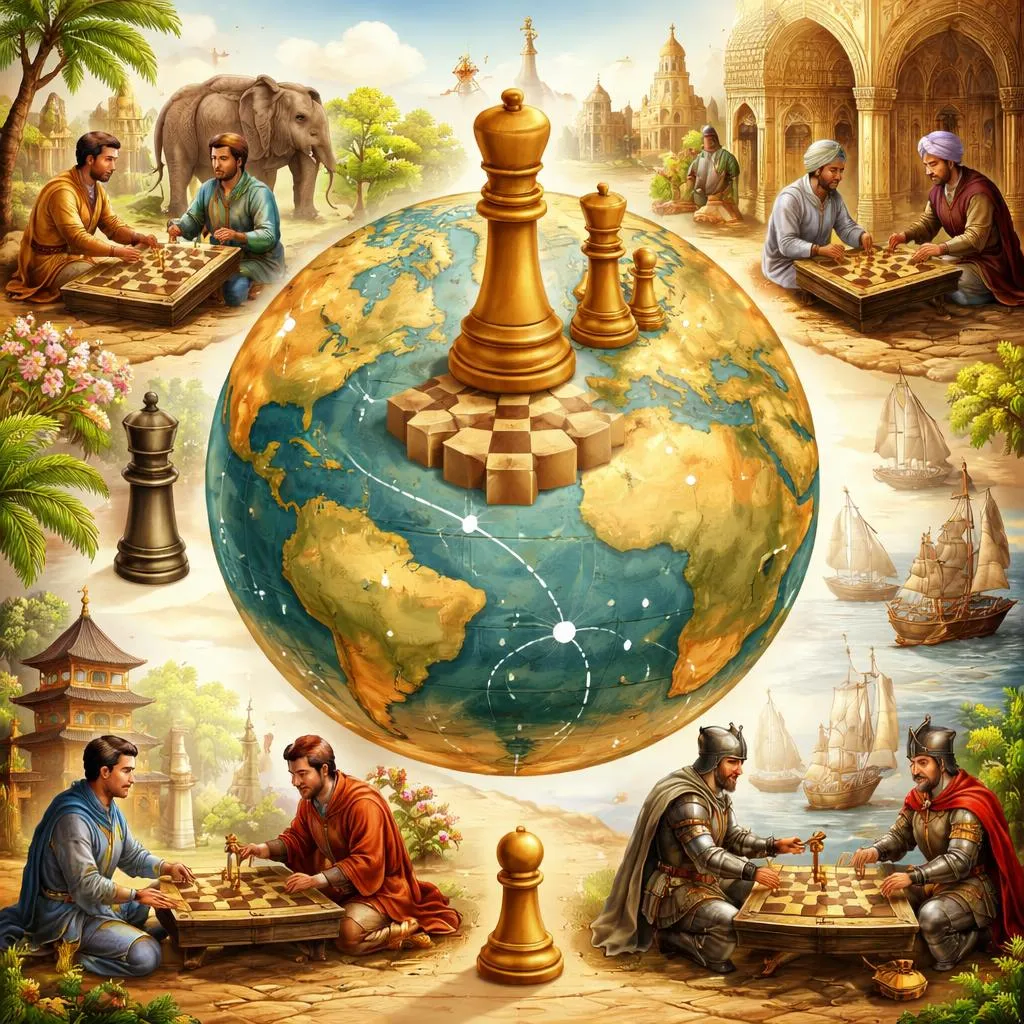

The story of chess origin begins many centuries ago. Chess is one of the oldest strategy games still played today. Its history connects different cultures, languages, and civilizations.
Most historians believe that chess began in ancient India. The early form of the game was called Chaturanga. This game appeared around the sixth century.
What Was Chaturanga?
Chaturanga was a strategic board game. The name means “four divisions of the army.” These divisions represented:
Infantry Cavalry Elephants Chariots
These pieces later evolved into modern chess pieces.
Infantry became pawns. Cavalry became knights. Elephants later influenced bishops. Chariots developed into rooks.
The board used in Chaturanga was similar to the modern chessboard. It had sixty-four squares.
How Did Chess Spread from India?
From India, the game traveled to Persia. In Persia, it was called Shatranj.
Persian players developed new rules and strategies. The word “check” comes from the Persian word “shah,” meaning king. When the king was threatened, players said “shah.” The phrase “checkmate” comes from “shah mat,” meaning “the king is helpless.”
When Arab armies conquered Persia, the game spread further across the Islamic world. Scholars and traders carried it to North Africa and Spain.
Chess in Europe
Chess entered Europe around the ninth and tenth centuries. It became popular in medieval courts. Nobles and scholars enjoyed the game.
During the late Middle Ages, important rule changes happened in Europe. The queen became the most powerful piece. The bishop gained greater movement. These changes made the game faster and more dynamic.
By the fifteenth century, modern chess rules began to take shape.
The Modern Chessboard
The chessboard has sixty-four squares arranged in eight rows and eight columns. The pieces include:
King Queen Rook Bishop Knight Pawn
Each piece has specific movements. Strategy depends on planning, positioning, and foresight.
Why Chess Became So Popular
Chess is more than a game. It develops logical thinking. It encourages patience and planning. It requires concentration.
Because the rules are simple but strategies are complex, chess appeals to both beginners and experts.
The game crossed cultures easily. It did not depend on language. The board and pieces communicate through movement.
Chess Tournaments and Global Recognition
By the nineteenth century, organized chess competitions appeared. In 1886, the first official World Chess Championship took place.
In the twentieth century, chess became an international sport. The FIDE, founded in 1924, governs international competitions.
World champions such as Garry Kasparov and Magnus Carlsen helped increase global interest in chess.
Chess in the Digital Age
Today, chess is played online around the world. Digital platforms allow players to compete instantly. Computer programs analyze games and improve strategy.
Despite modern technology, the basic structure remains connected to its ancient roots.
Why Understanding Chess Origin Matters
The origin of chess shows how ideas travel between cultures. From India to Persia, from the Islamic world to Europe, the game evolved step by step.
Chess origin reflects creativity, strategy, and shared human history. It remains a timeless game that continues to challenge minds across generations.
Chess Origin and Cultural Exchange
The chess origin story is also a story of cultural exchange. As the game moved from India to Persia and later to Europe, each region shaped it in unique ways. Rules changed slowly. Piece movements developed over time. The game adapted to local traditions while keeping its strategic core.
In the Islamic world, chess was studied carefully. Scholars wrote books about strategy and openings. Famous players became respected thinkers. The game was not only entertainment. It was considered an intellectual exercise.
When chess reached Europe, it entered royal courts and monasteries. Kings and nobles played it as a symbol of intelligence and leadership. The design of the pieces changed to reflect European society. The queen became powerful during a time when strong female rulers influenced politics. This historical context shaped how the game evolved.
Development of Modern Rules
During the fifteenth century, major rule changes created what is sometimes called “modern chess.” The queen gained the ability to move across the board in many directions. The bishop gained long diagonal movement. These changes made the game faster and more dynamic.
Before these changes, matches could last for many hours without clear progress. After the rules were updated, attacks became stronger and strategies more complex.
Castling was introduced to protect the king. The rule of en passant was added to balance pawn movement. Pawn promotion allowed a pawn reaching the last row to become a stronger piece, usually a queen.
These adjustments shaped the chess game known today.
Chess Origin and Language
The history of chess origin is connected to language. Many chess terms come from Persian and Arabic.
“Check” comes from the Persian word “shah.” “Checkmate” comes from “shah mat.”
In Spanish, chess is called “ajedrez,” which comes from Arabic. In French, it is “échecs.” In Russian, it is “shakhmaty.”
Each name reflects the journey of the game across regions.
Language preserves history. Chess vocabulary shows how cultures influence one another.
Chess Boards and Piece Design
Early chess pieces were simple. In some regions, pieces were abstract shapes. Religious traditions sometimes discouraged detailed human figures. As chess spread to Europe, more recognizable shapes appeared.
The king often wears a crown. The queen is taller and more detailed. The rook looks like a castle tower. The knight often appears as a horse head.
The design helps players identify pieces quickly.
The black and white board pattern became standard over time. Earlier boards sometimes used plain colors without alternating squares.
Chess and Education
Throughout history, chess has been used as a teaching tool. It trains memory. It strengthens concentration. It encourages planning ahead.
In schools today, chess programs help students develop critical thinking skills. Players learn to think before moving. They evaluate consequences. They study patterns.
Because chess does not rely on language, it can connect people from different countries. Two players who do not share a spoken language can still compete fairly.
Famous Moments in Chess History
The nineteenth century saw the rise of international tournaments. Players traveled to compete. Written analysis of games became common.
In the twentieth century, chess became part of global politics. During the Cold War, matches between top players symbolized national pride. Games were broadcast worldwide.
The 1972 World Chess Championship between Bobby Fischer and Boris Spassky became one of the most famous events in chess history. The match showed how deeply chess had entered international culture.
Chess Computers and Artificial Intelligence
In 1997, a major milestone occurred. A computer developed by IBM called Deep Blue defeated world champion Garry Kasparov. This event changed how people viewed artificial intelligence.
Since then, chess engines have grown stronger. Modern programs can analyze millions of positions per second. Online platforms allow players to practice with computer assistance.
Even with powerful computers, human creativity remains important. Strategy, psychology, and preparation still influence high-level games.
Chess Origin and Global Popularity Today
Today, chess is played in nearly every country. International competitions are organized regularly. Young players begin learning at early ages.
Online platforms connect millions of users. Games can be played instantly across continents. Streaming and video lessons make learning accessible.
Despite modern changes, the core idea remains the same as in ancient India. Two players sit across from each other. Each tries to protect the king and outthink the opponent.
The Lasting Importance of Chess Origin
Understanding chess origin provides insight into world history. It shows how ideas travel through trade, conquest, and communication. It reveals how cultures influence one another.
From Chaturanga to modern tournaments governed by FIDE, chess has traveled across centuries.
The game continues to evolve. New strategies appear. Young champions rise. Technology advances.
Yet the foundation remains rooted in its ancient past.
The chess origin story demonstrates how a simple board game can become a global symbol of intelligence, strategy, and cultural connection.