
Start! Find a Pair of 'Tiny Twin' Words
Hello, word explorer! Have you ever seen a long line of tiny insects on the ground? They are all working together. What do you call them? You might say "ants." Now, imagine you see a group of pale insects eating an old piece of wood. Are those ants too? Maybe they are "termites." They both live in big groups. Are they the same? This is a fun nature puzzle. Today we explore a word pair. We explore ant and termite. They are like two different types of tiny builders. But they build different things! Knowing the difference is a superpower. Your nature stories will be smart and accurate. Let us start our tiny word adventure!
Be a Language Watcher now. Our first clue is at home. You see a trail of black insects in the kitchen. Your parent says, "There are ants in the sugar." Then, you watch a show about houses. It talks about damage from termites. They are both small insects that live in groups. But are they the same? Let us test with two sentences.
"The ant carried a breadcrumb much bigger than itself." This shows a strong, hard worker. "The termite ate the soft wood inside the old fence post." This shows an insect that eats wood.
They both describe busy, social insects. But one is a strong carrier. One is a wood eater. Your watching mission starts. Let us crawl into their word world.
Adventure! Crawl Into the Word World
Feel the Word's Job!
Feel the word ant. It is a strong, busy word. It feels like a determined worker. It is a scavenger and a hunter. The word termite is a silent, munching word. It feels like a hidden destroyer or a recycler. It eats cellulose, like wood. Ant is the outdoor forager. Termite is the hidden wood-eater. One is a busy street cleaner. The other is a quiet demolition crew. Let us see this at school.
In a science class, you learn: "The ant colony has a queen, workers, and soldiers." This is about social structure. In a lesson about homes, you might learn: "Termite damage can weaken a house." This is about a problem. Saying "ant damage" is less common. The job of the words is different. One is often seen as hardworking, the other as destructive.
Compare Their Bodies and Homes!
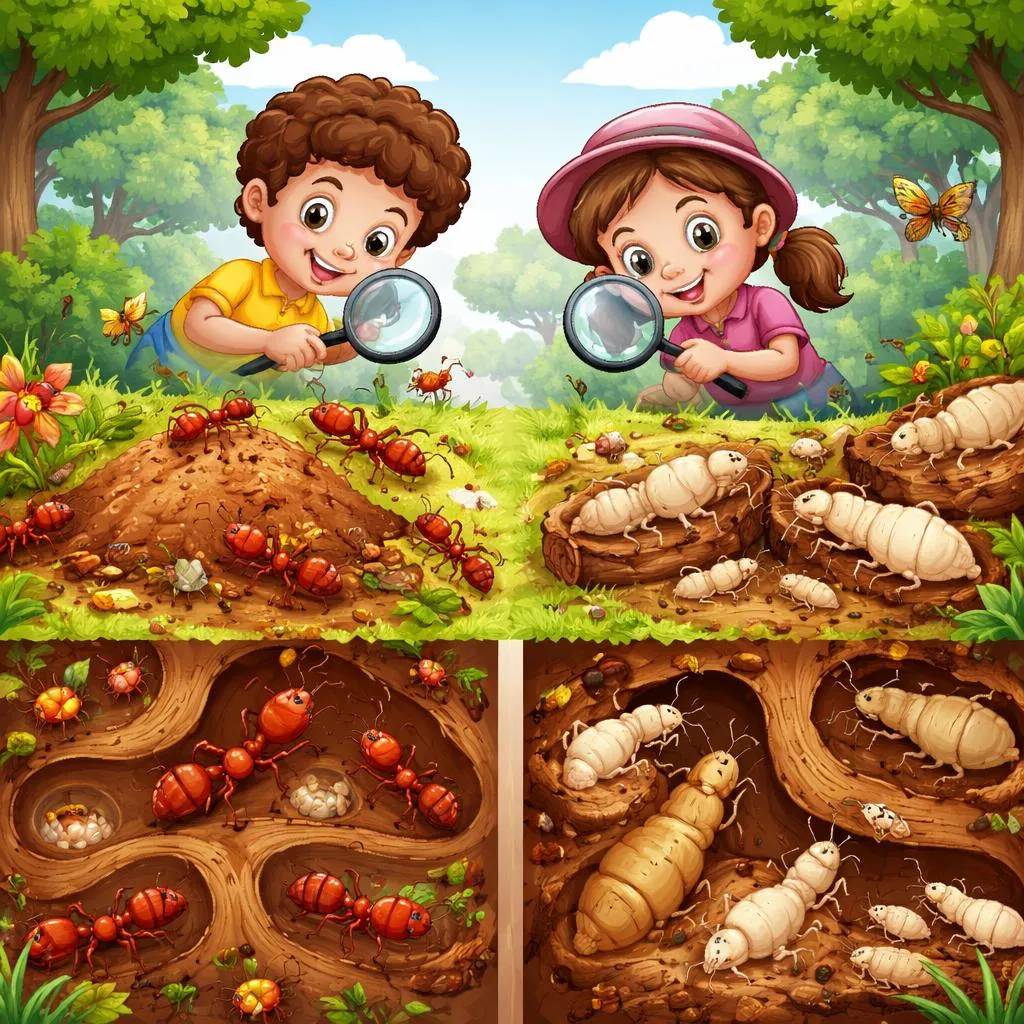
Think about a tiny waist and a thick waist. The word ant makes us think of a tiny waist. An ant has a narrow, pinched waist. Its body is in three clear parts. The word termite makes us think of a thick waist. A termite has a broad waist. Its body is more straight. Their homes are different too. Ants often live in soil or mounds. Termites often live in wood or big, hard mounds. Let us test this on the playground.
You play a game. You walk with a pretend narrow waist, carrying a toy. You say, "I am an ant worker!" Your friend walks with a straight body, pretending to chew. He says, "I am a termite eating wood!" The word ant suggests a segmented, active body. The word termite suggests a straight, chewing body. The playground shows the difference.
Meet Their Best Word Friends!
Words have favorite tiny partners. The word ant likes hard work and colony words. It teams up with 'hill', 'colony', 'worker', 'farm', and 'fire'. You see an ant hill. You watch ants farm aphids. The word termite likes wood and damage words. It teams up with 'mound', 'winged', 'inspection', 'damage', and 'swarm'. You get a termite inspection. A termite swarm happens in spring. Their partners are different. Let us go back to school.
In a biology lesson, you study the ant's life cycle. This is common. In a home economics class, you might learn about preventing termite infestation. This is about home care. You would not usually study "ant infestation" in the same way. The word friends set the right topic.
Our Little Discovery!
We crawled through the word dirt. We made a clear discovery. The words ant and termite are different insects. The word ant describes a hardworking insect with a narrow waist. It lives in colonies and forages for food. The word termite describes a wood-eating insect with a broad waist. It lives in colonies inside wood or mounds. Ant is the scavenger. Termite is the decomposer. One is often seen as helpful (or a picnic pest). The other is often seen as a threat to wood.
Challenge! Become a Tiny Word Expert
"Best Choice" Challenge!
Let us look at nature. Read each scene. Pick the champion word. Scene one: You are on a hike. You see a big pile of sand with many tiny holes. Your guide says, "That is an ______ mound." Is it Ant or Termite? The champion is Ant! Ants make sandy mounds. Scene two: You see a group of pale, soft insects inside a rotten log. Your book says, "These are ______ breaking down the wood." Is it ants or termites? The champion is termites! Termites are famous for eating wood. Great choice!
"My Sentence Show"!
Now, create your own sentences. Here is a scene: Imagine a sunny sidewalk crack. Use the word ant in one sentence. Now imagine a dark, damp space under an old house. Use the word termite in another. Try it! Here is an example. Sentence one: "A line of ants marched toward the spilled juice." Sentence two: "The termite colony had been eating the support beam for years." See the difference? The first is about active, visible foraging. The second is about hidden, long-term damage.
"Eagle Eyes" Search!
Can you find the word that needs help? Read this sentence: "We had to call an exterminator because we found a huge termite hill in our backyard that was full of workers." Hmm. This is a bit mixed. Termites build mounds, but we usually call an ant nest an "ant hill." Termite structures are often just called mounds or nests. Also, the word "hill" is more associated with ants. A better sentence might be: "We had to call an exterminator because we found a huge ant hill in our backyard that was full of workers." Or, for termites: "...a huge termite mound..." You spotted the common mix-up!
What a wonderful tiny adventure! You started as a curious observer. Now you are a word entomologist. You know the secret of ant and termite. You can feel their different jobs. You see their bodies and homes. You know their best word friends. This is a real language superpower.
You can learn amazing things from this article. You now know that an 'ant' is a hardworking insect with a narrow waist that forages for food. You understand that a 'termite' is a wood-eating insect with a broad waist that lives inside wood or mounds. You can explain that ants are often seen as helpful cleaners, while termites are known for damaging wood. You learned that we have 'ant hills' and 'termite inspections'.
How can you use this today? It is easy and fun. Next time you see a line of insects, be a detective. Look at their waists. Are they narrow? They are probably ants. Are they broad and pale, in wood? They might be termites. Look at nature shows or books. Test your knowledge. Draw two pictures. Draw an ant with a narrow waist. Draw a termite with a straight body. You are using your new skill every day.
Keep your explorer eyes open. The world is full of amazing tiny societies. You are learning the words to describe them correctly. Great work, word expert. Your English journey is getting more detailed and fascinating with every new word pair you discover!