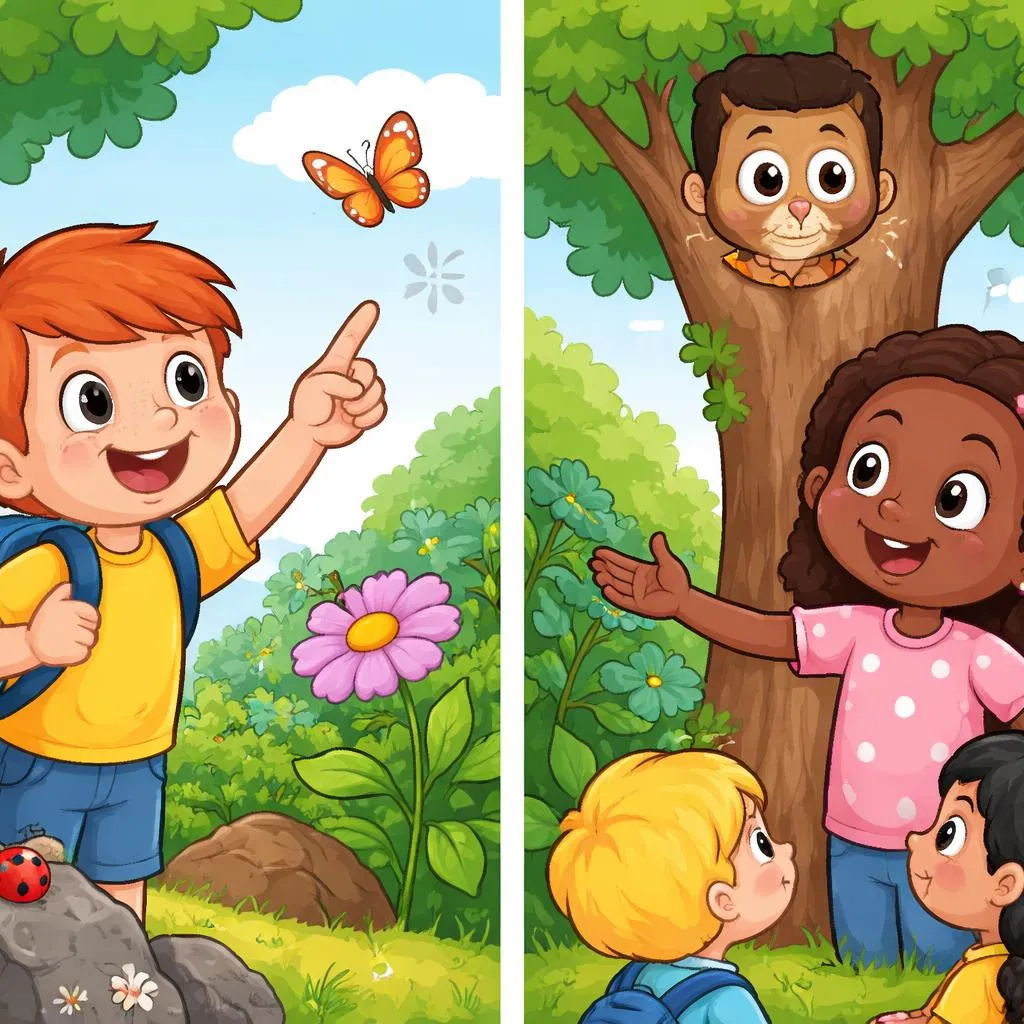

Hello, direction detective! Do you know how to show someone where something is? What do you do with your finger? Do you point at a bird in a tree? What does a sign on the street do? Does it indicate the way to the park? They both seem to be about showing direction. But are they the same? They are like two different kinds of arrows. One is like a direct laser beam from your finger. One is like a smart hint from a sign. Let's find out! Today, we explore the word friends "point" and "indicate". Knowing their secret is a superpower. It makes you a clear and smart guide. Let's begin our direction adventure!
First, let's be Direction Detectives. Listen at home. Here are two sentences. "I used my finger to point at the cookie jar on the high shelf." "The big red 'X' on the map is there to indicate our favorite picnic spot." They both involve showing where something is. Finding a cookie jar. Finding a spot. Do they sound the same? One feels like a simple, direct action with your body. One feels like a sign giving you quiet information. Can you sense it? Great observation! Now, let's look closer.
Adventure! Into the World of Showing the Way
Welcome to the world of physical gestures and smart signs! "Point" and "indicate" are two different ways to show something. Think of "point" as a direct, physical action. You use your finger or hand. It is a body move. Think of "indicate" as a way to show or give information, often indirectly. It is a clue. Both can show direction. But one is the "body arrow". One is the "information arrow". Let's learn about each one.
The Physical Action vs. The Information Clue Think about the word "point". "Point" feels direct, simple, and physical. It is something you do. You stretch out your finger or hand. You point at a picture. You point to the door. It is a clear, bodily gesture. Now, think about "indicate". "Indicate" feels more formal, smart, and hint-like. It means to show, suggest, or be a sign of something. A clock can indicate the time. A frown can indicate sadness. "Point" is like a laser pointer from your finger. "Indicate" is like a silent teacher giving a clue. One is an action you do. One is a hint you see.
A Direct Finger vs. A Smart Sign Let's compare their nature. "Point" is the physical act of directing attention. It is very direct. You point your finger at a specific thing. You can also point a telescope at the stars. "Indicate" is about giving information or evidence. It is more about facts and signs. A needle on a compass indicates north. Dark clouds can indicate rain. You point at the book you want. The title on the cover indicates what the story is about. "Point" is the action of the finger. "Indicate" is the action of the clue. One is a gesture. One is a sign.
Their Special Word Partners and Common Uses Words have best friends. "Point" loves words about body parts, direction, and directness. Point at something. Point your finger. Point the way. Point of view. Come to the point. "Indicate" loves words about information, signs, and evidence. Indicate a direction. Indicate a problem. As I indicate on the chart. Research indicates. Note: You can "point out" a mistake. You can "point to" an answer. A sign can "clearly indicate". A feeling can "indicate" happiness.
Let's visit a school scene. In art class, your friend asks, "Which blue paint did you use?" You lift your brush. You direct it toward the small pot of sky-blue paint. You point with your brush. This is a direct, physical action. Later, in science class, you are learning about thermometers. The teacher says, "The red line inside the tube rises. The number it reaches indicates the air temperature." The red line is not pointing. It is showing information. The word "point" fits the direct action with your brush. The word "indicate" fits the line giving information about temperature.
Now, let's go to the playground. You are looking for your friend's red hat. Your friend is across the field. You see the hat on a bench. You turn to your friend. You lift your arm and stretch out your finger toward the bench. You point right at the hat. This is a clear, physical gesture. Later, you see a sign at the park entrance. The sign has an arrow. The arrow shows which path leads to the duck pond. The arrow on the sign does not point like a finger. It shows information. The sign is there to indicate the way to the pond. The word "point" fits your direct finger gesture. The word "indicate" fits the sign giving directional information.
Our Little Discovery So, what did we find? "Point" and "indicate" are both about showing. But they do it in different ways. "Point" is a physical action. It means to direct your finger, hand, or an object toward something. It is a simple, direct gesture. "Indicate" is about showing information or being a sign of something. It is more about giving clues or facts. You point at a star in the sky. A flashing light can indicate a problem with a machine. Knowing this helps you understand gestures and information clearly.
Challenge! Become a Direction Word Champion
Ready for a nature test? Let's try your new skills!
"The Best Choice" Challenge Let's imagine a nature scene. A mother deer is in the forest with her fawn. The fawn hears a strange sound. It looks at its mother, unsure. The mother deer turns her head. She looks toward a thick bush. She lifts her head and directs her nose toward the bush. She seems to point her nose at the hiding place. This is a direct, bodily gesture showing a location. Now, look at some birds in the sky. They are flying south in a big 'V' shape. This action of flying south is not pointing. It is a sign of the changing season. Their migration indicates that winter is coming soon. "Point" wins for the deer's direct, physical gesture with her nose. "Indicate" is the word for the birds' behavior being a sign of a future event. "Point" is the direct show. "Indicate" is the informative clue.
"My Sentence Show" Your turn to create! Here is your scene: Helping someone find something in your classroom. Can you make two sentences? Use "point" in one. Use "indicate" in one. Try it! Here is an example: "When my friend asked for a pencil, I used my finger to point at the cup on the desk." This is a direct, physical action. "A small label on the cup is there to indicate that it holds our shared pencils." This is a sign giving information. Your sentences will show two different ways to show something!
"Eagle Eyes" Search Look at this sentence. Can you find the word that could be better? Let's check a home context. "The thermometer on the wall will point the current room temperature." Hmm. A thermometer does not use a finger or a physical gesture. It shows a number. That number is a sign that gives you information. A better word is "indicate". "The thermometer on the wall will indicate the current room temperature." Using "point" here is mixing up a physical action with giving information. "Indicate" is the champion for instruments that show facts. Did you spot it? Excellent word work!
Harvest and Action! Turn Knowledge Into Your Superpower
Great exploring! We started thinking "point" and "indicate" were similar. Now we know they are two different showing-heroes. "Point" is the direct, physical action of aiming your finger or an object. "Indicate" is the smart way of showing information or being a sign. You can now talk about gestures and clues with perfect accuracy. This is a great skill for a helper and a thinker.
What you can learn from this article: You can now see that to "point" is a direct physical action where you aim your finger, hand, or an object toward something to show where it is. You can now understand that to "indicate" is to show information, be a sign of something, or give a clue, like a sign, a needle on a dial, or evidence. You know that you point at a distant building, but a map's legend uses symbols to indicate what things are. You learned to match the word to the method: "point" for a direct, bodily gesture; "indicate" for giving information or a sign.
Life practice application: Try your new skill today! Be a direction expert. Watch how people show things. Do they point with their finger? Does a sign indicate the rules? Next time you are playing 'I Spy', notice the difference. Say, "I point to the blue car!" or "The dark clouds indicate that rain is coming." Tell a friend about a time you had to point at something far away. Describe a time a chart or gauge helped indicate something important. You are now a master of showing-words! Keep observing and sharing information clearly.