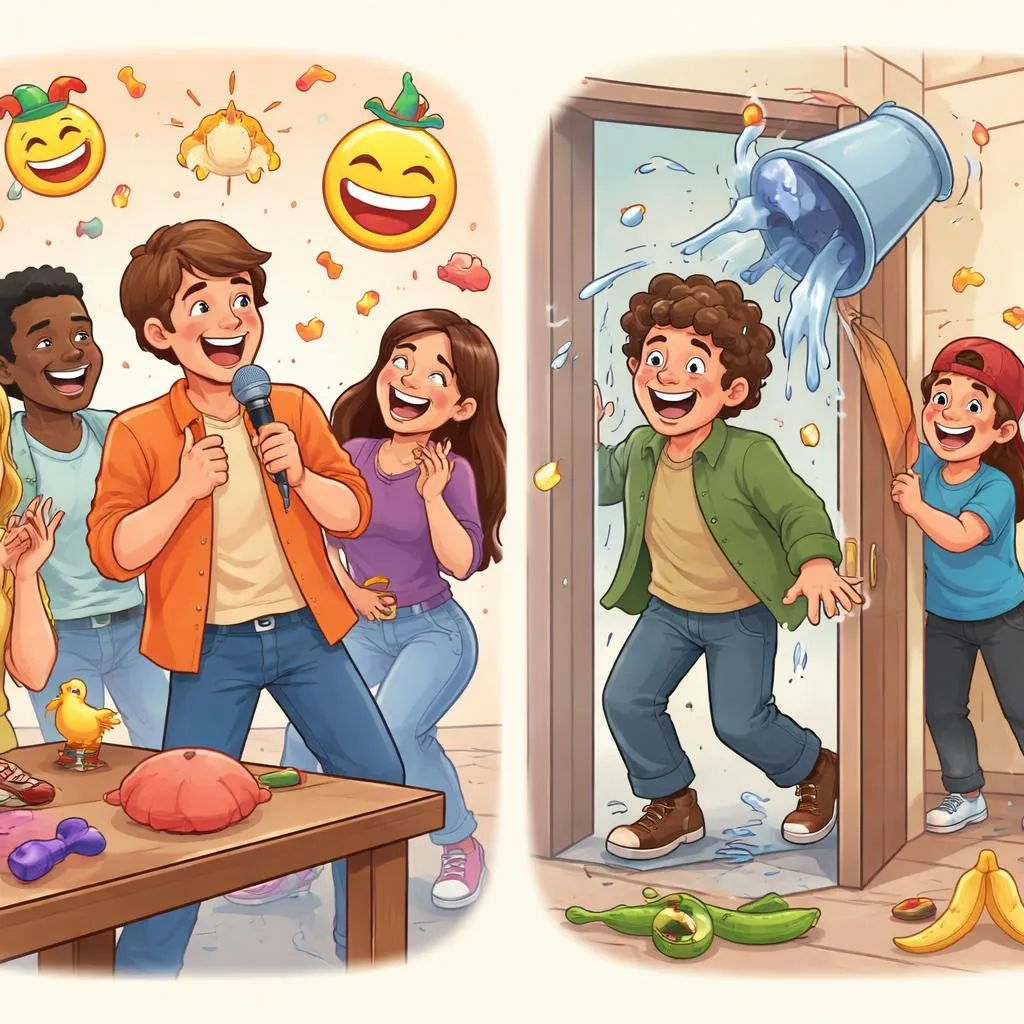

Hello, word explorer! Your friend tells a funny story. You laugh. That is a joke. Your friend hides your backpack. You jump. That is a prank. Both are meant to be fun. But are they the same kind of fun? They are two ways to have a laugh. One is like a sunny, warm laugh. One is like a fizzy, surprise bubble. Let's discover their secret! Today, we explore the playful word friends "joke" and "prank". Knowing the difference helps you be the fun expert. Let's begin.
First, let's be Language Listeners. Listen at home. Here are two sentences. "My dad told a silly joke at dinner." "My brother played a prank on me with a whoopee cushion." Both are about fun. Dinner time. A whoopee cushion. Do they sound the same? One is about words that make you laugh. One is about an action that surprises you. Can you sense the difference? Great listening! Now, let's look closer.
Adventure! Into the World of Fun and Laughs
Welcome to the world of fun! A "joke" and a "prank" are both for laughs. But they are different games. Think of a "joke" as a sunny, warm laugh. It is a short, funny story or question. It uses words to make you laugh. Think of a "prank" as a fizzy, surprise bubble. It is a playful trick or action. It surprises someone for fun. Both are "funny". But one is the "sunny laugh" of words. One is the "fizzy bubble" of action. Let's learn about each one.
Funny Words vs. Playful Action Think about the word "joke". A "joke" is about words. It is a short, funny story or question. You tell a joke. You hear a joke. The goal is to make people laugh with words. Now, think about "prank". A "prank" is about an action. It is a playful trick you do to someone. You play a prank. You plan a prank. The goal is to surprise someone for fun. A "joke" is the sunny laugh you share. A "prank" is the fizzy bubble you pop on someone. One is spoken fun. One is active fun.
Shared Laughter vs. Surprise Reaction Let's compare their feelings. A "joke" creates shared laughter. Everyone hears it and laughs together. It is a warm, happy feeling. That joke was hilarious! A "prank" creates a surprise reaction. One person is surprised, then (hopefully) laughs. It is a fizzy, excited feeling. His prank made me jump! The feeling is different. A good joke makes everyone happy. A good prank ends with everyone laughing, especially the surprised person. One builds connection. One creates a playful shock.
Their Special Word Partners and Common Uses Words have best friends. "Joke" often partners with telling and hearing. Tell a joke. Hear a joke. A funny joke. "Prank" often partners with playing and planning. Play a prank. Plan a prank. A harmless prank. Note: You "crack a joke". You "pull a prank". "Joke" is about the speech. "Prank" is about the activity.
Let's visit a school scene. Mia told a great joke during lunch. Everyone laughed. This is about a funny spoken story. Leo played a prank by putting a fake bug on the chair. The word "joke" fits the funny story told to the group. The word "prank" fits the action of placing a fake bug to surprise someone. One creates group laughter. One creates a single surprise.
Now, let's go to the playground. His joke about the monkey was so funny. This is about a spoken, funny idea. Their prank was to fill the bucket with confetti. The word "joke" fits the funny comment about the monkey. The word "prank" fits the planned action with the bucket and confetti. One is a comment. One is a planned trick.
Our Little Discovery So, what did we find? A "joke" and a "prank" are both for fun. But a "joke" is a funny story or question you say. Its goal is to make people laugh with words. A "prank" is a playful trick or action you do. Its goal is to surprise someone, hopefully leading to laughs. You tell a joke. You play a prank. A "joke" is the sunny, shared laugh. A "prank" is the fizzy, surprise bubble.
Challenge! Become a Fun Word Champion
Ready for a nature test? Let's try your new skills!
"The Best Choice" Challenge Let's imagine a nature scene. The parrot learned a funny joke from the zookeeper. This is about a funny phrase or sound the bird can say. The raccoon's prank was stealing shiny keys from the keeper's pocket. The word "joke" is the champion for the funny words or sounds the parrot says. The word "prank" is the best choice for the raccoon's mischievous action of stealing keys. One is about spoken humor. One is about a sneaky action.
"My Sentence Show" Your turn to create! Here is your scene: A friend's birthday. Can you make two sentences? Use "joke" in one. Use "prank" in one. Try it! Here is an example: "I told a birthday joke to make her smile." This is about using funny words. "We played a birthday prank by hiding her gift." This is about doing a playful trick. Your sentences will show funny words versus a playful action!
"Eagle Eyes" Search Look at this sentence. Can you find the word that could be better? Let's check a home context. "We played a funny joke on Dad by switching the salt and sugar." Hmm. Switching the salt and sugar is an action, a playful trick. The word for a playful trick or action is "prank", not "joke". You tell a joke with words. You play a prank with actions. A better sentence is: "We played a funny prank on Dad by switching the salt and sugar." Using "prank" correctly describes the trick action. "Joke" would be for something you said. Did you spot it? Super thinking!
Harvest and Action! Turn Knowledge Into Your Superpower
Great exploring! We started thinking a "joke" and a "prank" were similar. Now we know they are different kinds of fun. A "joke" is a funny story or question you tell to make people laugh. It is all about the words. A "prank" is a playful trick or action you do to surprise someone. It is all about the activity. You can now talk about fun times with perfect clarity.
What you can learn from this article: You can now see that a "joke" is something you say. It is a short, funny story or a question with a punchline. You tell a joke to make people laugh with your words. You can now understand that a "prank" is something you do. It is a playful trick or surprise action you plan for someone. You play a prank to create a fun surprise. You know that a comedian tells a joke. A friend might play a prank on April Fools' Day. You learned to match the word to the fun: "joke" for funny words; "prank" for playful actions.
Life practice application: Try your new skill today! Be a fun detective. Listen for jokes—they are the funny things people say. Watch for pranks—they are the playful tricks people do. Remember, the best jokes and pranks make everyone laugh, including the person surprised! Use "joke" when you hear or tell something funny. Use "prank" when you see or plan a playful trick. Your way of describing fun will be perfectly clear