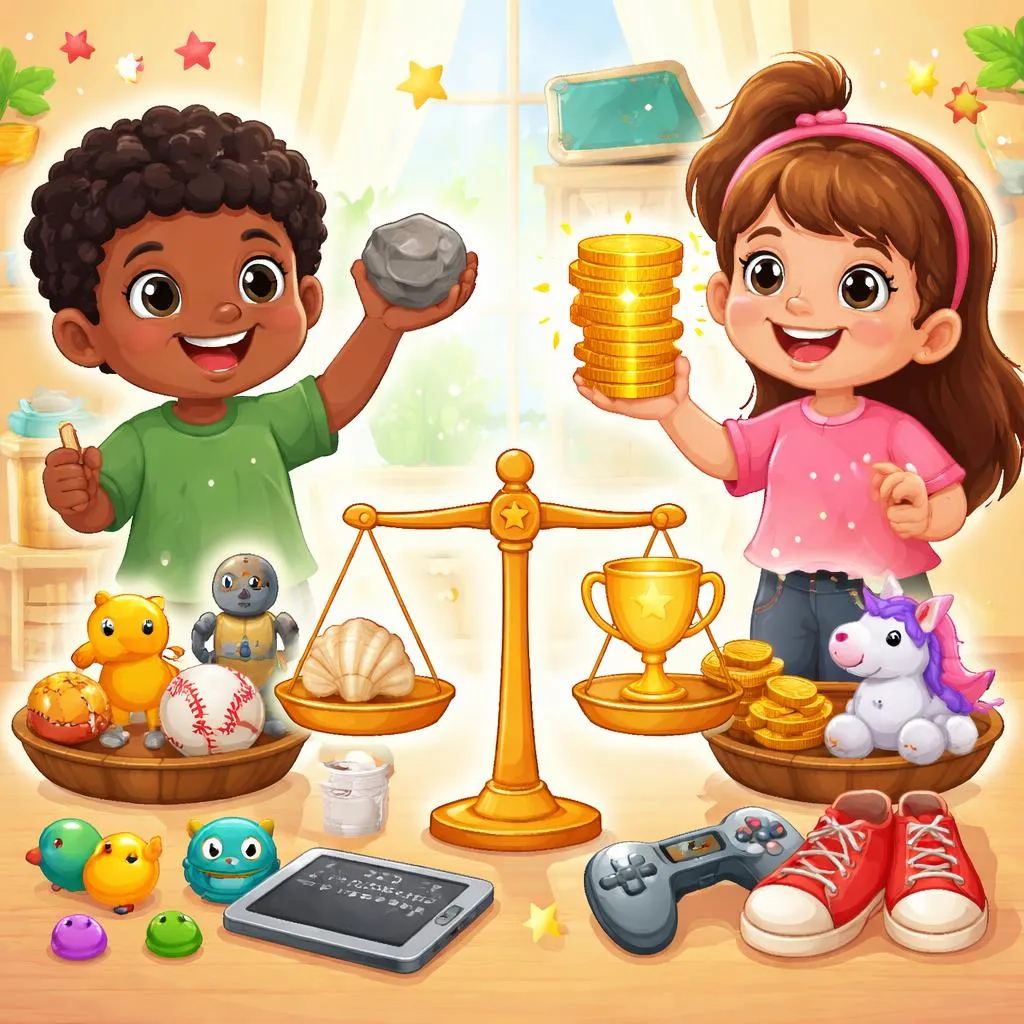

Hello, word explorer! Have you ever thought about what things mean? Is the value of a toy in its fun? Is the worth of a gold coin in its weight? They both seem to be about importance. But are they the same? They are like two different ways to measure treasure. One is like a measuring cup for usefulness. One is like a scale for weight. Let's find out! Today, we explore the word friends "value" and "worth". Knowing their secret is a superpower. It makes you a judge of importance. Let's begin our treasure hunt adventure!
First, let's be Importance Detectives. Listen at home. Here are two sentences. "My grandma's old necklace has great sentimental value to our family." "The worth of this rare coin is over one hundred dollars." They both involve importance. A necklace. A coin. Do they sound the same? One feels like a personal, emotional measure. One feels like a fixed, money measure. Can you sense it? Great observation! Now, let's look closer.
Adventure! Into the World of Importance
Welcome to the world of measuring meaning! "Value" and "worth" are about importance. But they are not the same. Think of "value" as the measuring cup. It measures how useful or good something is. Think of "worth" as the scale. It measures the weight in money or quality. Both measure importance. But one is the "usefulness measure". One is the "weight measure". Let's learn about each one.
The Usefulness Measure vs. The Weight Measure Think about the word "value". "Value" feels flexible and personal. It is about usefulness, importance, or goodness. A book can have great value for learning. You can value your friend's advice. It can be a feeling you have. Now, think about "worth". "Worth" feels more fixed and factual. It is often a specific amount. The car is worth ten thousand dollars. Is it worth the trouble? "Value" is like a measuring cup for how much you like or need something. "Worth" is like a scale telling you the exact weight. One is about benefit. One is about an amount.
A Flexible Feeling vs. A Fixed Fact Let's compare their nature. "Value" can change. It can be a verb or a noun. You can value honesty. The value of practice is clear. It is about the good something gives. "Worth" is often a fixed state or price. It is usually a noun. Know your worth. The house's worth is high. It states a fact. A toy's value is in the fun it gives. A toy's worth might be twenty dollars. "Value" is the benefit you get. "Worth" is the price tag it has. One is about quality. One is about quantity.
Their Special Word Partners and Common Uses Words have best friends. "Value" loves words about usefulness, ideals, and personal feelings. Good value. Value for money. Family values. Value your time. "Worth" loves words about money, effort, and fixed amounts. Net worth. Worth it. Worth your while. Of great worth. Note: You can "add value". You can be "worthwhile". Something has "value". Something is "worth" a certain amount.
Let's visit a school scene. Your teacher talks about recycling. She says, "Recycling has great value for our planet." This is about the usefulness and importance of the action. Later, in math, you have a word problem. It says, "If a bike is worth 50, and you have 30, how much more do you need?" The word "value" fits the importance of recycling. The word "worth" fits the fixed dollar amount of the bike. One is about a big idea. One is about a math fact.
Now, let's go to the playground. You find a smooth, special rock. It is not a toy. It is not for sale. But you love it. You say, "This rock has value to me. It is my lucky rock." This is about your personal feeling. Later, you see a shiny, new video game console in a store window. It has a big price tag. Your friend says, "It is worth five hundred dollars!" The word "value" fits your personal feeling about the rock. The word "worth" fits the fixed price of the console. One is in your heart. One is on the tag.
Our Little Discovery So, what did we find? "Value" and "worth" are about importance. But they are used differently. "Value" is about the usefulness, importance, or goodness of something. It can be personal and can change. "Worth" is about the equivalent of something in money, quality, or effort. It is often a fixed fact. A teacher's advice has great value. A gold ring has a high worth. Knowing this helps you talk about feelings and facts.
Challenge! Become an Importance Word Champion
Ready for a nature test? Let's try your new skills!
"The Best Choice" Challenge Let's imagine a nature scene. A single bee is tiny. It seems small. But a bee's work is huge. It pollinates flowers. It helps make food. The value of one bee to the environment is very high. This is about its usefulness and importance. Now, think about a lump of gold in the ground. It is shiny and heavy. People want it. The worth of that gold is set by its weight and purity. "Value" wins for the bee's importance to nature. "Worth" is the word for the gold's fixed money amount. "Value" is the bee's role. "Worth" is the gold's price.
"My Sentence Show" Your turn to create! Here is your scene: Finding an old, handmade blanket in your attic. Can you make two sentences? Use "value" in one. Use "worth" in one. Try it! Here is an example: "This blanket has great sentimental value because my great-grandmother made it." This is about the personal importance and memory. "A shop might say its worth is not high in money, but to me it is priceless." This contrasts a low money amount with high personal importance. Your sentences will show feeling versus fact!
"Eagle Eyes" Search Look at this sentence. Can you find the word that could be better? Let's check a home context. "The worth of reading books every day is huge for your brain." Hmm. This sentence is about the usefulness and importance of an activity. The word "value" is a better fit for talking about the benefit of something. The word "worth" is more about a fixed amount. A better sentence is: "The value of reading books every day is huge for your brain." Using "worth" here is not wrong, but "value" is the champion for describing the benefit. Did you spot it? Excellent word work!
Harvest and Action! Turn Knowledge Into Your Superpower
Great exploring! We started thinking "value" and "worth" were similar. Now we know they are two different importance heroes. "Value" is the word for the usefulness, importance, or goodness of something. "Worth" is the word for the fixed amount, in money or quality, that something has. You can now talk about feelings and facts with perfect accuracy. This is a great skill for a wise thinker.
What you can learn from this article: You can now see that "value" is about the importance, usefulness, or goodness of something, which can be personal and change, like the value of a friend or the value of a good habit. You can now understand that "worth" is about the fixed amount of money, quality, or effort something is equal to, like the worth of a car or knowing your own worth. You know that a handwritten card from a friend has great value, but its worth in money is very low. You learned to match the word to the idea: "value" for usefulness and personal importance; "worth" for a fixed amount or equivalent.
Life practice application: Try your new skill today! Be an importance word expert. Look at things around you. What has value to you? What is its worth in money? Next time you get a gift, think about its value to you. Ask a parent about the worth of a family heirloom. Tell a friend about the value of being kind. Describe the worth of your favorite toy. You are now a master of importance words! Keep noticing what is useful and what has a fixed measure.