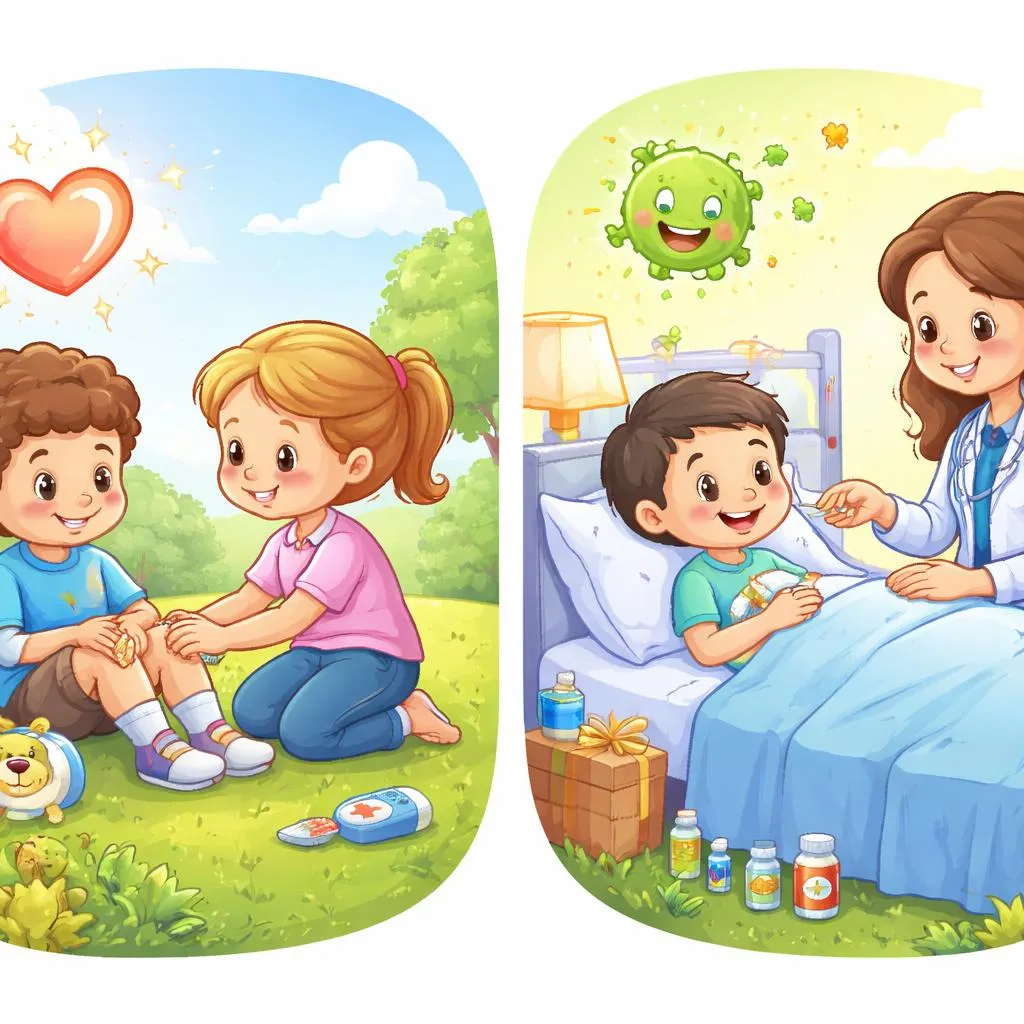

Hello, word explorer! Have you ever had a scraped knee? Did it slowly get better? Did it heal? Have you ever had a bad cold? Did medicine help you? Did it cure your cold? They both seem to be about getting better. But are they the same? They are like two different kinds of fix-it magic. One is like your body's own slow, steady repair work. One is like a quick, powerful solution from outside. Let's find out! Today, we explore the word friends "heal" and "cure". Knowing their secret is a superpower. It makes you a health word expert. Let's begin our recovery adventure!
First, let's be Health Detectives. Listen at home. Here are two sentences. "My small paper cut will heal in a couple of days." "This medicine can cure your headache quickly." They both involve getting better. A small cut. A headache. Do they sound the same? One feels slow and natural. One feels quick and active. Can you sense it? Great observation! Now, let's look closer.
Adventure! Into the World of Getting Better
Welcome to the world of recovery! "Heal" and "cure" are about making things better. But they are not the same. Think of "heal" as the natural, slower process. Your body does the work. Think of "cure" as the active, complete solution. Something fixes the problem. Both are about improvement. But one is the "body's magic". One is the "doctor's fix". Let's learn about each one.
The Natural Process vs. The Active Solution Think about the word "heal". "Heal" feels natural, slow, and internal. It is what your body does. A wound will heal. A broken bone will heal. It takes time. Feelings can also heal. Now, think about "cure". "Cure" feels active, complete, and external. It is what a treatment does. A doctor finds a cure for a disease. Medicine can cure an infection. "Heal" is like a plant growing back a leaf slowly. "Cure" is like a gardener fixing the plant with special food. One is a process. One is a solution.
A Slow Process vs. A Complete End Let's compare their nature. "Heal" is often slow. It describes the process of getting better. Her sadness will heal with time. Your scrape is starting to heal. "Cure" aims to end the problem completely. Scientists work to cure serious illnesses. A good night's sleep can cure your tiredness. Your body works to heal a bruise. A doctor can help cure an ear infection. "Heal" focuses on the journey to health. "Cure" focuses on the end of the sickness. One is the road. One is the destination.
Their Special Word Partners and Common Uses Words have best friends. "Heal" loves words about the body, time, and nature. Heal completely. Heal slowly. The wound will heal. Time to heal. "Cure" loves words about medicine, diseases, and solutions. Find a cure. Cure a disease. A miracle cure. Cure someone. Note: You can say "a healing process". You can say "a cure for cancer". Cuts heal. Doctors try to cure.
Let's visit a school scene. In science class, you learn about the human body. You see a video. It shows how a small cut on the skin slowly closes up. New skin grows. The narrator says, "The body works to heal the cut." This is a natural, slow process. Later, a nurse visits your class. She talks about vaccines. She says, "Vaccines help prevent diseases. Some can even help cure people." The word "heal" fits the body's own repair work. The word "cure" fits the medicine's job to end sickness.
Now, let's go to a playground. You fall off your bike. You get a bad scrape on your knee. Your friend says, "Put a bandage on it. It will help it heal faster." The bandage helps, but your body does the real work. Later, imagine you have a splinter in your finger. It hurts. Your parent uses tweezers. They take the splinter out completely. Now the problem is gone! The tweezers helped cure the problem. The word "heal" fits the scrape's natural recovery. The word "cure" fits the act of removing the splinter to end the pain.
Our Little Discovery So, what did we find? "Heal" and "cure" are about becoming healthy again. But they are different. "Heal" usually means to become healthy again, especially by natural processes over time. Your body does it. A cut heals. "Cure" usually means to make someone healthy again by ending a disease or problem. Medicine or a treatment does it. A doctor cures an illness. Knowing this helps you talk about natural recovery and medical solutions.
Challenge! Become a Recovery Word Champion
Ready for a nature test? Let's try your new skills!
"The Best Choice" Challenge Let's imagine a nature scene. A young deer gets a small cut on its leg from a thorn. The deer keeps living in the forest. Over the next few weeks, the cut slowly gets smaller. New skin grows. Finally, only a small scar remains. The deer's cut took time to heal. Now, imagine a different scene. A group of monkeys eats some bad berries. They get very sick. A wildlife veterinarian comes. She gives them special medicine. The medicine fights the sickness in their bodies. Soon, all the monkeys are healthy again. The medicine helped cure the monkeys. "Heal" wins for the deer's slow, natural skin repair. "Cure" is the word for the medicine that ended the monkeys' sickness. "Heal" is the body's work. "Cure" is the medicine's job.
"My Sentence Show" Your turn to create! Here is your scene: Getting better from a common cold. Can you make two sentences? Use "heal" in one. Use "cure" in one. Try it! Here is an example: "Rest and sleep help your body heal when you have a cold." This is about your body's natural recovery process. "There is no single magic pill that can cure a common cold, but medicine helps the symptoms." This is about an external solution ending the illness. Your sentences will show caring for your body and finding solutions!
"Eagle Eyes" Search Look at this sentence. Can you find the word that could be better? Let's check a home context. "My grandma put a special cream on her sore back. She hopes it will cure the pain." Hmm. Cream can help with pain. But a sore muscle or back often needs time. The body must do the repairing. The word "heal" is a better fit for this natural process. "My grandma put a special cream on her sore back. She hopes it will help it heal." Using "cure" here suggests the cream is a complete, instant solution. "Heal" is the champion for the body's slower recovery journey. Did you spot it? Excellent word work!
Harvest and Action! Turn Knowledge Into Your Superpower
Great exploring! We started thinking "heal" and "cure" were similar. Now we know they are two different recovery heroes. "Heal" is the word for your body's own natural repair work over time. "Cure" is the word for a treatment that ends a sickness or problem. You can now talk about getting better with perfect accuracy. This is a great skill for a future scientist or a caring friend.
What you can learn from this article: You can now see that to "heal" usually means to become healthy or whole again, which is often a natural, slower process that your own body does, like a cut closing up or a heart feeling better with time. You can now understand that to "cure" usually means to make someone healthy again by removing a disease or solving a problem, which is often something a treatment, medicine, or doctor does. You know that a small scratch will heal on its own, but a doctor might give you medicine to cure an ear infection. You learned to match the word to the process: "heal" for the body's natural recovery; "cure" for an external solution that ends an illness.
Life practice application: Try your new skill today! Be a recovery word expert. Watch how you get better next time. Do you have a scrape that starts to heal? Does medicine help cure your cough? Next time you read a book, notice the words. Say, "The superhero's power lets him heal very fast." or "The story is about finding a cure for a disease." Tell a family member about a time you watched something heal. You are now a master of getting-better words! Keep noticing the amazing ways bodies and medicines work.