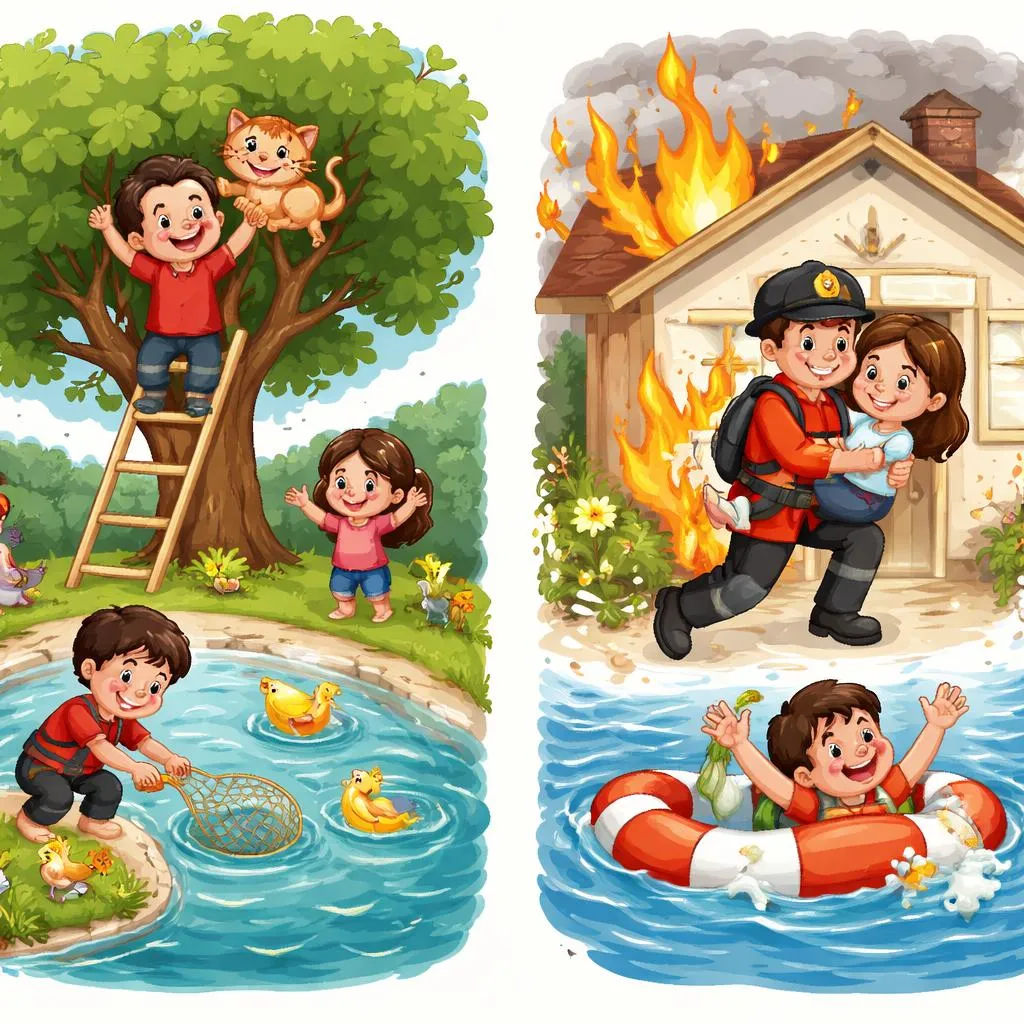

Hello, word explorer! Have you ever been a helper? Did you save your money for a new toy? Did you help rescue a cat stuck in a tree? They both seem to be about helping. But are they the same? They are like two different kinds of heroes. One is like a careful planner. One is like an emergency hero. Let's find out! Today, we explore the word friends "save" and "rescue". Knowing their secret is a superpower. It makes you a master helper. Let's begin our hero adventure!
First, let's be Help Detectives. Listen at home. Here are two sentences. "I want to save my allowance to buy a game." "Firefighters worked hard to rescue the people from the fire." They both involve helping. Money for a game. People from a fire. Do they sound the same? One feels like planning for later. One feels like urgent action now. Can you sense it? Great observation! Now, let's look closer.
Adventure! Into the World of Helping
Welcome to the world of heroes! "Save" and "rescue" are about helping. But they are not the same. Think of "save" as the planner hero. It is about keeping something for the future or preventing loss. Think of "rescue" as the emergency hero. It is about saving someone from immediate, dangerous trouble. Both are about helping. But one is the "planner". One is the "emergency hero". Let's learn about each one.
Planning for Later vs. Acting Right Now Think about the word "save". "Save" feels thoughtful and planned. It is often for the future. You save time. You save a seat. You save a file on a computer. It is about keeping safe from loss. Now, think about "rescue". "Rescue" feels urgent and exciting. It is for immediate danger. Lifeguards rescue swimmers. Heroes rescue people from danger. "Save" is like putting coins in a piggy bank. "Rescue" is like a superhero flying to the scene. One is a careful action. One is an urgent mission.
A Wide Net vs. A Specific Danger Let's compare their scope. "Save" is a very wide word. It has many uses. You can save energy. You can save a document. You can save someone's life. "Rescue" is more specific. It is almost always for people or animals in immediate, physical danger. The team launched a rescue mission. We must rescue the stranded hikers. You save water by turning off the tap. A boat goes to rescue the shipwreck survivors. "Save" can be for things, ideas, or people. "Rescue" is for living things in trouble. One is a wide net. One is a lifeline.
Their Special Word Partners and Common Uses Words have best friends. "Save" loves words about resources, the future, and prevention. Save money. Save time. Save the day. Save your work. "Rescue" loves words about danger, missions, and urgent help. Rescue mission. Rescue team. Rescue someone. Mount a rescue. Note: You "save up" for something. You can be a "lifesaver". A "rescue" is also a noun for the operation. The rescue was a success.
Let's visit a school scene. Your teacher says, "Remember to save your computer work often." This means to keep it safe for later. It is a planned, smart habit. Later, the school has a safety drill. The teacher says, "In a real earthquake, emergency crews would come to rescue anyone trapped." The word "save" fits the action of keeping your digital work. The word "rescue" fits the action of helping people in a real, dangerous situation. One is for data. One is for lives.
Now, let's go to the playground. You are playing a game. You have a special power-up. You decide not to use it now. You say, "I will save this for the final level!" This is planning for future need. Later, imagine your friend's ball goes over the fence. It lands in a muddy pond. Your friend cannot reach it. You find a long stick. You use it to get the ball. You rescue the ball from the muddy water! The word "save" fits your plan for the power-up. The word "rescue" fits the act of getting the ball out of immediate trouble. One is strategy. One is recovery.
Our Little Discovery So, what did we find? "Save" and "rescue" are about helping and keeping safe. But they are used in different ways. "Save" is the general word for keeping something from being lost, wasted, or harmed. It is often for the future. "Rescue" is the specific, exciting word for saving someone or something from a dangerous or difficult situation. It is an urgent action now. You save your money. A lifeguard will rescue a drowning person. Knowing this helps you talk about smart planning and emergency action.
Challenge! Become a Helper Word Champion
Ready for a nature test? Let's try your new skills!
"The Best Choice" Challenge Let's imagine a nature scene. A squirrel finds many nuts in autumn. It does not eat them all. It buries some nuts in the ground. The squirrel is planning for winter. It works hard to save food for the cold months. This is a smart plan for the future. Now, imagine a different scene. A little bird falls from its nest. It is too young to fly. A kind person finds it. The person carefully picks up the bird. They rescue the bird and take it to a safe place. "Save" wins for the squirrel's future planning. "Rescue" is the word for the immediate act of saving the bird from danger. "Save" is for later. "Rescue" is for now.
"My Sentence Show" Your turn to create! Here is your scene: Watching or reading a story about ocean adventures. Can you make two sentences? Use "save" in one. Use "rescue" in one. Try it! Here is an example: "The pirate wanted to save his treasure map from getting wet." This is about keeping the map safe for later use. "The coast guard had to rescue the sailors from the sinking ship." This is an urgent mission to save lives from immediate danger. Your sentences will show the difference between keeping safe and emergency help!
"Eagle Eyes" Search Look at this sentence. Can you find the word that could be better? Let's check a home context. "I had to make a daring rescue of my homework from my puppy's mouth!" Hmm. Getting homework from a puppy is a bit urgent. But it is not a real, dangerous emergency mission. The word "save" is a better, more common choice. "I had to save my homework from my puppy's mouth!" Using "rescue" here sounds very dramatic, like a life-or-death scene. "Save" is the champion for this everyday problem. Did you spot it? Excellent word work!
Harvest and Action! Turn Knowledge Into Your Superpower
Great exploring! We started thinking "save" and "rescue" were similar. Now we know they are two different helper heroes. "Save" is the smart planner word for keeping things safe for later. "Rescue" is the urgent hero word for saving from immediate danger. You can now talk about helping in all its forms with perfect accuracy. This is a great skill for a thoughtful and brave storyteller.
What you can learn from this article: You can now see that to "save" is the general word for keeping someone or something safe from harm, loss, or danger, and it often involves planning for the future, like saving money or saving time. You can now understand that to "rescue" is a more specific and exciting word that means to save someone or something from a dangerous or difficult situation, and it feels urgent, like a lifeguard rescuing a swimmer. You know that you can save a game on your computer, but a firefighter might rescue a cat from a tree. You learned to match the word to the situation: "save" for planning and preventing loss; "rescue" for urgent, dramatic help from danger.
Life practice application: Try your new skill today! Be a helper word expert. Listen to how people use these words. Do they talk about needing to save energy? Do news reports talk about a mountain rescue? Next time you read a book, notice the words. Say, "The character wanted to save the kingdom from the evil spell." or "The dolphins worked together to rescue their friend from the net." Tell a friend about a time you helped save something. Describe a rescue you saw in a movie. You are now a master of helper words! Keep noticing the planners and the heroes all around you.