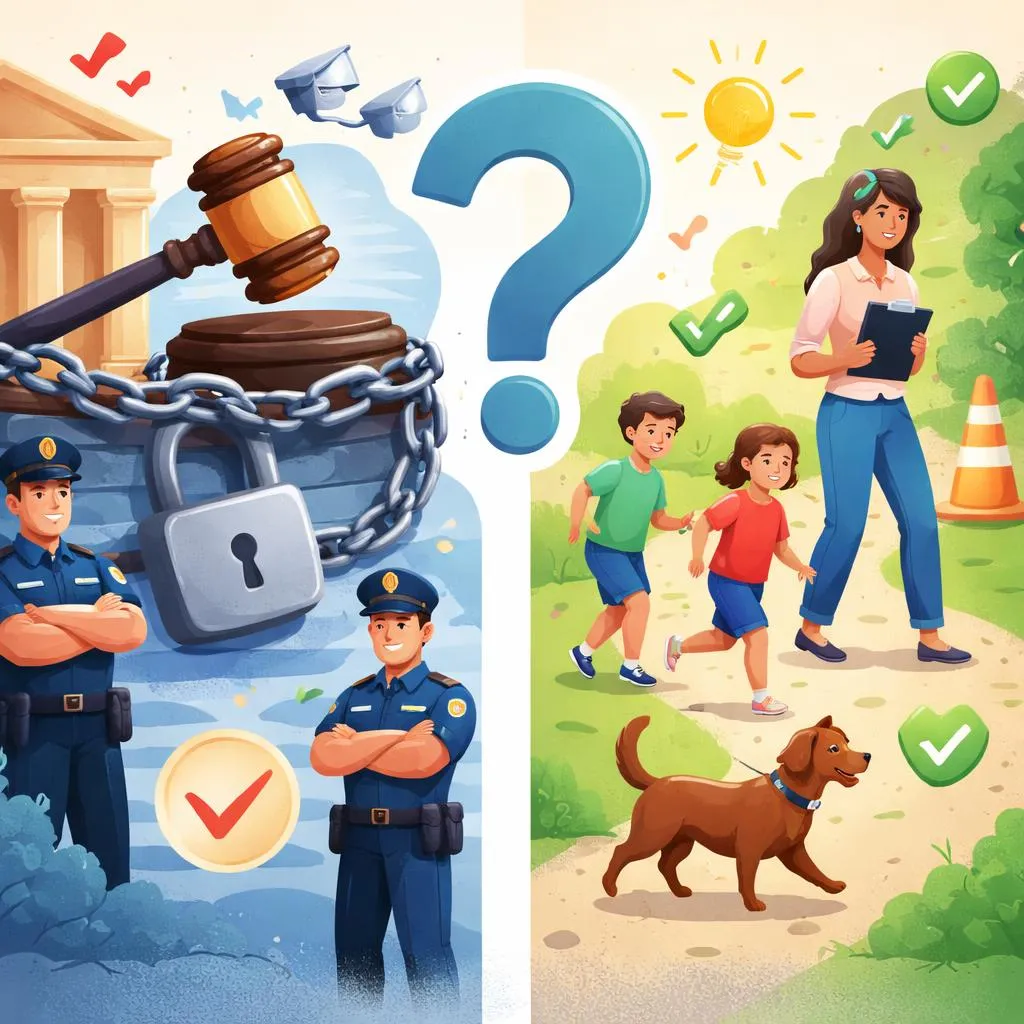

Hello, word explorer! Your school has a rule about running. Your country has a law about driving. Both tell you what to do. But are they the same? They are two types of guides. One is like a giant, ancient tree. One is like a helpful sign on the path. Let's discover their secret! Today, we explore the guiding word pair "law" and "rule". Knowing the difference helps you understand your world. Let's begin.
First, let's be Language Listeners. Listen at home. Here are two sentences. "There is a law against stealing." "Our family has a rule about screen time." Both talk about what you should do. Stealing. Screen time. Do they sound the same? One sounds very big and official. One sounds smaller and more personal. Can you sense the difference? Great listening! Now, let's look closer.
Adventure! Into the World of Guides
Welcome to a world of order. A "law" and a "rule" both guide us. But their power and place are different. Think of a "law" as a giant, ancient tree. It is deep, strong, and for everyone. It forms the forest of society. Think of a "rule" as a helpful sign on a path. It is specific, clear, and for a certain place. It shows the way for a game or group. Both are "guides". But one is the "giant tree" for a whole country. One is the "helpful sign" for a smaller place. Let's learn about each one.
For Everyone vs. For a Group Think about the word "law". A "law" is a system. It is for all people in a country or city. You must follow the law. It is created by governments. Now, think about "rule". A "rule" is a guide for a smaller group. Your school has rules. A game has rules. The feeling is more local. A "law" is the giant tree for the whole forest. A "rule" is the sign for the park path. One binds everyone. One guides a team.
Very Strong vs. More Flexible Let's compare their strength. A "law" is very strong and serious. Breaking a law can have big consequences. The feeling is formal and powerful. A "rule" can be strong too. But it is often more flexible. Breaking a rule might mean a warning. The feeling can be lighter. You must obey the law. You should follow the rules. One is like the trunk of the tree. One is like a branch you can sometimes bend.
Their Special Word Partners and Common Uses Words have best friends. "Law" often partners with big, official words. The law. Break the law. Law and order. "Rule" often partners with groups and activities. School rule. Game rule. Follow the rules. Note: You have "lawmakers". You have "rulebooks". "Law" is for society. "Rule" is for systems.
Let's visit a school scene. Our country has a law that all kids must go to school. This is a big, official rule for everyone. Our classroom has a rule about raising your hand. The word "law" fits the official, national requirement for education. The word "rule" fits the specific guideline for our classroom. One is from the government. One is from the teacher.
Now, let's go to the playground. The city has a law for park safety. This is an official rule for the public park. Our kickball game has a new rule today. The word "law" fits the official city regulation. The word "rule" fits the agreement for our fun game. One is official for all. One is just for our play.
Our Little Discovery So, what did we find? A "law" and a "rule" both tell us how to act. But a "law" is a very strong, official rule made by a government. It is for everyone in a place. A "rule" is a guide for how to act in a smaller group or activity. It is for a specific place or game. Speeding is against the law. Talking in the library is against the rules. A "law" is the giant, ancient tree. A "rule" is the helpful sign.
Challenge! Become a Guide Word Champion
Ready for a nature test? Let's try your new skills!
"The Best Choice" Challenge Let's imagine a nature scene. A bee hive follows the natural laws of biology. This is about the big, unchanging principles of nature. The hive also has rules about which bees collect pollen. The word "law" is the champion for the fundamental, scientific principles all bees follow. The word "rule" is the best choice for the specific, group behaviors of that hive. One is a universal fact. One is a group's custom.
"My Sentence Show" Your turn to create! Here is your scene: A soccer match. Can you make two sentences? Use "law" in one. Use "rule" in one. Try it! Here is an example: "Players must follow the laws of the game set by the international group." This is about the official, overarching laws of soccer. "Our team made a new rule about passing three times before shooting." This is about our team's specific agreement. Your sentences will show official laws versus team rules!
"Eagle Eyes" Search Look at this sentence. Can you find the word that could be better? Let's check a home context. "My mom's most important kitchen law is to wash your hands." Hmm. A mom's kitchen guideline is a family guideline, not an official government law. The word for a family's specific guide is "rule", not "law". "Law" is much too big and official here. A better sentence is: "My mom's most important kitchen rule is to wash your hands." Using "rule" correctly describes a family's specific guideline. "Law" would be for something like a health code for all restaurants. Did you spot it? Super thinking!
Harvest and Action! Turn Knowledge Into Your Superpower
Great exploring! We started thinking "law" and "rule" were similar guides. Now we know they are different in scope. A "law" is a formal, official rule made by a government. It applies to everyone in a country, state, or city. A "rule" is a statement that tells you what is allowed or expected in a specific situation, like a game, school, or family. You can now talk about society and groups with perfect clarity.
What you can learn from this article: You can now see that a "law" is a very important, official rule made by the government for a whole country or city. Everyone who lives there must follow it. You can now understand that a "rule" is a guide for how to behave in a specific place or activity, like your classroom, a sport, or your home. You know that not stealing is a law. No running in the hall is a school rule. You learned to match the word to the scope: "law" for big, official, society-wide guides; "rule" for specific, group, or activity guides.
Life practice application: Try your new skill today! Be a guide detective. Look around you. Listen for laws—they are the big rules for everyone you hear on the news. Notice the rules—they are the guides for your classroom, your home, and your games. Remember, laws are like the trunk of the tree, rules are the helpful signs on your path. Use "law" when talking about government rules for all people. Use "rule" when talking about guides for your team, class, or family. Your way of understanding the world will be much clearer!