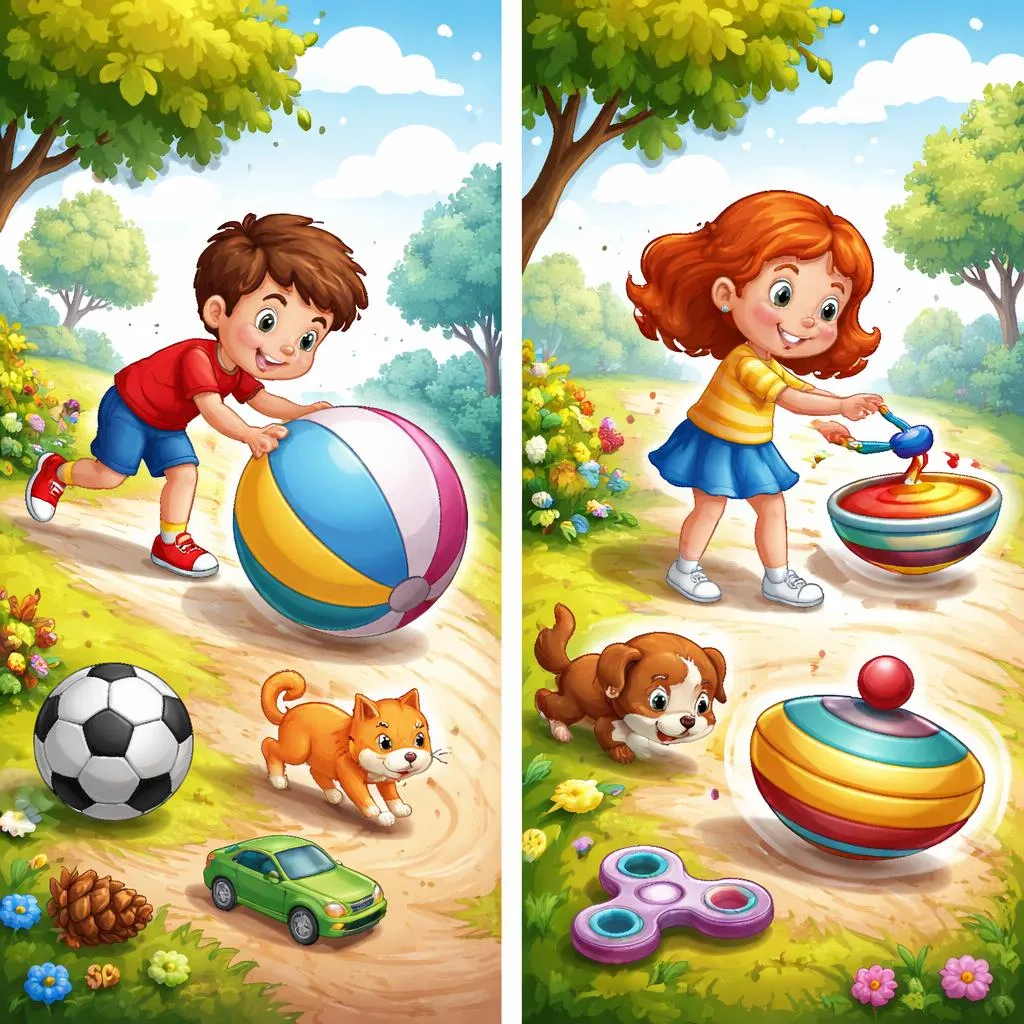

Hello, movement master! Have you ever watched things move? Does a ball roll across the grass? Does a toy top spin on the floor? They both involve turning around. But are they the same? They are like two different types of circles. One is like moving forward in a circle. One is like turning fast in one spot. Let's find out! Today, we explore the word friends "roll" and "spin". Knowing their secret is a superpower. It makes you a science and play expert. Let's begin our turning adventure!
First, let's be Motion Detectives. Listen at home. Here are two sentences. "My toy car fell off the table and started to roll across the floor." "I can make a coin spin on its edge before it falls over." They both involve circular motion. A toy car. A coin. Do they sound the same? One feels like moving forward while turning. One feels like turning fast in one place. Can you sense it? Great observation! Now, let's look closer.
Adventure! Into the World of Turning Motion
Welcome to the world of circles! "Roll" and "spin" are two different ways to turn. Think of "roll" as moving forward (or backward) by turning over and over. It changes location. Think of "spin" as turning quickly around a center point. It often stays in one spot. Both involve rotation. But one is the "traveling turn". One is the "stationary whirl". Let's learn about each one.
The Traveling Turn vs. The Stationary Whirl Think about the word "roll". "Roll" feels like a journey. An object turns over and over as it moves from point A to point B. A ball can roll down a hill. A log can roll. You can roll a piece of clay. The movement has direction. Now, think about "spin". "Spin" feels like a fast, dizzy turn in place. An object rotates around its own center. A ceiling fan spins. A dancer can spin. A planet spins. "Roll" is like a wheel moving a car forward. "Spin" is like a merry-go-round turning in a circle. One moves you somewhere. One makes you dizzy where you stand.
Moving Circles vs. Stationary Circles Let's compare their path. "Roll" means an object is turning and changing its location. The object moves across a surface. A marble can roll under the couch. You can roll a tire. "Spin" means an object is turning around its own center, often staying in one spot. A figure skater spins on the ice. A washing machine spins the clothes. You roll a ball to your friend. You spin a fidget toy on your desk. "Roll" is the moving action. "Spin" is the stationary action. One travels. One stays and turns.
Their Special Word Partners and Common Uses Words have best friends. "Roll" loves words about forward movement and objects. Roll a ball. Roll down a hill. Roll over. Roll out dough. "Spin" loves words about speed, dizziness, and fixed points. Spin around. Spin a top. Spin a tale. Spin cycle. Note: You can "roll up" a rug. You can "spin a web". A wheel can "roll along". A record can "spin on" a turntable.
Let's visit a school scene. In science class, you learn about forces. Your teacher has a ramp and two objects: a ball and a top. She lets the ball go. It moves down the ramp. She says, "Watch the ball roll to the end." This shows turning while moving forward. Next, she sets the top on the table. She flicks it. It turns rapidly in one spot. She says, "Now, watch the top spin." The word "roll" fits the ball's journey. The word "spin" fits the top's stationary whirl.
Now, let's go to the playground. You are playing soccer. You kick the ball to your friend. The ball moves across the grass. It is turning as it goes. The ball will roll to a stop. This is turning while moving forward. Later, you go on the merry-go-round. You push it and jump on. The platform turns around the center pole. You all scream as you spin around and around. The word "roll" fits the soccer ball's travel. The word "spin" fits the merry-go-round's fixed rotation.
Our Little Discovery So, what did we find? "Roll" and "spin" are both about turning. But they are different. "Roll" means to move along a surface by turning over and over. The object changes its place. A wheel rolls on the road. "Spin" means to turn or whirl around a central point very quickly. The object often stays in the same spot. A planet spins in space. You roll a dice across the board. You spin the dial on a game. Knowing this helps you describe motion with perfect accuracy.
Challenge! Become a Motion Word Champion
Ready for a nature test? Let's try your new skills!
"The Best Choice" Challenge Let's imagine a nature scene. A pine cone falls from a tall tree. It lands on a steep, grassy hill. It doesn't just fall straight down. It starts turning over and over. It moves all the way down the slope. The pine cone begins to roll down the hill. This is turning while moving forward. Now, watch a maple seed pod fall from a tree. It has a little wing. As it falls, it doesn't just drop. It turns around and around in a circle as it floats down through the air. The seed pod seems to spin like a little helicopter as it falls. "Roll" wins for the pine cone's turning journey down the hill. "Spin" is the champion for the seed's whirling descent in one spot of air. "Roll" is the traveling turn. "Spin" is the whirling fall.
"My Sentence Show" Your turn to create! Here is your scene: Playing with different toys on the floor. Can you make two sentences? Use "roll" in one. Use "spin" in one. Try it! Here is an example: "I pushed my toy truck, and I watched its wheels roll across the carpet." This is turning while moving forward. "I flicked my colorful top, and I saw it spin in a fast, blurry circle." This is turning rapidly in one spot. Your sentences will show two different types of turning!
"Eagle Eyes" Search Look at this sentence. Can you find the word that could be better? Let's check a home context. "The hamster ran inside its wheel, making it spin quickly across the cage floor." Hmm. A hamster wheel rotates around a central axle. The wheel itself turns in place. The word "spin" is correct for the wheel's rotation. But the phrase "across the cage floor" is the problem. A spinning wheel does not move locations. The wheel stays attached. The correct idea is that the wheel spins, but it doesn't roll away. A better sentence is: "The hamster ran inside its wheel, making it spin quickly." Using "roll" here would be wrong because the wheel is fixed. Did you spot it? Excellent word work!
Harvest and Action! Turn Knowledge Into Your Superpower
Great exploring! We started thinking "roll" and "spin" were similar. Now we know they are two different turning heroes. "Roll" is the traveling turn that moves from one place to another. "Spin" is the whirling turn that happens in one spot. You can now describe how things move with perfect accuracy. This is a great skill for a scientist and a player.
What you can learn from this article: You can now feel that to "roll" means to move along a surface by turning over and over, like a ball moving across the floor or a car's wheel on the road, and the object changes its location. You can now feel that to "spin" means to turn or whirl rapidly around a central point, like a top on a table or a planet in space, and the object often stays in the same spot. You know that a marble can roll off a table, but a coin can spin on the table before it stops. You learned to match the word to the movement: "roll" for turning that moves you somewhere, "spin" for turning that stays in one place.
Life practice application: Try your new skill today! Be a motion word expert. Look at moving things. Does a bicycle wheel roll down the street? Does a ceiling fan spin above you? Next time you are playing, name the action. Say, "Watch this ball roll down the ramp!" or "Look how fast I can spin in this office chair!" Tell a friend about something that can roll. Describe something that can spin. You are now a master of motion words! Keep observing and having fun.