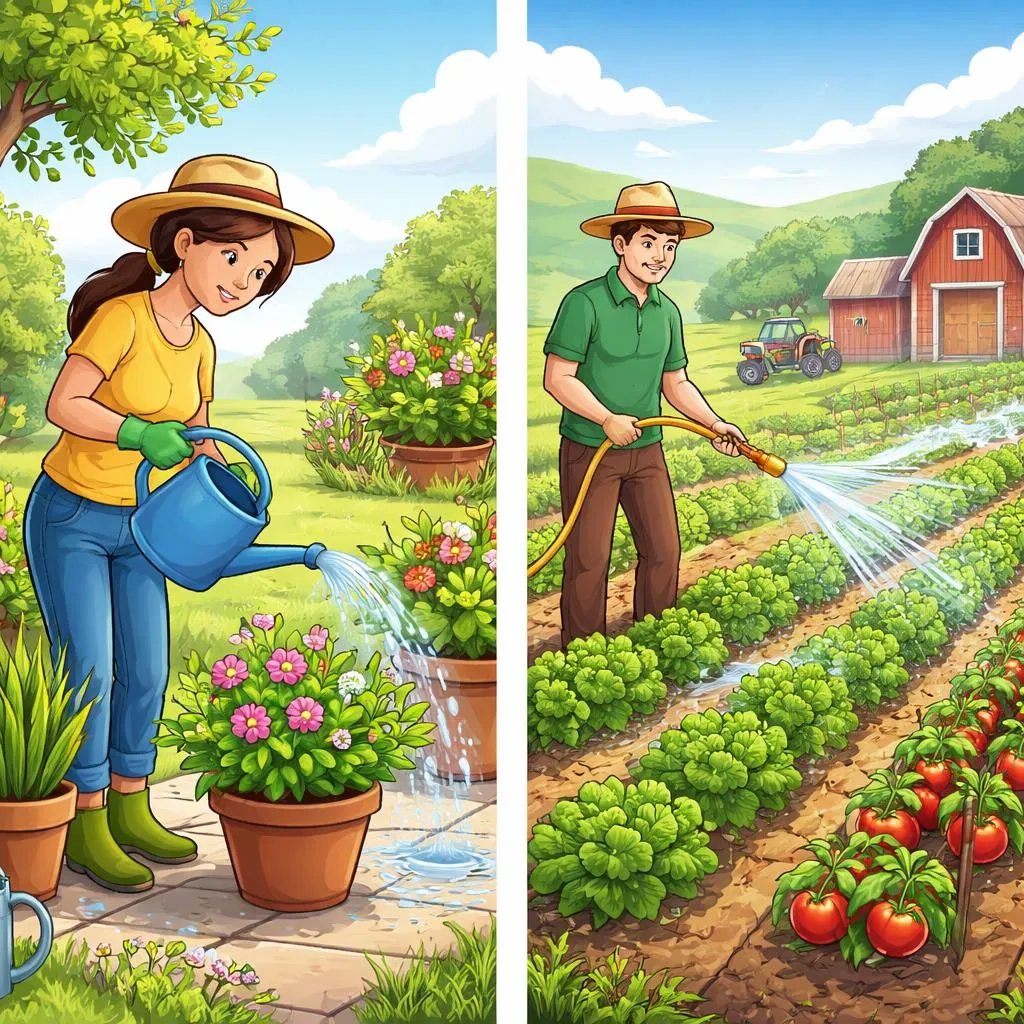

Hello, plant helper! Do you love helping things grow? Do you help with the garden? How do you give plants a drink? Do you water the flowers with a can? Or does a farmer irrigate a whole field? They both seem to be about giving plants water. But are they the same? They are like two different ways to share a drink. One is like giving a cup of water. One is like turning on a city fountain. Let's find out! Today, we explore the word friends "water" and "irrigate". Knowing their secret is a superpower. It makes you a smart gardener. Let's start our watering adventure!
First, let's be Watering Detectives. Look at home. Here are two sentences. "My chore is to water Mom's houseplants every Sunday." "Big farms use special systems to irrigate their crops." They both involve plants and water. Houseplants. Crops. Do they sound the same? One feels like a small, simple job. One feels like a big, planned job. Can you sense it? Great observation! Now, let's look closer.
Adventure! Into the World of Giving Drinks
Welcome to the world of thirsty plants! "Water" and "irrigate" are two different watering helpers. Think of "water" as a friendly, small watering can. It is simple and for small jobs. Think of "irrigate" as a giant, smart sprinkler system. It is a big, planned system. Both give water. But one is for a few friends. One is for a whole park. Let's learn about each one.
The Friendly Watering Can vs. The Giant Sprinkler System Think about the word "water". To "water" feels friendly and simple. It is the everyday word. You use a can, a hose, or a cup. You can water the garden. You can water the dog. It is a common, gentle action. Now, think about "irrigate". To "irrigate" sounds big and scientific. It means to supply water to land or crops using channels, pipes, or sprinklers. Farmers irrigate fields. A city might irrigate a park. "Water" is the friendly can. "Irrigate" is the giant system. One is personal. One is big and planned.
For Small Tasks vs. For Large Land Let's compare their size. "Water" is for small, everyday tasks. You water a single plant. You water a small flower bed. You water" the lawn with a hose. It is for homes and gardens. "Irrigate" is for large, planned areas. Farmers irrigate huge fields of corn. Towns irrigate public golf courses. It is for farms, parks, and sports fields. You water your tomato plant. A farm irrigates one hundred tomato plants. One is for your backyard. One is for the whole countryside.
Their Special Word Partners and Common Uses Words have best friends. "Water" loves simple objects and tools. Water the plants. Water the lawn. Water with a hose. Water the vegetable patch. "Irrigate" loves land and special equipment. Irrigate the fields. Irrigate farmland. An irrigation system. Drip irrigation. Note: A person can "water" the garden. A person uses a machine to "irrigate" the field. You "water" a small area. You "irrigate" a large area.
Let's visit a school scene. Your class has a small windowsill garden. Your job is on Monday. You take a small plastic bottle. You fill it with water. You sprinkle water on the soil. You are helping to water the class plants. This is a small, simple job. Later, you learn about farming. Your teacher shows a video. Big metal pipes stretch across a huge field. They spray water automatically. The farmer uses this system to irrigate the whole field. The word "water" fits your classroom chore. The word "irrigate" fits the farmer's big system.
Now, let's go to a playground. The grass is looking dry. A groundskeeper connects a hose. He sprays the soccer field. He is using the hose to water the grass. This is a direct, simple action. Next to the playground is a big public garden. Every evening, hidden sprinklers pop up. They turn on by themselves. They spray water in circles. This automatic system is designed to irrigate the whole garden. The word "water" fits the hose job. The word "irrigate" fits the automatic system.
Our Little Discovery So, what did we find? "Water" and "irrigate" both mean to give water. But they are different. To "water" is the simple, everyday word. It means to pour or sprinkle water on something, like a plant or a lawn. It is often a small job you do yourself. To "irrigate" is a more specific, big word. It means to supply water to a large area of land using planned methods like ditches, pipes, or sprinklers. It is often a large, systematic job. You water your flowers. A farm uses machines to irrigate crops. Knowing this helps you choose the perfect word.
Challenge! Become a Watering Word Champion
Ready for a nature test? Let's try your new skills!
"The Best Choice" Challenge Let's imagine a nature scene. A mother bird is back at her nest. Her babies are thirsty. She flies to a puddle. She fills her beak with water. She flies back to the nest. She lets the water drip into her babies' mouths. The mother bird is trying to water her chicks. This is a small, direct, and personal action. Now, think of a beaver. It builds a dam in a river. The dam makes a pond. The pond's water spreads out. It soaks the soil near the riverbank. The beaver's work helps irrigate the nearby land. This is a large, system-like effect. "Water" wins for the bird's direct feeding. "Irrigate" is the champion for the beaver's large-scale water supply.
"My Sentence Show" Your turn to create! Here is your scene: Helping to take care of a community vegetable garden. Can you make two sentences? Use "water" in one. Use "irrigate" in the other. Try it! Here is an example: "My job is to water the herb pots near the shed with a small can." This is a simple, small task. "The whole garden has a network of hoses to irrigate the large tomato and corn patches." This is a planned, large system. Your sentences will show two levels of watering!
"Eagle Eyes" Search Look at this sentence. Can you find the word that could be better? Let's check a home context. "I need to irrigate this tiny cactus on my desk. I will use an eyedropper to give it a few drops." Hmm. An eyedropper is for a very small, precise task. The word "irrigate" is for large, systematic watering. The word "water" is the correct choice here. "I need to water this tiny cactus on my desk. I will use an eyedropper to give it a few drops." Using "irrigate" here makes a tiny job sound like a huge farm project. Did you spot it? Excellent word work!
Harvest and Action! Turn Knowledge Into Your Superpower
Great exploring! We started thinking "water" and "irrigate" were similar. Now we know they are two different helpers. "Water" is the friendly, everyday watering can. "Irrigate" is the big, smart farming system. You can now talk about plants and gardening with perfect accuracy. This is a great skill for a future gardener or scientist.
What you can learn from this article: You can now feel that to "water" is the simple, everyday word for giving a drink to plants, lawns, or even animals, and it is often a small job you do with a can, hose, or even a cup. You can now feel that to "irrigate" is a more specific, science or farming word, and it means to supply water to a large area of land using planned systems like channels, pipes, or sprinklers, usually for farms or big parks. You know that you water your houseplants on the windowsill, but a farmer uses machines to irrigate a whole cornfield. You learned to match the word to the scale: "water" for small, personal tasks, "irrigate" for large, systematic tasks.
Life practice application: Try your new skill today! Be a watering word expert. Look at a gardening job. Will you water the flowers on the balcony? Or do you live near a farm that uses ditches to irrigate the fields? Next time you help in the garden, name your action. Say, "I will water the vegetable seedlings." or "I learned that farmers irrigate their land." Tell a friend about a time you helped water something. Describe what an irrigation system might look like. You are now a master of watering words! Keep helping things grow.