
Start! Find a Pair of 'Tiny Twin' Words
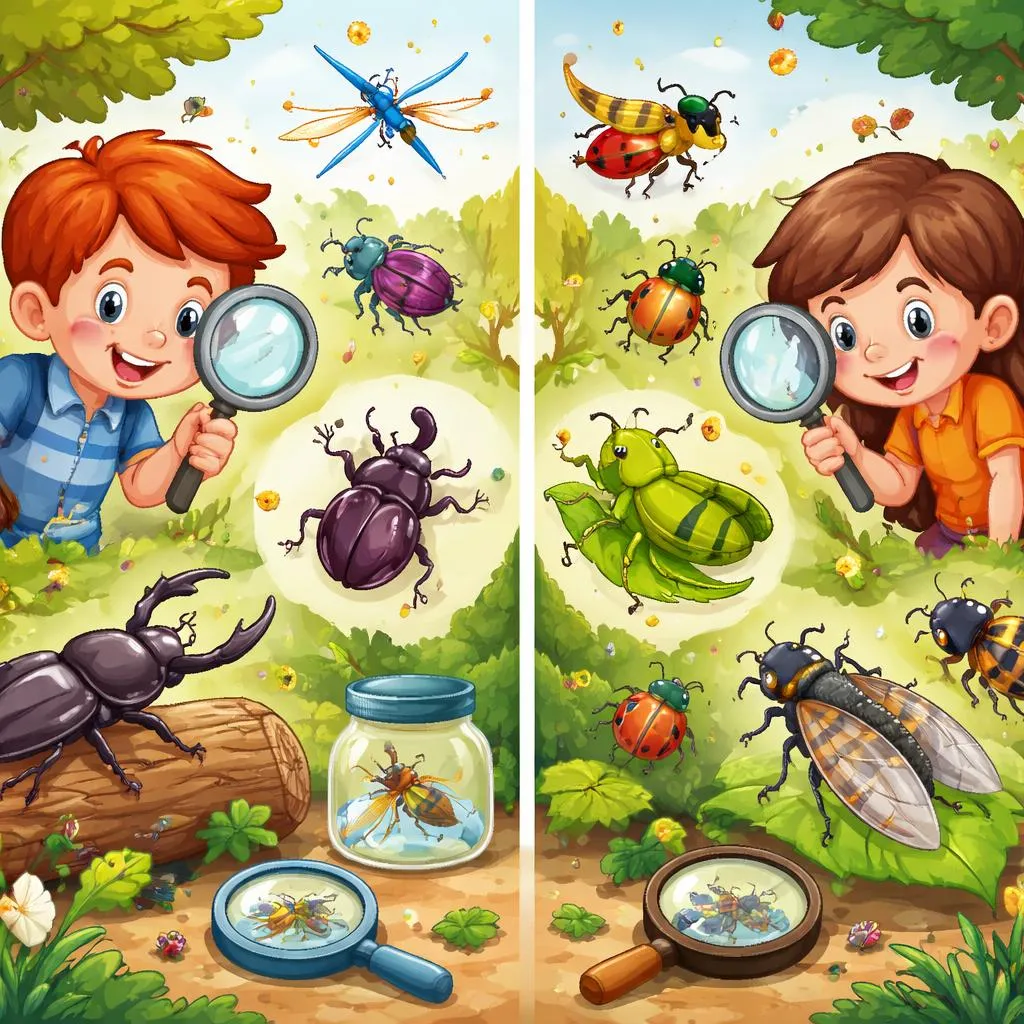
Hello, word explorer! Have you ever seen a small, hard-shelled insect? It might have shiny spots. What do you call it? You might say "beetle." Or maybe you just call it a "bug." They are both small creatures. Are they the same? This is a common nature puzzle. Today we explore a word pair. We explore beetle and bug. They are like two different boxes. One is a small, specific box. One is a big, general box. Knowing the difference is a superpower. Your insect talk will be smart and clear. Let us start our tiny word adventure!
Be a Language Watcher now. Our first clue is at home. You see a red insect with black spots. Your parent says, "Look, a ladybug!" But then your book says a ladybug is a beetle. Hmm. Then, you see a green insect on a plant. Your friend calls it a stink bug. They are both small and crawl. But are they the same? Let us test with two sentences.
"The beetle had a hard, shiny shell on its back." This describes a specific type of insect. "A tiny bug crawled across the page of my book." This describes any small insect.
They both talk about little creatures. But one is a specific kind. One is a general word. Your watching mission starts. Let us crawl into their word world.
Adventure! Crawl Into the Word World
Feel the Word's Precision!
Feel the word beetle. It is a specific, scientific word. It feels like a well-defined toy. Think of a ladybug or a stag beetle. The word bug is a general, everyday word. It feels like a big basket of toys. It can mean many small creatures. Beetle is a specific player. Bug is the whole team. One is a single flavor. The other is the whole candy store. Let us see this at school.
In a science class, you learn: "A beetle has two pairs of wings. The front wings are hard." This is a specific fact. In a computer class, you might hear: "There is a bug in the software." This means a problem. Saying "a beetle in the software" sounds silly. The precision of the words is different. One is exact. The other is broad.
Compare Their Science and Everyday Use!
Think about a specific toy car and a big box of vehicles. The word beetle is the specific toy car. In science, it is an insect in the order Coleoptera. It has hard wing cases. The word bug is the big box. In everyday talk, it can mean any insect. In science, a true bug is in the order Hemiptera, like a stink bug. A ladybug is a beetle, not a true bug. Their "word size" is different. Let us test this on the playground.
You play a guessing game. You say, "I am thinking of a bug with spots." Your friend might guess "ladybug!" Correct. Now you say, "I am thinking of a beetle with big jaws." Your friend might guess "stag beetle!" The word bug is a broad clue. The word beetle is a more specific clue. The playground shows the difference in scope.
Meet Their Best Word Friends!
Words have favorite tiny partners. The word beetle likes specific and hard-shell words. It teams up with 'lady', 'dung', 'June', 'stag', and 'Hercules'. You see a June beetle. The beetle has a hard case. The word bug likes general and problem words. It teams up with 'stink', 'bed', 'love', 'computer', and 'spray'. You have a bug spray. You find a computer bug. Their partners are different. Let us go back to school.
In a biology lesson, you study the beetle's life cycle. This is about a specific insect group. In a health class, you learn about bed bugs. This is about a pest. You would not usually study "bed beetles." The word friends set the right topic.
Our Little Discovery!
We crawled through the word garden. We made a clear discovery. The words beetle and bug are not the same. The word beetle is a specific scientific word. It describes insects with hard wing cases. The word bug is a general word. In everyday talk, it means any small insect. In science, a true bug is a different insect order. Beetle is the specific type. Bug is the general category. One is a member. The other is the club.
Challenge! Become an Insect Word Expert
"Best Choice" Challenge!
Let us look at nature. Read each scene. Pick the champion word. Scene one: You are in the forest. You see a large, black insect with huge mandibles. Your guide says, "That is a stag ______." Is it Beetle or Bug? The champion is Beetle! The stag beetle is a famous type of beetle. Scene two: Your computer program has an error. Your teacher says, "We need to fix the ______ in the code." Is it beetle or bug? The champion is bug! A computer bug is a common term for a problem. Great choice!
"My Sentence Show"!
Now, create your own sentences. Here is a fun scene: Imagine a sunny garden log. Use the word beetle in one sentence. Now imagine a dark bedroom. Use the word bug in another. Try it! Here is an example. Sentence one: "A shiny green beetle scurried under the bark." Sentence two: "I hope there are no bugs in my bed." See the difference? The first describes a specific insect. The second talks about insects in general.
"Eagle Eyes" Search!
Can you find the word that needs help? Read this sentence: "My little brother is scared of all beetles, especially the little red beetle with black spots that flies." Hmm. This is almost correct. But the "little red beetle with black spots" is usually called a ladybug. And many people call it a ladybug, not a lady beetle. So the sentence is okay, but it's more common to say: "My little brother is scared of all bugs, especially the little red bug with black spots that flies." This uses the general word "bug" for the broad fear and the common name "bug" for the insect. You spotted the nuance!
What a wonderful tiny adventure! You started as a curious observer. Now you are a word entomologist. You know the secret of beetle and bug. You can feel their different precision. You see their science and everyday use. You know their best word friends. This is a real language superpower.
You can learn amazing things from this article. You now know that a 'beetle' is a specific type of insect with hard wing cases, like a ladybug or stag beetle. You understand that 'bug' is a general word for many small insects, and in science it also means a specific group like stink bugs. You can explain that all beetles are insects, but not all bugs are beetles. You learned that we use 'bug' for computer problems and 'beetle' for specific hard-shelled insects.
How can you use this today? It is easy and fun. Next time you see a small insect, be a detective. Does it have a hard shell? It might be a beetle. If you are not sure, you can call it a bug. Look at insect books. See if they use the word "beetle" for the hard-shelled ones. Draw two pictures. Draw a detailed beetle. Draw a general bug. You are using your new skill every day.
Keep your explorer eyes open. The world is full of amazing word categories. You are learning to sort them in your mind. Great work, word expert. Your English journey is getting more detailed and fascinating with every new word pair you discover!