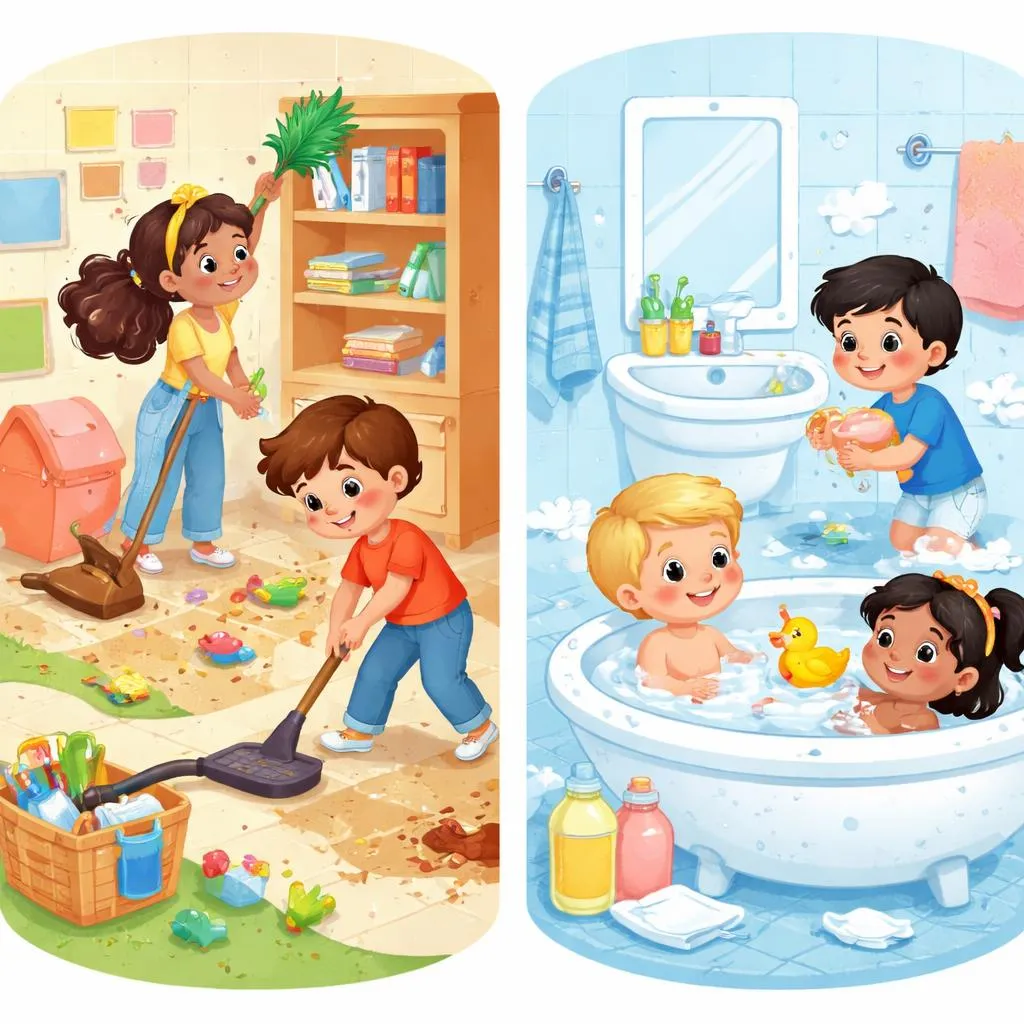

Hello, tidy-up champion! Do you like helping around the house? What do you do with a messy room? What do you do with dirty hands? Do you clean up your toys? Or do you wash your hands before dinner? They both seem to be about making things neat. But are they the same? They are like two different cleaning helpers. One is a big, general broom. One is a focused, soapy sponge. Let's find out! Today, we explore the word friends "clean" and "wash". Knowing their secret is a superpower. It makes you a super helper. Let's start our tidy adventure!
First, let's be Tidy Detectives. Look at home. Here are two sentences. "I need to clean my room. I will put my toys away and make my bed." "I must wash my muddy hands with soap and water." They both make things better. A messy room. Muddy hands. Do they sound the same? One feels like organizing and dusting. One feels like using water and soap. Can you sense it? Great observation! Now, let's look closer.
Adventure! Into the World of Making Things Neat
Welcome to the world of tidiness! "Clean" and "wash" are two different helpers. Think of "clean" as a big, general broom. It sweeps away mess in a big area. It can mean to make something neat, tidy, or free from dirt. Think of "wash" as a focused, soapy sponge. It uses water and soap to clean a surface. It is a specific action. Both make things better. But one is a big job. One is a specific job. Let's learn about each one.
The Big Broom vs. The Soapy Sponge Think about the word "clean". To "clean" feels wide and open. It is the main word for making something neat. You remove dirt, dust, or clutter. You can clean a room. You can clean a window. You can clean a cut on your knee. It is the big idea. Now, think about "wash". To "wash" feels specific and wet. It means to clean something with water and soap. You wash the dishes. You wash your hair. You wash the car. "Clean" is the big broom. "Wash" is the soapy sponge. One is the big idea. One is a way to do it.
Making Neat vs. Using Water Let's compare their action. "Clean" is the result. You want something to be neat. How you do it can vary. You can clean by organizing, dusting, wiping, or washing. "Wash" is the method. It is the action of using water. You wash to get something clean. You can clean a shirt by brushing off dust. You wash a shirt by putting it in the washing machine. "Clean" is the goal. "Wash" is one way to reach that goal. One is the end. One is a means.
Their Special Word Partners and Common Uses Words have best friends. "Clean" loves places and big tasks. Clean your room. Clean the kitchen. Clean up. A clean house. "Wash" loves things that get wet. Wash your face. Wash the clothes. Wash the dog. A car wash. Note: You "clean" a cut. You "wash" a wound (with water). A parent says, "Go clean up!" A parent says, "Go wash up!"
Let's visit a school scene. It is the end of art class. The table is covered in paper scraps and glue. Your job is to make the table neat. You throw away the scraps and wipe the glue. You are helping to clean the art table. Later, you have paint on your hands. You go to the sink. You use soap and water. You are going to wash your hands. The word "clean" fits the big table job. The word "wash" fits the specific hand job with water.
Now, let's go to the playground. After playing in the sand, your shoes are sandy. You take them off and shake out the sand. You are trying to clean your shoes. Your friend has a juice spill on their shirt. They go to the bathroom. They use water on a paper towel. They are trying to wash the stain. The word "clean" fits the sand removal. The word "wash" fits the water on the stain.
Our Little Discovery So, what did we find? "Clean" and "wash" are both about making things neat. But they are different. "Clean" is the big, general word. It means to make something neat, tidy, or free from dirt. You can clean by organizing, wiping, or washing. "Wash" is a specific way to clean. It means to use water and soap to clean something. You wash things that can get wet. You clean your desk by organizing it. You wash your desk with a wet cloth. Knowing this helps you describe your chores perfectly.
Challenge! Become a Tidy Word Champion
Ready for a tidy test? Let's try your new skills!
"The Best Choice" Challenge Let's imagine a nature scene. A bird is building a nest. It picks up twigs and leaves from the ground. It wants a neat, safe spot. The bird is making the area tidy. It is trying to clean the nest site. This is a general tidying. A mother cat has kittens. The kittens are new and messy. The mother cat uses her tongue. She licks the kittens to make them neat. Her tongue is like a wet cloth. She is helping to wash her kittens. "Clean" wins for the bird's tidying. "Wash" is the champion for the cat's licking.
"My Sentence Show" Your turn to create! Here is your scene: After helping in the garden, you are dirty. Can you make two sentences? Use "clean" in one. Use "wash" in the other. Try it! Here is an example: "First, I need to clean my gardening tools. I will wipe off the dirt and put them away." This is the general task. "Then, I must wash my face and arms with soap because they are covered in soil." This is the specific action with water. Your sentences will show two tasks!
"Eagle Eyes" Search Look at this sentence. Can you find the word that could be better? Let's check a home context. "I will wash my whole bedroom this Saturday. I will organize the shelves and vacuum the floor." Hmm. Organizing and vacuuming are general cleaning tasks. They do not involve water and soap. The word "clean" is the correct choice. "Wash" is for using water, like washing the floor with a mop. "I will clean my whole bedroom this Saturday. I will organize the shelves and vacuum the floor." Using "wash" here makes it sound like you will use water on everything, which is not right. Did you spot it? Excellent tidy word work!
Harvest and Action! Turn Knowledge Into Your Superpower
Great exploring! We started thinking "clean" and "wash" were the same. Now we know they are two different helpers. "Clean" is the big, general broom. "Wash" is the focused, soapy sponge. You can now talk about your chores with perfect accuracy. This is a great skill for being a big helper.
What you can learn from this article: You can now feel that to "clean" is the big, general word for making something neat, tidy, and free from dirt, and it can be done in many ways like organizing, dusting, or wiping. You can now feel that to "wash" is a specific way to clean, and it means to use water and soap to remove dirt from a surface, like washing your body, your clothes, or the dishes. You know that you clean your desk by putting things away, but you wash your desk with a wet cloth. You learned to match the word to the job: "clean" for the general goal of tidiness, "wash" for the specific action with water and soap.
Life practice application: Try your new skill today! Be a tidy word helper. Look at a chore. Will you clean the living room? Or will you wash the dirty cups? Next time you help, name your action. Say, "I will clean the play area." or "I will wash the apples for our snack." Tell a family member one thing you like to clean and one thing you know how to wash. You are now a master of tidy words! Keep being a fantastic helper.