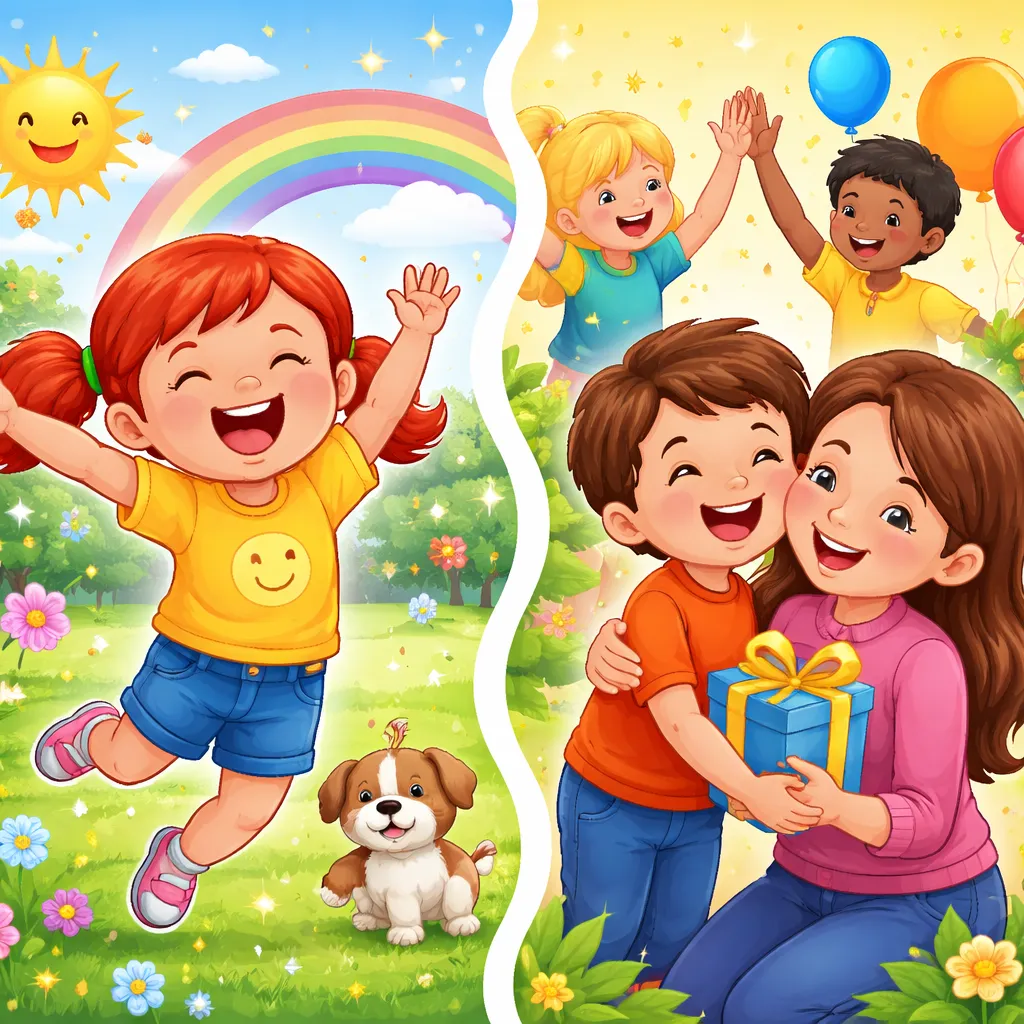

Hello, word explorer! Have you ever thought about feeling words? You get a new toy. Your friend says, "I'm happy for you!" Your mom helps you with homework. You say, "I'm glad you're here." They both mean a good feeling. But are they exactly the same? Sometimes, they seem like twins. Today, we will find out! We are going on a word adventure. We will meet "happy" and "glad". They are feeling word friends. Knowing their secret makes you a feeling expert. Your words can paint perfect pictures. Let's start our discovery journey!
First, let's be Feeling Detectives. We will look at a home scene. Listen carefully. "I am so happy on my birthday!" "I am glad you came to my party." Do they sound similar? They both talk about positive feelings. A birthday feeling. A friend's visit. But do you sense a small difference? One feeling feels bigger. One feels more about a specific thing. Can you guess? Great job noticing! Now, let's look closer with our feeling microscope.
Adventure! Into the World of Good Feelings
Welcome to the world of good feelings! Let's put on our explorer hats. We will examine "happy" and "glad" very closely.
The Warm Sunshine vs. The Gentle Sunbeam Think about the feeling of "happy". "Happy" is like a bright, warm summer sun. It shines on your whole day. It is a full, complete feeling. You feel happy on vacation. You feel happy with your friends. It is a big, general feeling. It can last a long time. It fills you up. Now, think about "glad". "Glad" is like a single, gentle sunbeam. It is a small, warm spot. It is a quick, nice feeling. You are glad the rain stopped. You are glad you found your pencil. "Happy" is the whole sunny day. "Glad" is the sunbeam through the window. Both are warm. But one is bigger and lasts longer.
The Loud Laugh vs. The Quiet Smile Now, let's listen to their volume. "Happy" is a loud, joyful laugh. It is a big sound. It shows a strong, clear emotion. A dog is happy to see you. It wags its tail fast. A party makes you happy. You jump and shout. "Glad" is a quiet, gentle smile. It is a softer sound. It shows relief or a quiet pleasure. You are glad your friend feels better. You are glad the test is over. "Happy" is the celebration. "Glad" is the peaceful feeling after. "Happy" is for big states of being. "Glad" is for smaller, specific moments.
Their Special Word Friends Words have favorite partners. "Happy" loves to describe a person's general state. It often comes before a noun. It describes the noun itself. She is a happy person. It was a happy day. "Happy" also loves phrases like "happy to see you" or "happy about something". "Glad" has a special job. It almost always describes a person's feeling about a specific thing. It loves to be followed by "that" or "to". I'm glad (that) you're here. I'm glad to help. "Happy" can stand alone more easily. "Are you happy?" "Yes, I am happy!" "Glad" usually needs a reason. You are glad about something.
Let's visit school now. Imagine you get a perfect score on a test. You jump up and down. You tell everyone. You say, "I am so happy!" This is perfect. It describes your big, overall joyful state. Now, imagine your friend was sick. They come back to school. You say, "I'm glad you're feeling better." This is also perfect. It shows your nice feeling about that one specific event. Using "happy" here is okay. But "glad" fits the specific relief better. It's like choosing the perfect crayon.
Now, let's run to the playground. You win a race. You throw your hands in the air. You shout, "I'm so happy I won!" This shows your big, excited emotion. Later, your friend shares a snack with you. You say, "I'm glad you shared your cookies." This shows your pleasant feeling about that kind action. The word "happy" paints the big win. The word "glad" paints the thankful moment.
Our Little Discovery So, what did we find? We learned that "happy" and "glad" are close friends. But they are not twins. "Happy" is a big, warm, general feeling. It is like the whole sunny sky. "Glad" is a smaller, gentle, specific feeling. It is like a single sunbeam. "Happy" is the loud laugh of joy. "Glad" is the quiet smile of relief. "Happy" can stand alone. "Glad" usually needs a reason. Knowing this helps you share your feelings just right.
Challenge! Become a Feeling Word Master
Ready for some fun tests? Let's use your new word power!
"The Best Choice" Challenge Let's imagine a nature scene. You are at a park. You see a puppy. The puppy finds its favorite toy. It runs around with it, tail wagging like crazy. The puppy is very... what? Is it happy or glad? The puppy is happy! This describes its overall, joyful state. Now, imagine a little bird. It has been trying to fly. It finally lands safely on a branch. The bird might feel... what? The bird is glad. It feels relief about that safe landing. "Happy" wins for the big, general joy. "Glad" is the champion for the specific moment of relief.
"My Sentence Show" Your turn to create! Here is your scene: Dinner time with your family. Can you make two sentences? Use "happy" in one. Use "glad" in the other. Try it! Here is an example: "Our family dinner makes me happy." This describes your general good feeling. "I'm glad we are having pizza tonight." This shows your nice feeling about the specific pizza. Your sentences will share different shades of happiness!
"Eagle Eyes" Search Look at this sentence. Can you find the word that could be better? Let's check a home context. "My dad was glad all day after his promotion at work." Hmm. The phrase "all day" suggests a long, general feeling. The word "happy" might be a more perfect fit here. "My dad was happy all day..." shows his lasting joyful state. "Glad" is great for the moment he heard the news. But for the whole day, "happy" is stronger. Did you find it? You have excellent word eyes!
Harvest and Action! Turn Knowledge Into Your Superpower
Wow! What a great adventure! We started thinking "happy" and "glad" were the same. Now we are experts. We can feel their different sizes. We can hear their different volumes. You know when to use the big sunshine feeling. You know when to use the gentle sunbeam feeling. This is a super useful skill!
What you can learn from this article: You can now feel that "happy" is a big, warm, lasting feeling like a summer sun. You can feel that "glad" is a gentler, specific feeling of relief or pleasure like a sunbeam. You know that saying "I am happy" describes your whole mood. Saying "I am glad" usually needs a reason, like "I am glad to see you." You learned to pick the word that matches the size of your good feeling.
Life practice application: Try your new skill today. Tell your family one thing that makes you happy. Then, tell them one specific thing you are glad about right now. Watch your favorite cartoon. Listen for the words "happy" and "glad". When does a character use each one? This makes you a super listener. Keep sharing your feelings with perfect words. You are an amazing feeling communicator!