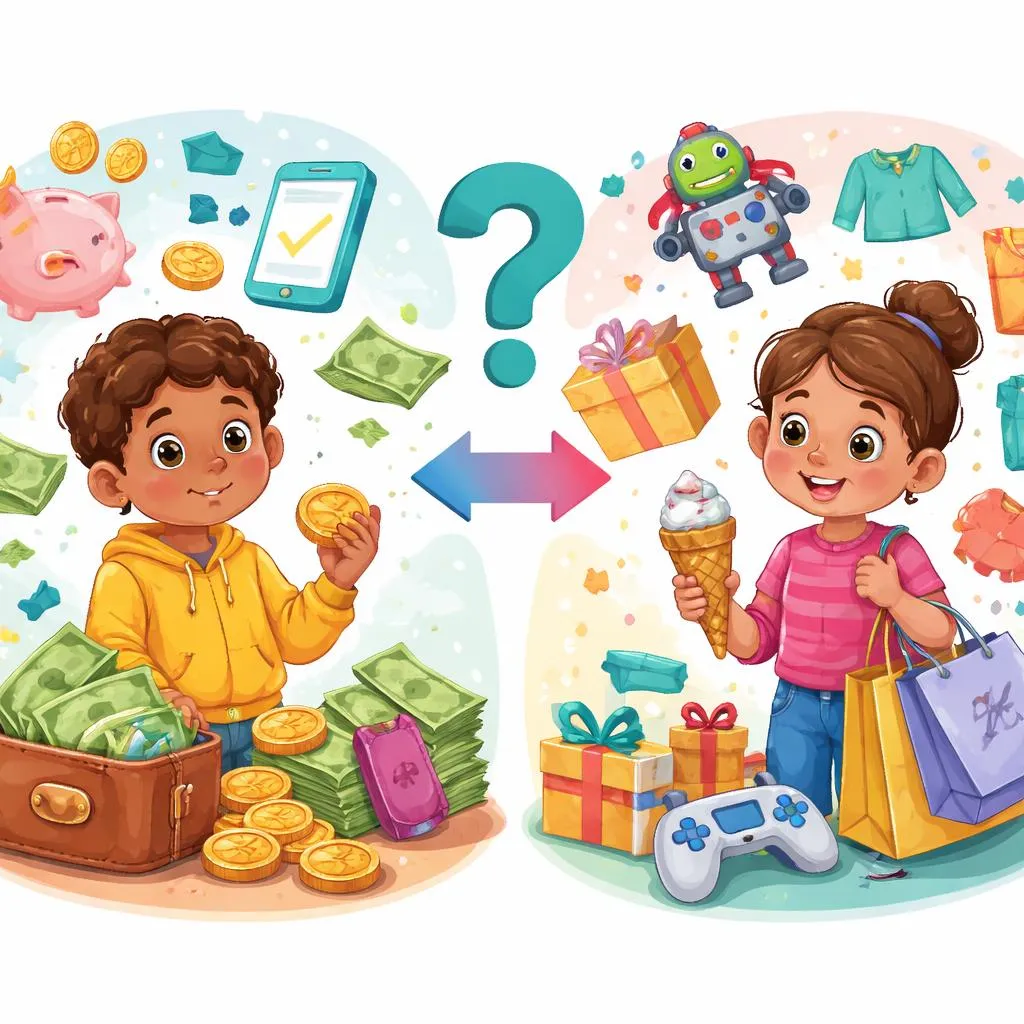

Hello, word explorer! Do you have pocket money? What do you do with it? Do you pay for a tasty ice cream? Or do you spend your money on a new comic? They both involve money leaving your pocket. But are they the same? They are like two steps in one shopping trip. One is the final handover. One is the whole activity. Let's find out! Today, we explore the word friends "pay" and "spend". Knowing their secret makes you a smart shopper with words. Let's begin our money word adventure!
First, let's be Shopping Detectives. Listen at home. Here are two sentences. "I will pay the cashier five dollars for this toy." "I like to spend my allowance on stickers and sweets." They both involve using money. Five dollars. Allowance. Do they sound the same? One feels like the final action of giving money. One feels like the general act of using money. Can you sense it? Great observation! Now, let's look closer.
Adventure! Into the World of Using Money
Welcome to the world of transactions! "Pay" and "spend" are about using money. But they are not the same. Think of "pay" as the check-out action. It is the specific act of giving money for something. Think of "spend" as the shopping trip. It is the general act of using up your money or time. Both are about money going away. But one is the "final click". One is the "whole process". Let's learn about each one.
The Specific Action vs. The General Activity Think about the word "pay". "Pay" feels direct and specific. It focuses on the transaction. You pay a person. You pay a bill. You pay for an item. It is about settling what you owe. Now, think about "spend". "Spend" feels broader. It focuses on the use of your resources. You spend money. You spend time. You spend energy. "Pay" is like the moment you hand cash to the cashier. "Spend" is like walking around the store choosing what to buy. One is a specific point. One is a wider activity.
The Receiver vs. The Resource Let's compare their focus. "Pay" always needs a receiver. You pay the seller. You pay the fee. The focus is on completing the payment to someone or something. "Spend" focuses on the resource leaving you. You spend your money. You spend your afternoon. The focus is on your resource being used up. You pay the librarian a fine. You spend your money on books. With "pay", you know who gets the money. With "spend", you know what you used up.
Their Special Word Partners and Common Uses Words have best friends. "Pay" loves words about people, bills, and specific costs. Pay someone. Pay for lunch. Pay attention (a special phrase!). Pay the price. "Spend" loves words about resources, time, and general use. Spend money. Spend time. Spend the day. Spend wisely. Note: You "pay" a specific amount to someone. You "spend" your resources on something.
Let's visit a school scene. Your class is going on a trip. Your teacher says, "Please pay ten dollars to the school office by Friday." This is a direct instruction to give money to a specific place. Later, you have a free afternoon. You think, "How should I spend my time? Should I read or draw?" The word "pay" fits the specific act of giving money to the office. The word "spend" fits the general use of your free time. One is a transaction. One is an activity.
Now, let's go to the playground. You want to buy a drink from the snack stand. You say, "I need to pay for this lemonade." This is about the action of giving money for the drink. Later, you think about your weekly allowance. You make a plan: "I will spend two dollars on snacks and save the rest." The word "pay" fits the act of buying the drink now. The word "spend" fits your plan for using your money overall. One is an event. One is a plan.
Our Little Discovery So, what did we find? "Pay" and "spend" are a money team. "Pay" is about the specific action of giving money to someone for something. You pay the bus driver. You pay for a ticket. "Spend" is about the general activity of using your money, time, or energy. You spend money on games. You spend an hour playing. You pay a person. You spend a resource. Knowing this helps you talk about shopping and plans clearly.
Challenge! Become a Money Word Champion
Ready for a nature test? Let's try your new skills!
"The Best Choice" Challenge Let's imagine a nature scene. A squirrel finds a human picnic table. It sees a shiny coin. The squirrel takes a big, juicy nut. It leaves the coin on the table. The squirrel doesn't need to pay for the nut. There is no cashier! This is about a transaction, but there is no one to pay. Now, think about a busy bee. It flies from flower to flower all day. The bee works very hard. It uses a lot of energy. The bee must spend a lot of energy to make honey. "Pay" is wrong for the squirrel because no one is selling. "Spend" is perfect for the bee's use of energy. "Pay" needs a receiver. "Spend" uses a resource.
"My Sentence Show" Your turn to create! Here is your scene: Using your weekly allowance at a toy store. Can you make two sentences? Use "pay" in one. Use "spend" in one. Try it! Here is an example: "I had to pay the exact amount at the counter." This is about the action of giving money to the cashier. "I decided to spend all my money on a big robot." This is about the plan for using my allowance. Your sentences will show the action and the plan!
"Eagle Eyes" Search Look at this sentence. Can you find the word that could be better? Let's check a home context. "I need to spend the electricity bill by tomorrow." Hmm. A bill is something you give money to. You give money to the electricity company. The word "pay" is the better choice for giving money to settle a bill. The word "spend" is for using your money in general. A better sentence is: "I need to pay the electricity bill by tomorrow." Using "spend" here sounds like the bill itself is a thing you buy. "Pay" is the champion for bills and people. Did you spot it? Excellent word work!
Harvest and Action! Turn Knowledge Into Your Superpower
Great exploring! We started thinking "pay" and "spend" were similar. Now we know they are two key money steps. "Pay" is the word for the final action of giving money to someone. "Spend" is the word for using up your money, time, or energy. You can now talk about buying things and using resources with perfect accuracy. This is a great skill for a smart thinker.
What you can learn from this article: You can now see that to "pay" means to give money to someone for something you buy or for a service you receive, like paying a friend or paying for a movie ticket. You can now understand that to "spend" means to use your money, time, or energy on something, like spending your savings or spending an afternoon reading. You know that you pay the cashier at the store, and you spend your free time with friends. You learned to match the word to the idea: "pay" for the action of giving money to someone; "spend" for the act of using a resource.
Life practice application: Try your new skill today! Be a money word expert. Next time you buy something, think: "I pay the seller. I spend my money." Listen to adults talk. Do they need to pay a bill? How do they plan to spend their weekend? Tell a story about a character who must pay a dragon a gold coin. Describe how you like to spend a sunny Saturday. You are now a master of money words! Keep noticing the payment moment and the spending choice.