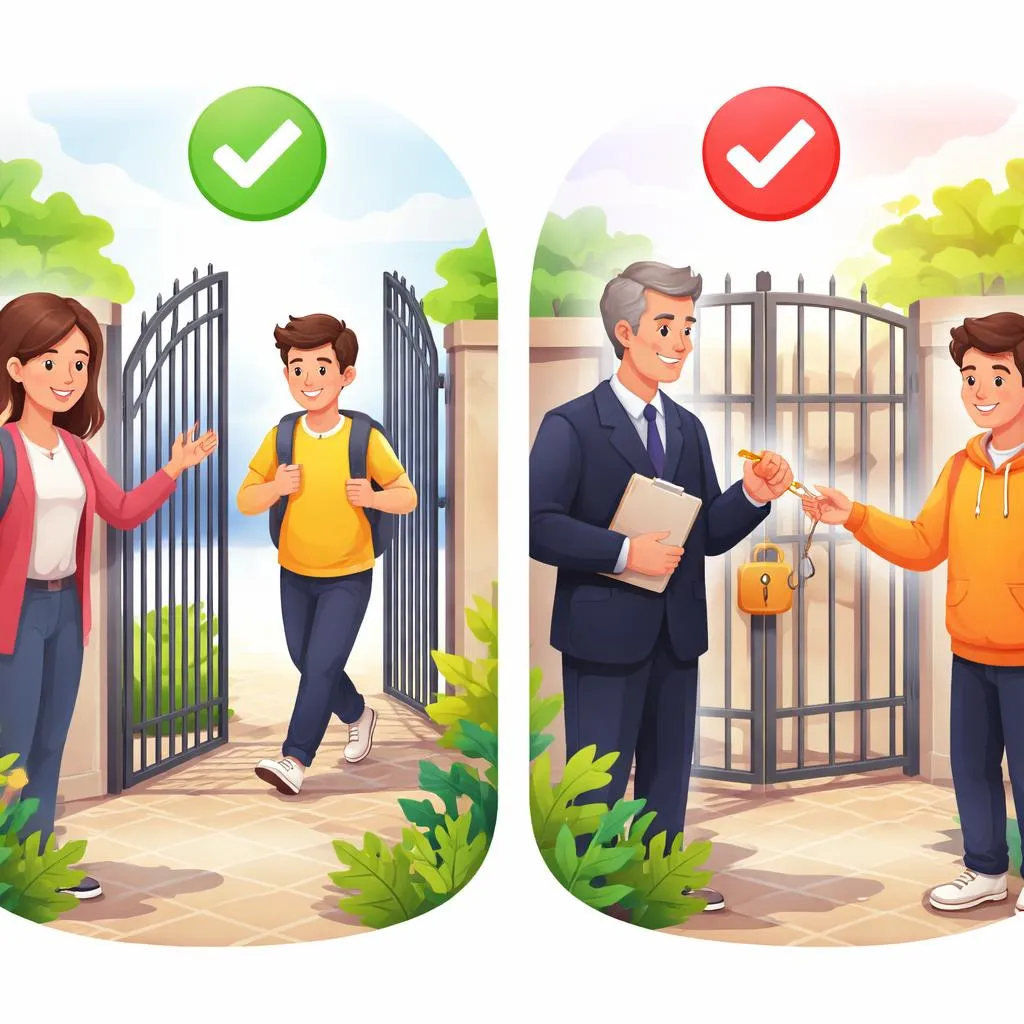

Hello, word explorer! Your mom might allow extra playtime. A library card permits you to borrow books. Both mean "it's okay". But are they the same kind of okay? They are two types of "yes". One is like a friendly, nodding smile. One is like an official stamp on a form. Let's discover their secret! Today, we explore the permission word pair "allow" and "permit". Knowing the difference makes your English super clear. Let's begin.
First, let's be Language Listeners. Listen at home. Here are two sentences. "Dad will allow me to have a friend over." "The rules permit two guests per student." Both talk about saying yes. A friend. Guests. Do they sound the same? One sounds like a personal, kind "yes". One sounds like a formal, rule-based "yes". Can you sense the difference? Great listening! Now, let's look closer.
Adventure! Into the World of "Yes"
Welcome to understanding permission. To "allow" and to "permit" both mean to say it is okay. But their feeling and formality are different. Think of "allow" as a friendly, green traffic light. It is a personal, everyday "go ahead". Think of "permit" as an official, printed ticket. It is a formal, rule-based "you may". Both are "permission". But one is the "friendly green light" from a person. One is the "official ticket" from a rulebook. Let's learn about each one.
A Friendly Nod vs. An Official Stamp Think about the word "allow". To "allow" is personal and common. A person in charge gives their okay. My teacher allows us to talk. The feeling is casual and kind. Now, think about "permit". To "permit" is more formal and official. It often comes from rules or laws. The pass permits entry. The feeling is more serious. A parent can allow a treat. A license permits you to drive. "Allow" is the friendly nod. "Permit" is the official stamp.
Everyday Speech vs. Official Writing Let's compare where they live. "Allow" lives in everyday talk. It is the word we use all the time. "Are we allowed to eat here?" The feeling is normal and direct. "Permit" often lives in rules, signs, and official writing. "Fishing is not permitted." The feeling is formal and written. You ask a friend if it's allowed. You read a sign that says it's permitted. One is for speaking. One is for official notices.
Their Special Word Partners and Common Uses Words have best friends. "Allow" often partners with people and casual structures. Allow someone to do something. Allow it. "Permit" often partners with formal rules and things. The law permits it. A permit (noun) is needed. Note: You often say "My mom doesn't allow that." You often see "Parking is not permitted*." "Allow" is flexible. "Permit" is formal.
Let's visit a school scene. My teacher allows us to choose our project topic. This is her personal, kind permission to us. The school rules permit students to use the library. The word "allow" fits the teacher's personal decision. The word "permit" fits the official school rule. One is a person's choice. One is a written rule.
Now, let's go to the playground. The game leader allows one more try. This is a personal decision for fun. The pool sign says diving is not permitted. The word "allow" fits the leader's friendly "okay". The word "permit" fits the official safety rule on the sign. One is spoken kindness. One is a written rule.
Our Little Discovery So, what did we find? To "allow" and to "permit" both mean to give permission. But to "allow" is more common, personal, and casual. It is a person saying yes. To "permit" is more formal and official. It is often a rule or law saying yes. A parent might allow a late bedtime. A ticket permits you to enter. "Allow" is the friendly green light. "Permit" is the official ticket.
Challenge! Become a Permission Word Champion
Ready for a nature test? Let's try your new skills!
"The Best Choice" Challenge Let's imagine a nature scene. The mother bird allows her chicks to leave the nest. This is her personal, caring permission. The forest park permits camping in this area. The word "allow" is the champion for the mother bird's personal, caring "yes". The word "permit" is the best choice for the park's official rule that says "yes" to an activity. One is a family decision. One is a park rule.
"My Sentence Show" Your turn to create! Here is your scene: A science museum. Can you make two sentences? Use "allow" in one. Use "permit" in one. Try it! Here is an example: "The guide will allow us to touch this fossil." This is the guide's personal, kind permission. "Your ticket permits you to visit all the exhibits." This is the official rule of the ticket. Your sentences will show personal okay versus official okay!
"Eagle Eyes" Search Look at this sentence. Can you find the word that could be better? Let's check a home context. "The park regulation permits dogs if they are on a leash." Hmm. A park regulation is an official rule. The word "permits" is perfect here! But what about this: "My mom permitted me to have a cookie." This sounds very formal for a mom at home. The more common, personal word is "allow". A better sentence is: "My mom allowed me to have a cookie." Using "allow" correctly describes a parent's casual permission. "Permit" sounds too official for a cookie. Did you spot it? Super thinking!
Harvest and Action! Turn Knowledge Into Your Superpower
Great exploring! We started thinking "allow" and "permit" were the same okay. Now we know they are different in tone. To "allow" is to give casual, personal permission. It is the word for everyday "yes". To "permit" is to give formal or official permission, often from a rule or law. It is the word for written "yes". You can now talk about permission with perfect clarity.
What you can learn from this article: You can now see that "allow" means to give personal, casual permission, like when a parent or teacher says "yes" to something. It is friendly and common. You can now understand that "permit" means to give formal, official permission, like a rule, law, or ticket that says "yes". It is more serious. You know that your friend's dad might allow a movie night. Your library card permits you to borrow books. You learned to match the word to the situation: "allow" for personal, spoken okay; "permit" for official, written okay.
Life practice application: Try your new skill today! Be a permission detective. Listen for allow in everyday talk with family and friends—it's the friendly "yes". Look for permit on signs, tickets, and rules—it's the official "yes". Remember, "allow" is the green light from a person, "permit" is the stamp from a rule. Use "allow" when asking or talking about personal permission. Use "permit" when reading or talking about official rules. Your way of understanding and using English will be much more natural!