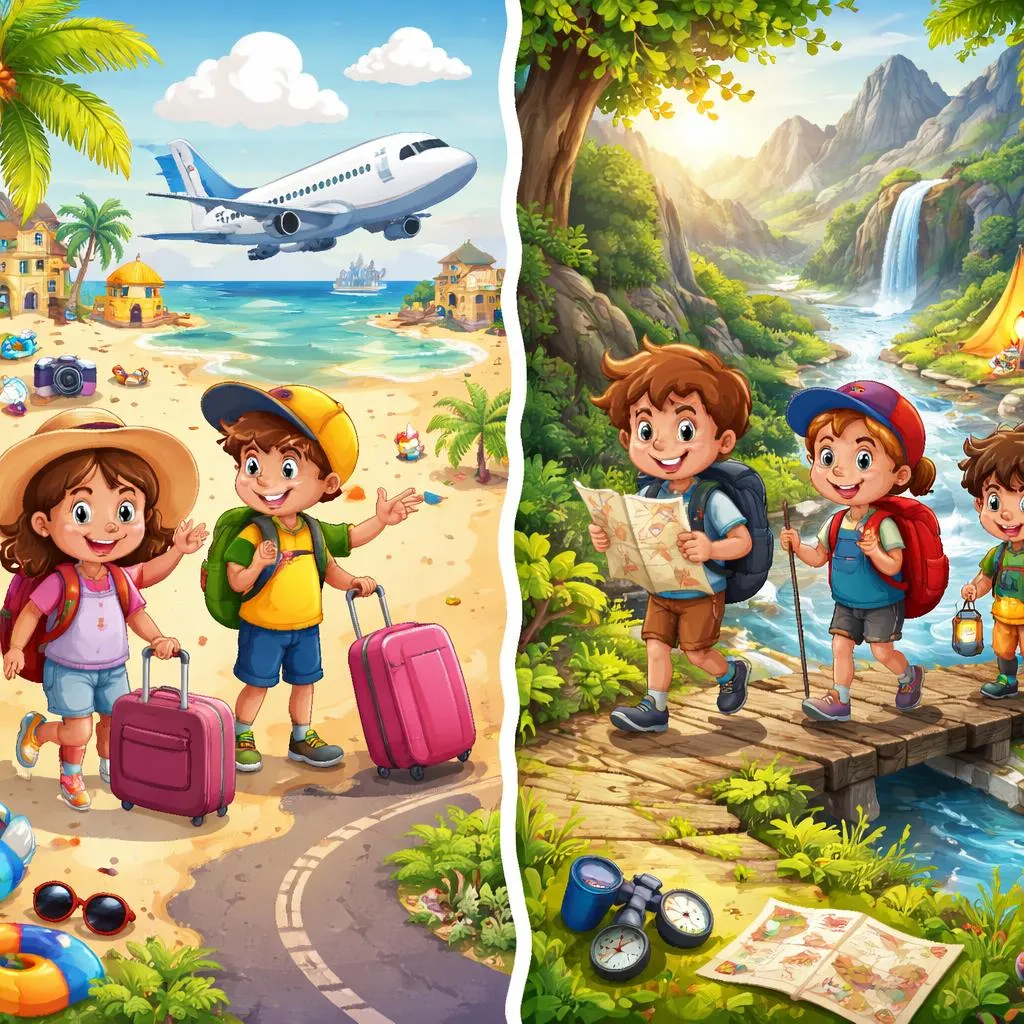

Hello, future explorer! Do you love going to new places? What do you do on summer holiday? Do you travel to a different city? Or do you go on a long journey across the country? They both seem to be about going somewhere. But are they the same? They are like two different ways to think about a trip. One is like a fast, exciting train ride. One is like a long, winding path with stories. Let's find out! Today, we explore the word friends "travel" and "journey". Knowing their secret is a superpower. It makes you a great storyteller. Let's start our word adventure!
First, let's be Trip Detectives. Listen at home. Here are two sentences. "My family loves to travel to the beach every summer for a week." "Moving to a new house felt like a big, emotional journey for all of us." They both involve going somewhere. The beach. A new house. Do they sound the same? One feels like the action of going. One feels like the whole experience. Can you sense it? Great observation! Now, let's look closer.
Adventure! Into the World of Going Places
Welcome to the world of movement! "Travel" and "journey" are two different trip-takers. Think of "travel" as a fast, exciting train. It is the action of going from one place to another. Think of "journey" as a long, winding path. It is the whole experience of traveling, including the feelings and changes. Both involve movement. But one is the "going". One is the "story of the going". Let's learn about each one.
The Fast Train vs. The Winding Path Think about the word "travel". "Travel" feels like movement itself. It is often a verb. It means to go from one place to another, often over a distance. You travel by car. You travel for work. People love to travel. It is the action. Now, think about "journey". A "journey" feels like a story. It is usually a noun. It is the act of traveling from one place to another, but it emphasizes the experience, the time, and the changes. A long journey. A difficult journey. A learning journey. "Travel" is the train. "Journey" is the path. One is the action. The other is the experience.
The Action of Going vs. The Story of the Trip Let's compare their focus. "Travel" is about the fact of moving. It answers "how do you get there?" or "do you go far?". You can travel quickly. You can travel often. "Journey" is about the whole process. It has a beginning, a middle, and an end. It often suggests a long distance, challenge, or personal change. Reading a long book can be a journey. Recovering from an illness is a journey. "Travel" is the physical act. "Journey" is the emotional story. One is the "how". The other is the "what it was like".
Their Special Word Partners and Common Uses Words have best friends. "Travel" loves methods and types. Travel by plane. Travel agent. Space travel. Love to travel. "Journey" loves descriptions and stories. A long journey. A journey of discovery. A safe journey. The journey home. Note: You can "go on a journey". You "travel to" a place. You wish someone "safe travels". You talk about a "life journey".
Let's visit a school scene. In geography class, you learn about different countries. Your teacher asks, "How do people travel from London to Paris?" The answers are: by train, by plane, by car. This is about the method of movement. Later, you read a book about explorers. The book describes their two-year journey across an unknown continent. This describes their long, difficult, and adventurous experience. The word "travel" fits the method. The word "journey" fits the epic story.
Now, let's go to the playground. You and your friends pretend to be astronauts. You say, "We will travel to Mars in our rocket ship!" This is about the action of going. One friend says, "The journey will take six months! What adventures will we have?" This is about the long, challenging experience of the trip. The word "travel" paints the action. The word "journey" paints the long adventure.
Our Little Discovery So, what did we find? "Travel" and "journey" are both about going places. But they are different. "Travel" is most often a verb. It is the action of going from one place to another. It is about the movement itself. "Journey" is almost always a noun. It is the trip or voyage from one place to another, especially when it is long, difficult, or full of experiences. You travel to school by bus. Your first year at a new school can be a journey. Knowing this helps you tell better stories about your adventures.
Challenge! Become a Trip Word Champion
Ready for an adventure test? Let's try your new skills!
"The Best Choice" Challenge Let's imagine a nature scene. Monarch butterflies are amazing. Every year, they travel thousands of miles from Canada to Mexico. This is the fact of their long movement. The whole migration, with all its dangers and wonders, is an incredible journey. "Travel" wins for describing the action of flying the distance. "Journey" is the champion for the epic, life-changing migration story. "Travel" describes the "how far". "Journey" describes the "what an amazing story".
"My Sentence Show" Your turn to create! Here is your scene: Your first time flying on an airplane to visit relatives. Can you make two sentences? Use "travel" in one. Use "journey" (as a noun) in the other. Try it! Here is an example: "We will travel to my grandparents' house by plane. The flight takes three hours." This is about the method and action. "My first flight felt like a big, exciting journey into the clouds." This is about the personal experience and feeling. Your sentences will show two ways to talk about a trip!
"Eagle Eyes" Search Look at this sentence. Can you find the word that could be better? Let's check a home context. "My dad's daily travel to his office across town is a long and tiring journey of 20 minutes in traffic." Hmm. A daily 20-minute commute is a routine trip. The word "journey" is too strong and dramatic for a short, regular drive. The word "trip" or "commute" is better. Using "travel" as a noun is possible but "trip" is more common. "My dad's daily trip to his office across town is a long and tiring drive of 20 minutes in traffic." Using "journey" here makes a normal drive sound like a grand adventure. Did you spot it? Excellent word work!
Harvest and Action! Turn Knowledge Into Your Superpower
Great exploring! We started thinking "travel" and "journey" were the same. Now we know they are two different ways to see a trip. "Travel" is often the action of going. "Journey" is usually the story of the experience. You can now talk about your adventures with perfect accuracy. This is a great skill for sharing your stories.
What you can learn from this article: You can now feel that "travel" is most often used as a verb for the action of going from one place to another, especially over a distance, and it focuses on the movement itself, like traveling by car, train, or plane. You can now feel that a "journey" is almost always a noun for the whole experience of traveling from one place to another, and it often describes a trip that is long, difficult, or full of change and stories. You know that you travel to school each day, but reading a great book can take you on a magical journey. You learned to match the word to your focus: "travel" for the action of going, "journey" for the story and experience of the trip.
Life practice application: Try your new skill today! Be a word explorer. Think about a trip you took. Did you travel there by car? Was the whole vacation a wonderful journey? Next time you hear about a trip, think about the word. Tell a friend how you travel to your activities. Describe a personal journey, like learning a new skill. You are now a master of trip words! Keep exploring the world and your words.