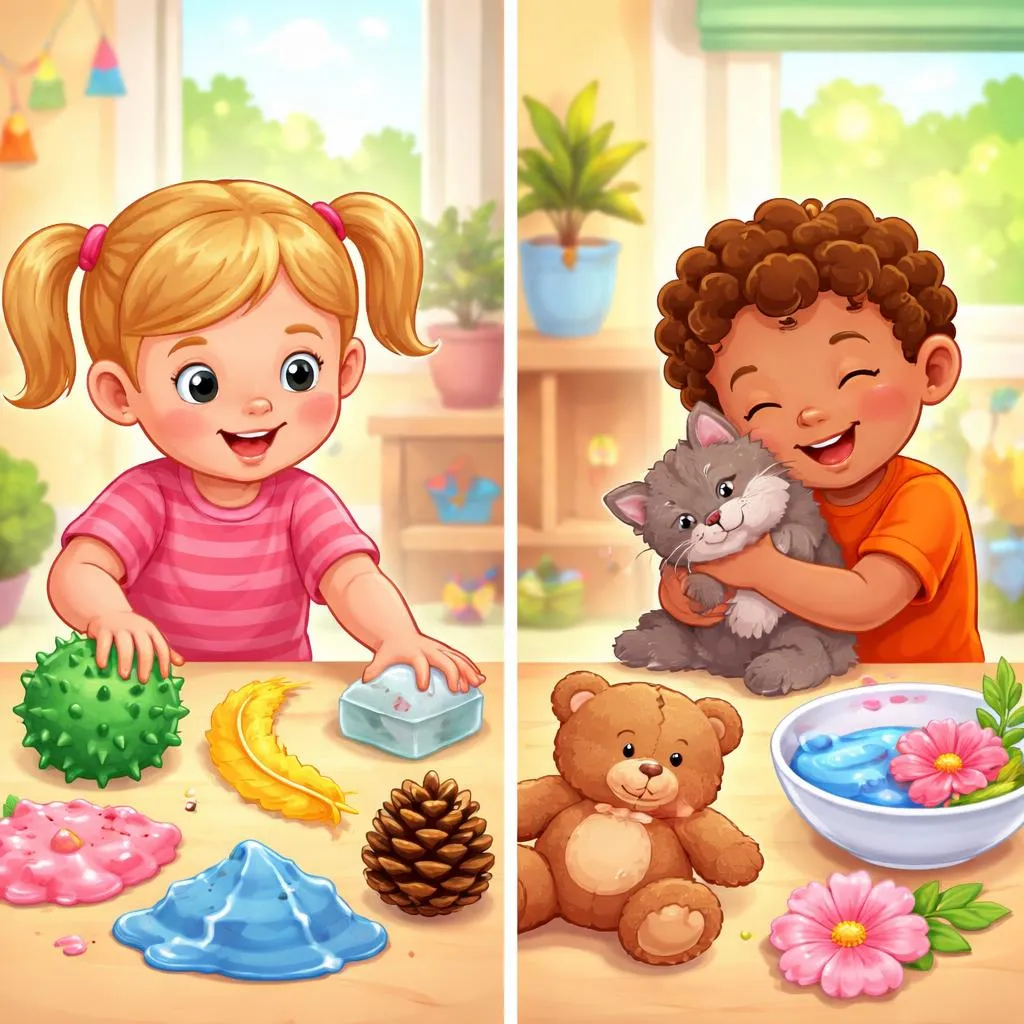

Hello, word explorer! Have you ever reached out with your hand? Do you touch a fuzzy pillow? Do you feel its softness? They both seem to be about your hands and skin. But are they the same? They are like two different parts of one superpower. One is like the action of a detective's hand. One is like the report from your skin. Let's find out! Today, we explore the word friends "touch" and "feel". Knowing their secret is a superpower. It makes you a super sense detective. Let's begin our sensory adventure!
First, let's be Sense Detectives. Listen at home. Here are two sentences. "I can touch the soft blanket with my hand." "The soft blanket feels nice on my skin." They both involve the blanket. Do they sound the same? One tells an action I do. One tells a sensation I get. Can you sense it? Great observation! Now, let's look closer.
Adventure! Into the World of Our Senses
Welcome to the world of contact and sensation! "Touch" and "feel" are connected. But they are not the same. Think of "touch" as the action you do. It is the move you make. Think of "feel" as the experience you have. It is the result of touching. Both are about your sense of touch. But one is the "doing". One is the "experiencing". Let's learn about each one.
The Action vs. The Experience Think about the word "touch". "Touch" is the action word. It is something you do. You use your hand or body. You touch a table. You touch a pet. It is the physical contact. Now, think about "feel". "Feel" is about the sensation. It is what you experience. The table feels smooth. The pet's fur feels fluffy. "Touch" is like a detective reaching out. "Feel" is like the detective's report. One is the move. One is the result.
A Physical Act vs. A Personal Sensation Let's compare their nature. "Touch" is the physical act of contact. It is about the object. Please do not touch the painting. You can touch the water. "Feel" is about your personal experience. It is about the quality. The water feels cold. The painting looks smooth. It probably feels smooth too. You touch the ice cube. The ice cube feels freezing. "Touch" is the action on the object. "Feel" is the sensation in you. One is external. One is internal.
Their Special Word Partners and Common Uses Words have best friends. "Touch" loves words about rules, actions, and objects. Touch the screen. Do not touch. Can I touch it? A light touch. "Feel" loves words about textures, temperatures, and emotions. It feels rough. I feel happy. This feels weird. Note: You can "touch base" with someone. You can "feel" an emotion. You can "get in touch". You can "feel like" something.
Let's visit a school scene. In art class, your teacher has a mystery box. You put your hand inside. You cannot see. You use your fingers to touch the object inside. This is the action you are doing. Your fingers move around. Then, you get information. The object is sticky and lumpy. It feels like clay! This is the sensation you experience. The word "touch" fits the action of your hand exploring. The word "feels" fits your brain understanding the texture.
Now, let's go to the playground. The slide is wet from rain. Your friend says, "Do not touch the slide yet!" This is a rule about an action. Later, you use a towel. You dry the slide. Now it is safe. You put your hand on it. The metal is now dry and a little warm from the sun. The slide feels warm and dry. The word "touch" fits the action rule. The word "feels" fits your sensation of warmth and dryness.
Our Little Discovery So, what did we find? "Touch" and "feel" are about our sense of contact. But they are different. "Touch" is usually the action. It is the verb for making physical contact with something. "Feel" is usually about the sensation or perception. It is the verb for experiencing texture, temperature, or emotion. You touch a cat with your hand. The cat's fur feels soft. Knowing this helps you describe actions and experiences clearly.
Challenge! Become a Sense Word Champion
Ready for a nature test? Let's try your new skills!
"The Best Choice" Challenge Let's imagine a nature scene. A young bear cub is curious. It sees a beehive on a tree. The cub reaches out its paw. It wants to make contact with the strange object. The bear cub wants to touch the hive. This is the action of making contact. Now, the cub's paw makes contact. The hive's surface is rough, bumpy, and strange. The hive feels very rough and strange to the cub. "Touch" wins for the cub's action of reaching out. "Feel" is the word for the cub's sensation of the rough texture. "Touch" is the action planned. "Feel" is the sensation experienced.
"My Sentence Show" Your turn to create! Here is your scene: Exploring a garden with different plants. Can you make two sentences? Use "touch" in one. Use "feel" in one. Try it! Here is an example: "My mom said I could gently touch the velvety rose petal." This is the action I am allowed to do. "The rose petal feels incredibly soft and smooth." This is the sensation I experience. Your sentences will show the action and the result!
"Eagle Eyes" Search Look at this sentence. Can you find the word that could be better? Let's check a home context. "Be careful, the soup is very hot. It will feel very painful if you put your hand in it." Hmm. The warning is about the action of making contact with a dangerous thing. The word "touch" is the better action word for the warning. "Be careful, the soup is very hot. Do not touch it!" Using "feel" here is not wrong, but "touch" is the champion for a clear warning about an action. Did you spot it? Excellent word work!
Harvest and Action! Turn Knowledge Into Your Superpower
Great exploring! We started thinking "touch" and "feel" were similar. Now we know they are two parts of one sense. "Touch" is the action of making contact. "Feel" is the experience of getting a sensation. You can now talk about exploring the world with perfect accuracy. This is a great skill for a scientist and a storyteller.
What you can learn from this article: You can now see that to "touch" is the action of making physical contact with something using a part of your body, like your hand. You can now understand that to "feel" is to experience a sensation, like texture, temperature, or even an emotion, which often comes from touching something. You know that you use your hand to touch a prickly pinecone, and then your brain understands that the pinecone feels sharp and pointy. You learned to match the word to the moment: "touch" for the action you do; "feel" for the sensation you get.
Life practice application: Try your new skill today! Be a sense detective. Find five things around you. First, say the action: "I will touch the window." Then, say the sensation: "The window feels cold and smooth." Do this with your blanket, a book, a toy, and your own arm. Tell a friend about something interesting you touch and how it feels. You are now a master of sense words! Keep exploring and describing your world.