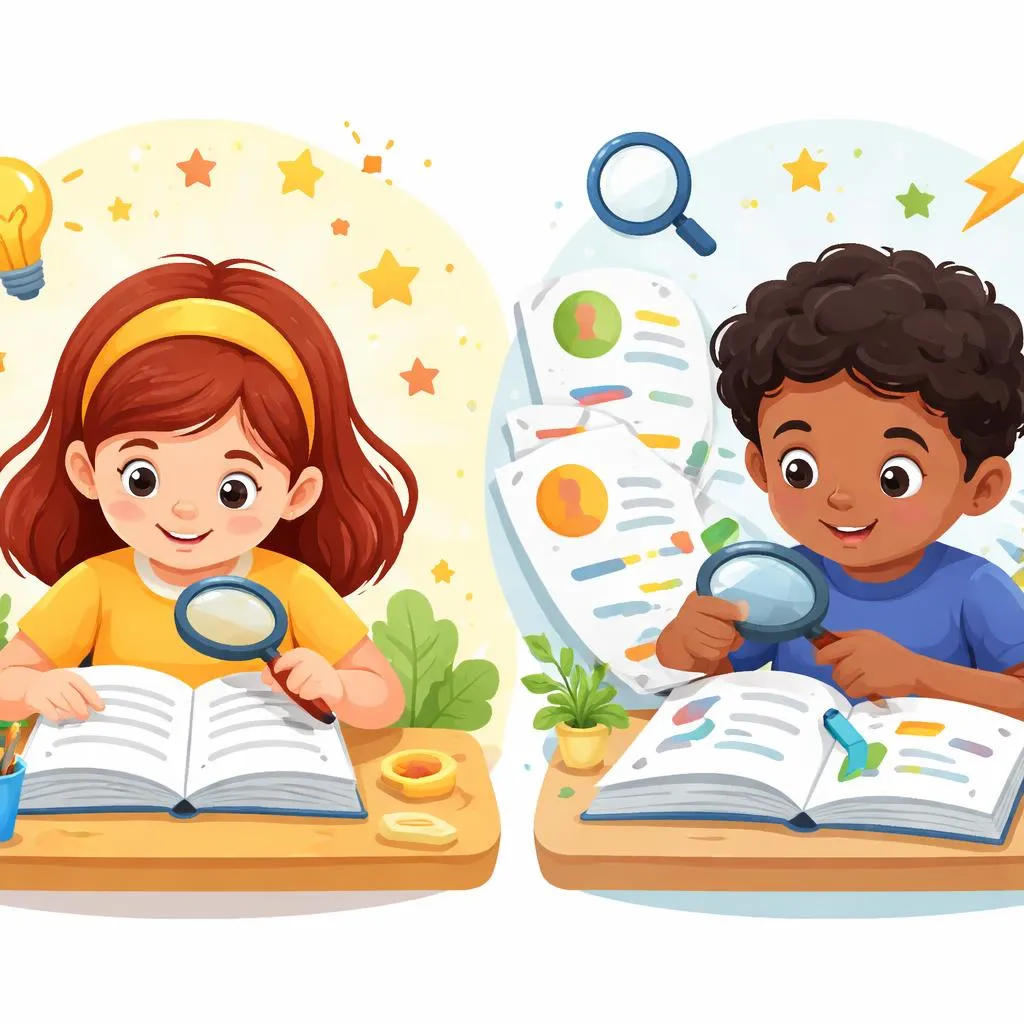

Hello, word explorer! Do you love looking at words and pages? What do you do with a new book? What do you do with a long menu? Do you read every word for fun? Or do you scan the page for one thing? They both seem to mean looking at text. But are they the same? They are like two different ways to explore a forest. One is a slow, careful walk. One is a quick search for treasure. Let's find out! Today, we explore the word friends "read" and "scan". Knowing their secret is a superpower. It helps you read smarter. Let's start our reading adventure!
First, let's be Reading Detectives. Look at home. Here are two sentences. "I love to read my comic book from the first page to the last." "I need to scan the movie times to find one that starts at 7 PM." They both involve your eyes on text. A comic book. A movie schedule. Do they sound the same? One feels like a fun journey. One feels like a quick search. Can you sense it? Great observation! Now, let's look closer.
Adventure! Into the World of Looking at Words
Welcome to the world of text! "Read" and "scan" are two different explorers. Think of "read" as a slow, careful walk. You enjoy every word. You understand the full story. Think of "scan" as a quick search for treasure. Your eyes move fast. You look for one specific thing. Both use your eyes. But one is for full understanding. One is for finding a fact. Let's learn about each one.
The Careful Walk vs. The Treasure Hunt Think about the word "read". To "read" feels calm and complete. It is the main word. You look at words. You understand their meaning. You read a book. You read a sign. Please read this. It is for full stories and ideas. Now, think about "scan". To "scan" feels fast and focused. Your eyes move quickly over the text. You look for a name, a time, or a word. You scan a list for your name. You scan a page for a number. "Read" is the walk. "Scan" is the hunt. One is for understanding everything. The other is for finding one thing.
Slow and Complete vs. Fast and Specific Let's compare their speed and goal. "Read" is often slower. You want to know all the information. You read a chapter for homework. You read a story for fun. The goal is comprehension. "Scan" is always faster. The goal is not to read everything. The goal is to find a key detail. You scan a menu for pizza. You scan the questions on a test. "Read" is complete. "Scan" is selective. One is a full meal. The other is a quick snack.
Their Special Word Partners and Common Uses Words have best friends. "Read" loves stories, books, and information. Read a novel. Read the instructions. Read carefully. "Scan" loves lists, pages, and documents. Scan a page. Scan the crowd. Scan for errors. Scan a barcode. Note: You "read" a text message. You "scan" an email for a date. A student "reads" a textbook. A student "scans" their notes before a test.
Let's visit a school scene. In English class, you get a new story. You sit down quietly. You look at each sentence. You follow the characters. You are going to read the story. This is for full understanding. Later, the teacher writes ten questions on the board. You look over them quickly. You are not reading every word slowly. You are looking for the easy ones first. You scan the questions. The word "read" fits the story. The word "scan" fits the quick look at the questions.
Now, let's go to the playground. Your friend gives you a long list of game rules. You sit on a bench. You go through each rule carefully. You want to play correctly. You read the rules. The game starts. You are "it". You need to find everyone. You look quickly around the playground. Your eyes move fast over the area. You scan the playground for your friends. The word "read" fits the careful rule check. The word "scan" fits the quick visual search.
Our Little Discovery So, what did we find? "Read" and "scan" both involve looking at text or a scene. But they are very different. To "read" is to look at words or symbols and understand their full meaning. It is a complete, often slower activity. You do it for stories, information, or instructions. To "scan" is to look over something very quickly to find specific information. Your eyes move fast. You do not read every part. You read a book chapter. You scan that chapter for a date. Knowing this helps you describe how you look at information perfectly.
Challenge! Become a Reading Word Champion
Ready for a reading test? Let's try your new skills!
"The Best Choice" Challenge Let's imagine a nature scene. An ant finds a new food source. It returns to the colony. It shares the news with another ant. They touch antennas carefully. They share the full message. The second ant understands the complete directions. It is like it read the message. This is for full, careful understanding. A hawk flies high in the sky. It does not look at every leaf on every tree. Its sharp eyes move quickly over the ground. It looks for one thing: movement. The hawk scans the field for a mouse. "Read" wins for the ant's detailed message. "Scan" is the champion for the hawk's quick, targeted search.
"My Sentence Show" Your turn to create! Here is your scene: Getting ready for a weekend trip with your family. Can you make two sentences? Use "read" in one. Use "scan" in the other. Try it! Here is an example: "I sat down to read the new guidebook about the city we are visiting." This is for full, careful understanding. "My mom asked me to quickly scan the weather website to see if it will rain on Saturday." This is a quick search for one piece of information. Your sentences will show two ways to look for information!
"Eagle Eyes" Search Look at this sentence. Can you find the word that could be better? Let's check a home context. "I spent the whole afternoon scanning my new library book because the story was so exciting." Hmm. If the story was exciting and you spent the whole afternoon, you were reading it completely and carefully. The word "reading" is the correct choice. "Scanning" means looking over it quickly for details, not enjoying the whole story. "I spent the whole afternoon reading my new library book because the story was so exciting." Using "scanning" here makes it sound like you were just flipping pages fast. Did you spot it? Excellent word work!
Harvest and Action! Turn Knowledge Into Your Superpower
Great exploring! We started thinking "read" and "scan" were similar. Now we know they are two different lookers. We can enjoy a slow "read". We can do a fast "scan". You can now talk about how you look at information with perfect accuracy. This is a great skill for school and life.
What you can learn from this article: You can now feel that to "read" is to look at words carefully and completely to understand a story, instructions, or information, and it is usually a slower activity where you try to understand everything. You can now feel that to "scan" is to look over text, a list, or even a place very quickly to find one specific piece of information, and your eyes move fast without reading every single word. You know that you read a novel for fun, but you scan a class schedule to find your next room. You learned to match the word to your goal: "read" for full understanding and enjoyment, "scan" for quick searching and finding.
Life practice application: Try your new skill today! Be a reading detective. Look at your homework. Will you read the chapter to learn? Or will you scan it to find an answer? Next time you look for something, name your action. Say, "I need to read these game rules." or "Let me scan this menu for ice cream." Tell a friend about a book you love to read. Describe a time you had to scan a page to find a fact. You are now a master of reading words! Keep exploring the wonderful world of information.