
Opening Introduction
Leo and Mia were helping their dad bring a big box from the attic. It was heavy. They opened it. Inside, they found a green tree made of plastic, shiny balls, and a star. "It's the Christmas box!" said Dad. "Every year, we do the same special things. We put up the tree. We hang stockings. We sing songs. These are traditions. And every item, like the star or the stocking, is a symbol. It has a special meaning. Let's learn all about Christmas traditions and symbols in English. Knowing the words and stories makes the holiday even more magical." Leo held a shiny red ball. A tradition? A symbol? This was a new way to look at Christmas. Let's explore together.
Core Knowledge Explanation
Christmas is a holiday celebrated on December 25th. For many people, it is a time for family, giving, and joy. Over many years, people have created special activities and used special objects. These are the Christmas traditions and symbols in English we know today. A tradition is something people do again and again, every year. A symbol is an object that stands for a bigger idea. Let's learn about the most famous ones.
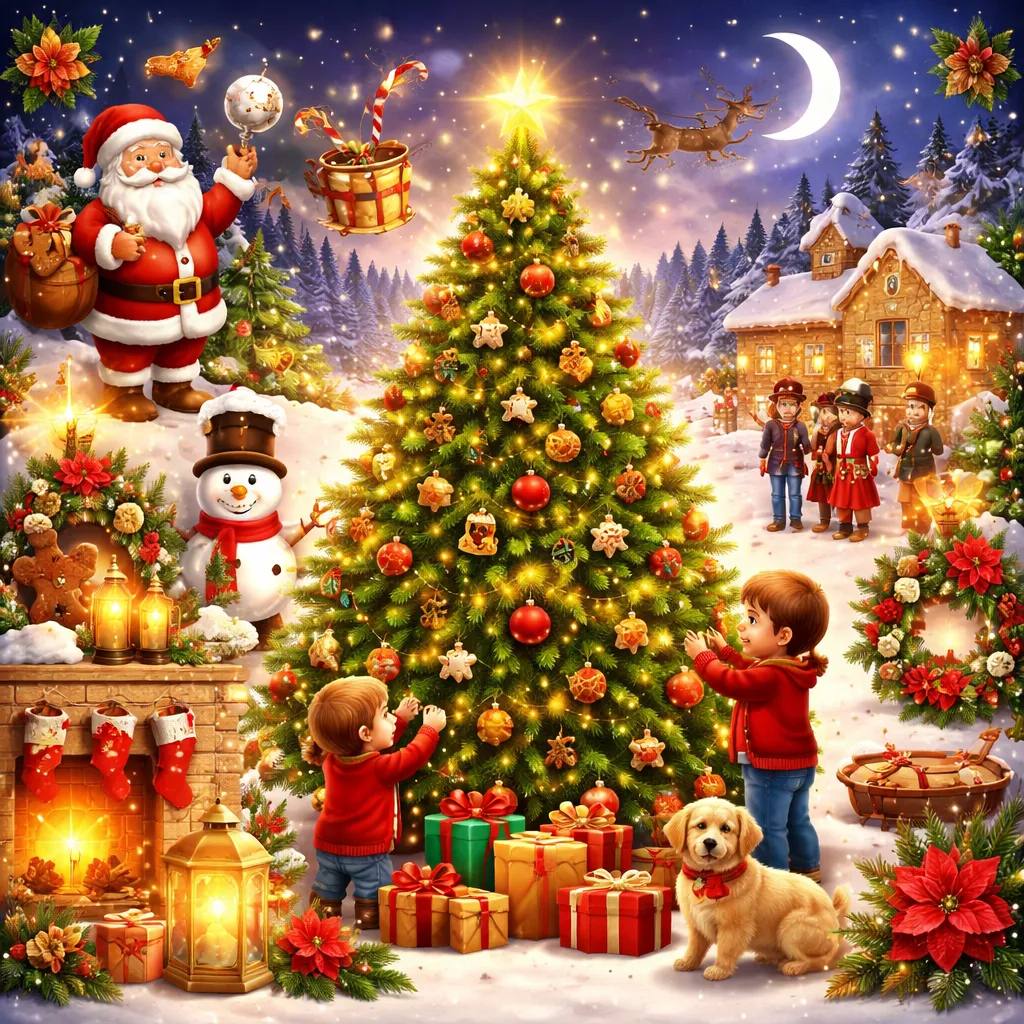
First, the Christmas tree. This is a big tradition. Families bring a pine tree inside their home. They decorate it with lights, balls, and a star on top. The evergreen tree is a symbol of life and hope in the middle of winter. The lights symbolize light in the dark. The star on top represents the Star of Bethlehem from the Christmas story. Another tradition is hanging stockings. Children hang empty socks by the fireplace. The story says Santa Claus fills them with small gifts and candy. The stocking is a symbol of surprise and generosity.
Santa Claus is a major symbol. He is a jolly man with a white beard and a red suit. The tradition is that he brings gifts to children on Christmas Eve. He travels in a sleigh pulled by reindeer. The most famous reindeer is Rudolph with a red nose. Santa symbolizes joy and giving. Giving gifts is a tradition. People wrap presents and put them under the tree. This symbolizes love and thoughtfulness. We also send Christmas cards to friends and family. This is a tradition of sharing good wishes.
Singing Christmas carols is a happy tradition. People go door to door or sing at home. Songs like "Jingle Bells" and "Silent Night" are carols. They symbolize celebration and peace. Another tradition is the Advent calendar. It is a special calendar with 24 little doors. You open one door each day in December until Christmas. Behind each door is a picture or a small chocolate. It symbolizes counting down to the big day. A Christmas wreath is a circle of evergreen branches. People hang it on the door. The circle has no end. It symbolizes eternal life and welcome.
These are the main Christmas traditions and symbols in English. Each one has a history and a reason. When you know the words and the meanings, you are not just decorating a tree. You are taking part in a story that is hundreds of years old. It connects you to families all over the world.
Fun Interactive Learning
Let's play a game called "Tradition Charades." Write the names of traditions and symbols on cards: Decorate the tree, Hang stockings, Sing carols, Open Advent calendar, Wrap a gift. Put them in a bowl. One player picks a card and acts it out. How do you act out "decorate the tree"? You might pretend to hang a ball on a branch. How do you act out "sing carols"? You might open your mouth and pretend to sing. The others guess. This is a fun way to remember the Christmas traditions and symbols in English.
Another activity is "Make Your Own Advent Calendar." Get a piece of cardboard. Draw 24 boxes. Number them 1 to 24. In each box, draw a simple Christmas symbol: a candy cane, a bell, a star, a gift. Every day in December, color one box. Say what the symbol is. "Today's symbol is a bell. Bells ring to celebrate!" This makes you wait and learn. You can also have a "Symbol Hunt" in your house. How many Christmas symbols can you find? A wreath on the door? A stocking? A picture of Santa? Make a list. This makes you a super observer of the Christmas traditions and symbols in English all around you.
Expanded Learning
Christmas traditions are different in every country. In England, people pull Christmas crackers at dinner. They make a bang and have a small toy inside. In Mexico, families have posadas, which are processions and parties. In Sweden, a girl dressed as Santa Lucia wears a crown of candles. But many Christmas traditions and symbols in English are shared, like the tree and Santa Claus. This shows how cultures mix and share joy.
Long ago, people had winter festivals with lights and greenery. The modern Christmas took these old ideas and added new ones. The story of Santa Claus comes from a real person, Saint Nicholas. He was a kind bishop who gave gifts. Over time, the story changed and grew. The poem "The Night Before Christmas" and Coca-Cola ads helped create the Santa we know today. Learning the history of the Christmas traditions and symbols in English is like being a holiday historian. It makes the season deeper and more interesting. Let's sing a Christmas tradition song. Sing to the tune of "Jingle Bells."
Christmas tree, Christmas tree, shining oh so bright! With a star on top, it's a lovely sight! Stockings by the fire, waiting for a treat! Santa Claus is coming down every street! Advent calendar, we count the days! Singing carols, giving praise! Oh, Christmas time, Christmas time, full of joy and cheer! Learning traditions every year!
What You Will Learn
You are learning about culture, history, and celebration. You are learning the key Christmas traditions and symbols in English: Christmas tree, lights, star, stockings, Santa Claus, reindeer, gifts, Christmas cards, carols, Advent calendar, wreath. You are also learning the words tradition and symbol, and what they mean.
You are learning descriptive and explanatory sentences. You can say, "We put a star on top of the Christmas tree." You can explain, "The Advent calendar helps us count the days until Christmas." You can share, "Singing carols is my favorite tradition." You are using English to talk about cultural practices with understanding and joy. This builds both language and social skills.
You are building wonderful knowledge and abilities. You are building cultural vocabulary. You learn specific words for the holiday season. You are building historical awareness. You see how customs develop. You are building observation skills. You notice symbols in decorations. You are building patience and anticipation. You learn to enjoy the waiting. You are building family connection. You understand the meaning behind shared activities.
You are forming a reflective and joyful habit. The habit of finding meaning in celebration. You learn that holidays are not just about getting, but about doing, sharing, and understanding. Learning about Christmas traditions and symbols in English enriches your experience and allows you to share the stories with others.
Using What You Learned in Life
Use your new words as you do each tradition. When you hang a stocking, say, "This is a Christmas tradition. The stocking is a symbol for gifts." When you see a wreath, tell a friend, "The wreath is a circle, a symbol of welcome." When you open your Advent calendar, name the picture inside. "It's a candy cane, a sweet Christmas symbol." This makes you an active participant.
At school, you can share in a show-and-tell. "I brought a Christmas ornament. It is a symbol of light on the tree." You can also write a letter to Santa in English, using the words you learned. When you read Christmas stories or watch movies, point out the traditions and symbols you see. The more you use the vocabulary of Christmas traditions and symbols in English, the more the holiday will feel like a story you are a part of, in every language.
Closing Encouragement
You are a tradition keeper. You are a symbol spotter. You are a joyful and curious holiday expert. I am so proud of you. Learning all about Christmas traditions and symbols shows you have a heart full of wonder and a mind eager to understand.
May your Christmas be bright with the light of understanding and the warmth of tradition. Remember, you are now a storyteller of the season, sharing the meaning behind the magic.
You are knowledgeable, you are festive, and you are learning the language of celebration. Great work, my wonderful Christmas scholar.