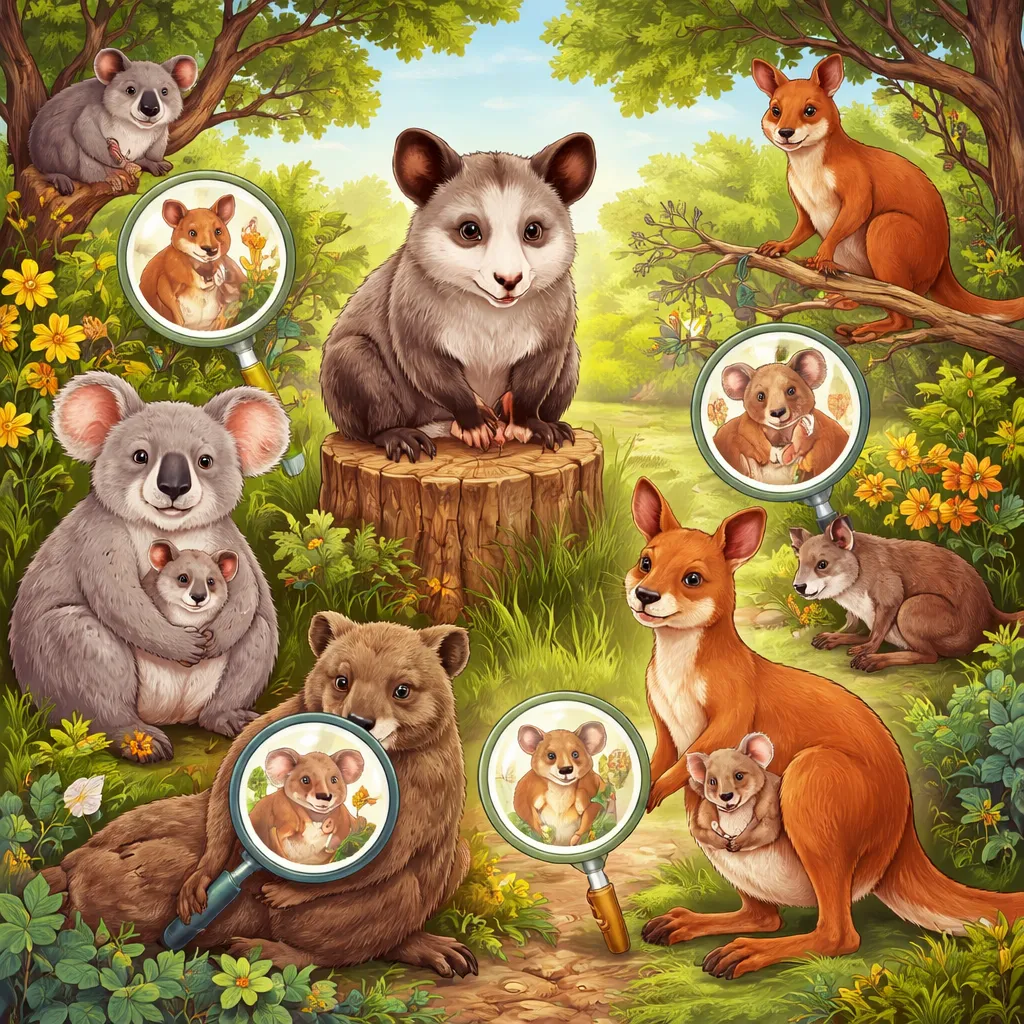

What Is This Animal?
An opossum is a medium-sized mammal with grayish fur, a pointed face, and a long, hairless tail. It has a round body and short legs. Its tail is prehensile, meaning it can wrap around branches. Opossums are the only marsupials found in North America.
Opossums carry their babies in a pouch. Female opossums have a pouch on their belly. Newborns crawl into the pouch after birth. They grow there for about two months. This is how marsupials raise their young.
These animals are found throughout North America. They live in forests, farmlands, and cities. They are nocturnal. They come out at night to search for food. They are famous for playing dead when frightened. This behavior is called playing possum.
For children, opossums are interesting. Their pouches and playing dead trick make them unique. Learning about opossums teaches children about marsupials, animal defenses, and the helpful role these animals play in nature.
English Learning About This Animal
Let us learn the English word opossum. We say it like this: /əˈpɒsəm/. The o sounds like “uh.” The pos sounds like “poss.” The sum sounds like “sum.” Put them together: opossum. Say it three times. Opossum. Opossum. Opossum. Many people say possum for short.
Now let us learn words about an opossum’s body. The pouch is where the babies grow. The tail is long and hairless. It can grip branches. The fur is gray and thick. The claws are sharp for climbing. The joeys are baby opossums.
There is a wise saying about opossums. People say, “The opossum plays dead to stay alive.” This describes their famous defense. Another saying is, “An opossum in the yard means fewer ticks.” This reflects their helpful role eating pests.
These English words help children understand opossum anatomy. When they say pouch, they learn how marsupials carry babies. When they say joeys, they know the babies. Parents can practice these words while looking at pictures. Point to the parts. Say the words together.
Animal Facts and Science Knowledge
Opossums belong to the marsupial family Didelphidae. They are the only marsupials in North America. Their ancestors came from South America. They spread north millions of years ago. There are over one hundred opossum species in the Americas. The Virginia opossum is the most common in North America.
Opossums live in many habitats. They live in forests, farmlands, and cities. They are adaptable. They make dens in hollow logs, brush piles, and under buildings. They are not picky. They will live wherever they find food and shelter.
Opossums are omnivores. They eat insects, small animals, fruits, and garbage. They are important pest controllers. They eat ticks, cockroaches, and mice. A single opossum can eat thousands of ticks in a season. They help keep gardens and yards healthy.
Opossums have special abilities. They can play dead. When frightened, they fall over and become still. Their body goes limp. They drool. They release a smell that makes predators think they are sick. They can stay like this for hours. This defense fools many predators.
Opossums have a prehensile tail. They can hang from branches. Their tails are strong enough to hold them. They are excellent climbers. They have opposable thumbs on their back feet. This helps them grip branches. They have fifty teeth, more than any other North American mammal.
How to Interact With This Animal Safely
Opossums are wild animals. They are not pets. They are generally not aggressive. They prefer to avoid people. If you see an opossum, give it space. It will likely move away. If it plays dead, leave it alone. It will wake up and leave when safe.
Teach children not to touch opossums. They may bite if they feel trapped. They are not dangerous but should be respected. Watch them from a window. Enjoy watching them from a distance.
If you find an opossum in your yard, do not chase it. It is looking for food. It will move on. Secure trash cans. Do not leave pet food outside. This reduces the chance of opossums staying near the house.
If you find an injured opossum, do not touch it. Call a wildlife rehabilitator. They have training to help wild animals. Do not try to care for it yourself. Wild animals need special care.
Opossums are helpful to have around. They eat ticks and other pests. They do not carry rabies often. Their body temperature is too low for the rabies virus to survive. They are beneficial neighbors in the backyard.
What Can We Learn From This Animal
Opossums teach us about defense. They play dead to survive. Children learn that sometimes the best way to handle a situation is to stay calm. Taking a moment, being still, and waiting can help us.
Opossums teach us about adaptability. They live in many places. They eat many foods. Children learn that being flexible helps us. Trying new things, going to new places, and adapting to change are good skills.
Opossums teach us about helpfulness. They eat pests that bother us. Children learn that helping others is valuable. Doing small helpful things, like cleaning up or sharing, makes the world better.
Opossums teach us about uniqueness. They are the only marsupials in North America. Children learn that being unique is special. Having something different about us makes us interesting.
Fun Learning Activities
Let us make learning about opossum fun. One activity is the opossum play dead game. Ask your child to pretend to be an opossum. When a predator comes, freeze. Lie still. Then get up and run away when safe. Say “opossum plays dead” and “opossum wakes up.”
Another activity is drawing an opossum. Look at pictures of opossums. Notice the gray fur, pointed face, and long tail. Draw an opossum with babies in its pouch. Add a tree branch. Label the parts. Say the words aloud.
Create a story about an opossum family. Ask your child what the mother does. Does she carry joeys in her pouch? Does she find food at night? Does she play dead when scared? Write a few sentences together. Let your child draw pictures. Read the story aloud.
Make an opossum craft. Use gray paper for the fur. Add a long, pink tail. Add a pouch with small babies inside. Add a pointed face and ears. Move the craft opossum. Practice saying “opossum carries joeys” and “opossum plays dead.”
Learn about marsupials. Talk about how opossums carry babies in pouches. Compare to other marsupials like kangaroos and koalas. Use words like “marsupial,” “pouch,” and “joeys.”
Learn about animal defenses. Talk about how opossums play dead. Compare to other animals with special defenses like skunks or armadillos. Use words like “defense,” “predator,” and “survival.”
These simple activities bring learning to life. Children build English vocabulary while playing. They learn science through understanding marsupials and animal behavior. They develop appreciation through learning about helpful backyard animals. Learning about opossum becomes a journey into the night. Each moment spent together strengthens language, curiosity, and a growing appreciation for the gray, pouch-carrying creatures that waddle through our yards, teaching us that playing dead can be a smart defense, that eating pests is a great way to help, and that being the only one of your kind in a whole continent is something to celebrate.