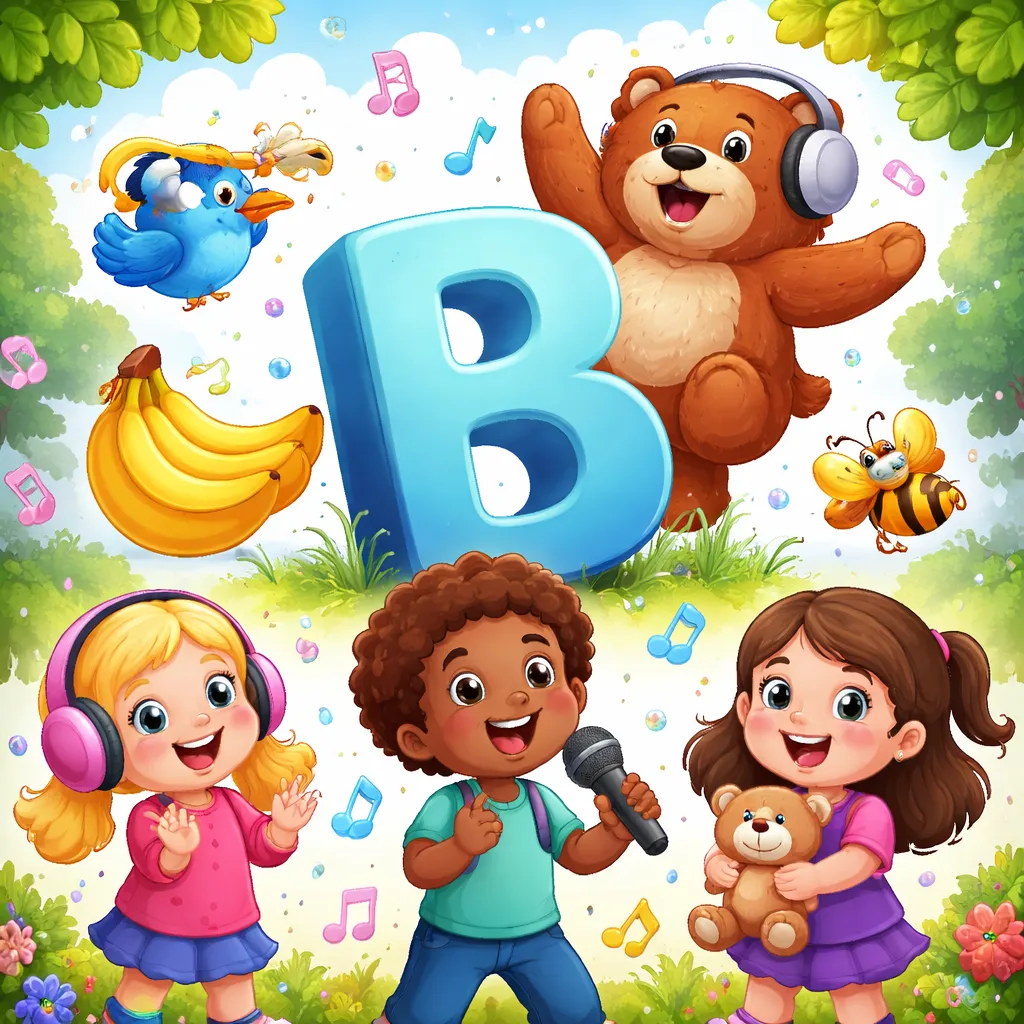

What Is This Situation? Music makes learning stick. When children sing, they remember. The letter B has a simple sound. B says "buh." Songs about B help children hear the sound and learn words that start with it.
Fun phonics songs for letter B give children a joyful way to learn. B says buh. Ball, bat, bear. Songs repeat the sound. They repeat the words. Children sing along. They learn without even trying.
This situation happens during music time, during car rides, during play. Songs are everywhere. Singing together is fun. And while children sing, they are building phonics skills.
These songs are best learned through repetition. Sing them again and again. Add actions. Add silly voices. The more you sing, the more the sound sticks.
Key English Phrases for This Situation Use phrases for introducing the song. "Let us sing a song about the letter B. B says buh. Listen to the sound."
Use phrases for singing. "Let us sing together. B says buh, B says buh. Ball and bat and bear. B says buh."
Use phrases for actions. "Let us do the actions. For ball, pretend to throw. For bat, pretend to swing. For bear, pretend to roar."
Use phrases for practicing. "Let us find the B sound in the song. Ball starts with B. Bat starts with B. Bear starts with B."
Use phrases for celebrating. "You sang the B song. Good job." "You found all the B words. You are a phonics star."
Simple Conversations for Kids Dialogue 1: Learning the B Song Parent: "Let us learn a song about the letter B. B says buh. Listen. B says buh, B says buh. Ball and bat and bear. B says buh." Child: "B says buh." Parent: "Yes. Now let us sing together."
This conversation introduces the song. The parent sings. The child joins. The sound becomes clear.
Dialogue 2: Adding Actions Parent: "Let us add actions to our B song. For ball, pretend to throw. For bat, pretend to swing. For bear, pretend to roar. Ready?" Child: "Yes." Parent sings. Child does actions. Parent: "Good job. You sang and moved."
This conversation adds actions. The child moves. The learning is active.
Dialogue 3: Finding B Words Parent: "Let us find all the B words in our song. Ball. Does ball start with B?" Child: "Yes. Buh-ball." Parent: "Good. Bat?" Child: "Yes. Buh-bat." Parent: "Bear?" Child: "Yes. Buh-bear." Parent: "You found all the B words."
This conversation finds B words. The child identifies the sound. The learning continues.
Vocabulary You Should Know B is the letter that makes the "buh" sound. You can say "B says buh." This is the letter.
Ball is a round toy. It starts with B. You can say "Buh-ball." This is a B word.
Bat is an animal or a sports tool. It starts with B. You can say "Buh-bat." This is a B word.
Bear is a big furry animal. It starts with B. You can say "Buh-bear." This is a B word.
Sound is what you hear. You can say "B says buh." This is the phonics skill.
Song is music with words. You can say "Let us sing the B song." This is the learning tool.
How to Use These Phrases Naturally Use a musical and happy tone. Songs are joyful. Your voice should show it. Sing with energy. Your child will join.
Say the phrases with rhythm. "B says buh, B says buh." Keep the beat. Clap along.
Add actions. Throw the ball. Swing the bat. Roar like a bear. Movement makes the song memorable.
Repeat often. Sing the same song many times. Repetition builds memory. Each time, the sound gets stronger.
Sing anywhere. In the car. At bath time. Before bed. Songs fit into any moment.
Common Mistakes to Avoid One mistake is singing too fast. Go slow. Let your child hear the B sound clearly. Speed comes later.
Another mistake is forgetting the sound. Remind your child "B says buh." Connect the sound to the song.
Some children add extra sounds. "Buh-uh" instead of "buh." Model the pure sound. "Buh. Quick and clean."
Avoid making it a lesson. Songs are for fun. If your child is not in the mood, sing another day. Keep it joyful.
Tips for Parents and Practice Ideas Make up your own B song. Use your child's name. "B says buh, B says buh. Ben and ball and bear." Personal songs are meaningful.
Use instruments. Shakers, drums, or clapping. Rhythm makes the song more fun.
Read B books. Many books have B words. Read them. Sing the B song after.
Draw B pictures. Your child draws a ball, a bat, a bear. They sing the song as they draw.
Sing with a puppet. The puppet sings the B song. Your child sings along. Puppets make it playful.
Fun Practice Activities Play the B song game. Sing the song. Stop. Your child says the next B word. The game builds memory.
Make B song cards. Draw a ball, a bat, a bear. Your child holds up the card when you sing the word. The cards make it visual.
Create a B song dance. Move to the beat. Throw the ball. Swing the bat. Roar like a bear. The dance makes learning active.
Sing B songs in different voices. Loud voice. Quiet voice. Silly voice. The variations make it fun.
Record your child singing. Play it back. They hear their own voice. They feel proud.
Fun phonics songs for letter B make learning joyful. B says buh. Ball, bat, bear. When children sing, they remember. They hear the sound. They learn the words. With playful repetition and patient guidance, your child will master the B sound. They will sing "B says buh." They will find B words everywhere. They will love phonics. That is the power of music. One song at a time, your child will learn. And you will be there to sing along.