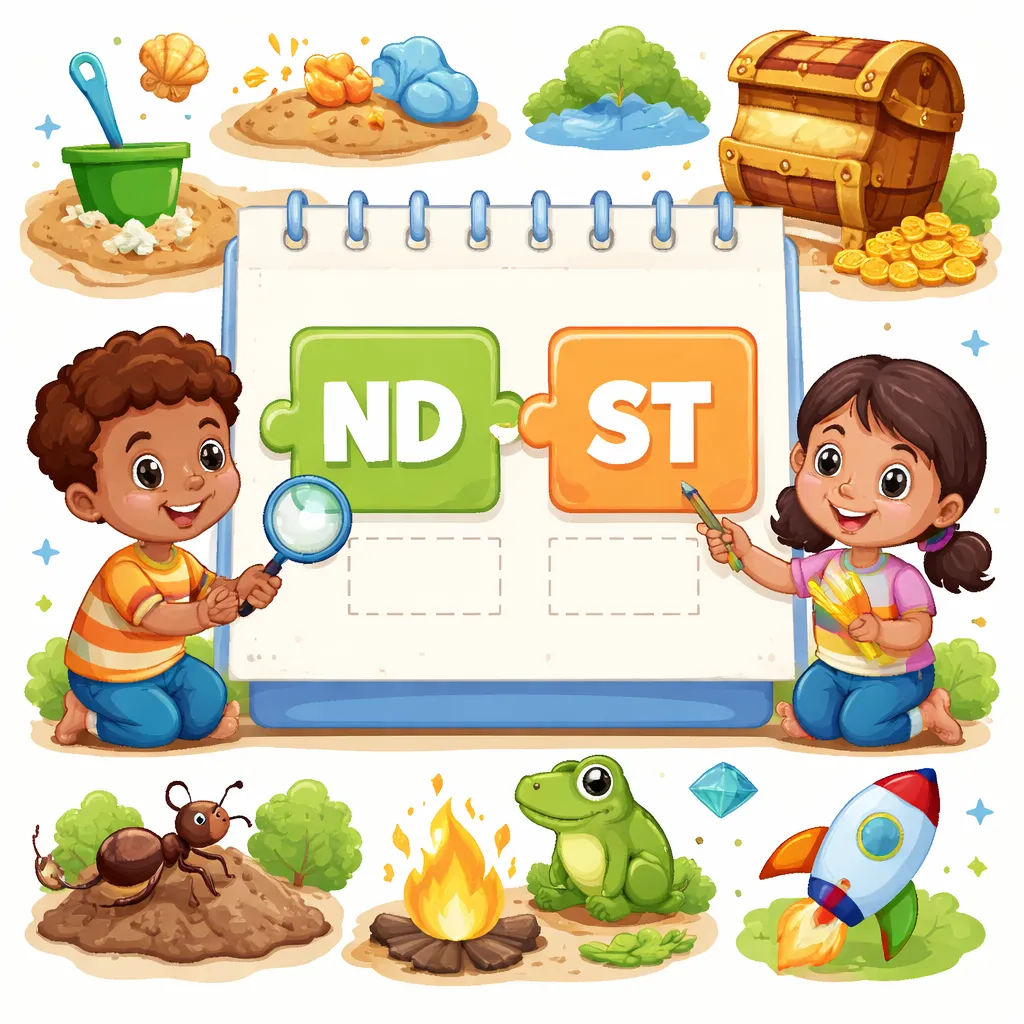

What Is This Situation? Ending blends are two consonants at the end of a word. ND and ST are common ending blends. ND is like in hand and wind. ST is like in nest and fast. Learning these blends helps children read and spell longer words.
Ending blends ND and ST words give children practice with these important final sounds. Words like hand, sand, and wind end with ND. Words like nest, fast, and last end with ST. Both blends have two sounds that come together.
This situation happens when children are learning to read longer words. They see "hand" and need to blend the N and D together. They see "nest" and need to blend the S and T together. Practice makes these blends automatic.
These words are best learned through playful practice. Word lists, games, and stories make the blends stick. With ND and ST, your child learns that endings can have two consonants.
Key English Phrases for This Situation Use phrases for introducing ending blends. "ND is a blend at the end of words. N and D together. Listen: hand. Ha-nd." "ST is a blend at the end of words. S and T together. Listen: nest. Ne-st."
Use phrases for practicing. "Let us say ND words. Hand, sand, wind, find." "Now ST words. Nest, fast, last, best."
Use phrases for comparing. "Hand ends with ND. Nest ends with ST. They sound different. Ha-nd. Ne-st."
Use phrases for reading. "Let us read these ND words. Hand, sand, wind." "Now ST words. Nest, fast, last."
Use phrases for celebrating. "You read an ND word. Good job." "You read an ST word. You know your ending blends."
Simple Conversations for Kids Dialogue 1: Learning ND Parent: "Let us learn the ND ending blend. N and D together make 'nd.' Listen: hand. Ha-nd. Say it with me." Child: "Hand." Parent: "Good. Now sand. Sa-nd." Child: "Sand." Parent: "Yes. ND says 'nd.'"
This conversation introduces the ND blend. The parent models. The child repeats. The sound becomes clear.
Dialogue 2: Learning ST Parent: "Now let us learn the ST ending blend. S and T together make 'st.' Listen: nest. Ne-st. Say it." Child: "Nest." Parent: "Good. Now fast. Fa-st." Child: "Fast." Parent: "Yes. ST says 'st.'"
This conversation introduces the ST blend. The child practices. The sound becomes clear.
Dialogue 3: Reading Both Blends Parent: "Let us read ND words. Hand, sand, wind, find." Child: "Hand. Sand. Wind. Find." Parent: "Good. Now ST words. Nest, fast, last, best." Child: "Nest. Fast. Last. Best." Parent: "You read all the ending blends. Good job."
This conversation practices reading both blends. The child reads. The parent praises. The skill builds.
Vocabulary You Should Know Hand is part of your body. It ends with ND. You can say "Wash your hands." Ha-nd.
Sand is tiny grains on the beach. It ends with ND. You can say "Play in the sand." Sa-nd.
Wind is moving air. It ends with ND. You can say "The wind is strong." Wi-nd.
Find means to discover. It ends with ND. You can say "I will find my toy." Fi-nd.
Nest is where birds live. It ends with ST. You can say "The bird is in the nest." Ne-st.
Fast means quick. It ends with ST. You can say "Run fast." Fa-st.
Last means final. It ends with ST. You can say "This is the last one." La-st.
Best means very good. It ends with ST. You can say "You are the best." Be-st.
How to Use These Phrases Naturally Use a clear and patient tone. Ending blends take practice. Your patience says "You can learn this."
Say the phrases with word lists. Write the words. Read them together. The list makes the pattern clear.
Practice one blend at a time. Master ND before adding ST. Do not rush.
Use your finger. Point to the last two letters. "N and D together make nd." The finger makes the blend visual.
Celebrate when they read a blend. "You read hand. Good job." Celebration reinforces learning.
Common Mistakes to Avoid One mistake is saying the letters separately. "Ha-n-d" instead of "ha-nd." Teach the blend as one unit. "Ha-nd."
Another mistake is confusing ND and ST. They sound different. Practice the difference. "Ha-nd. Ne-st."
Some children add extra sounds. "Ha-n-duh" instead of "hand." Model the clean blend. "Ha-nd."
Avoid moving too fast. Master one blend before adding another.
Tips for Parents and Practice Ideas Make an ND and ST chart. Write the blends at the top. Add example words. Hand, sand, wind. Nest, fast, last. Your child refers to the chart.
Use magnetic letters. Spell hand. Point to the ND blend. Spell nest. Point to the ST blend. Hands-on learning works.
Create word cards. Write ND and ST words. Your child reads them. The cards build recognition.
Play ending blend bingo. Make bingo cards with ND and ST words. Call out a word. Your child finds it. Bingo makes practice fun.
Sing the ending blend song. "ND says nd, hand and sand. ST says st, nest and fast. Ending blends at the end of words. Read them with me, you will be heard." Music makes learning fun.
Fun Practice Activities Make an ending blend book. Each page has a blend. "ND words: hand, sand, wind." Your child draws pictures. The book is a reference.
Play ending blend memory. Make pairs of word cards. Turn them over. Find the matching pair. The game builds word recognition.
Use an ending blend detective game. Give your child a list of words. They circle ND words in one color, ST words in another. The game builds discrimination.
Create an ending blend hunt. Hide word cards around the room. Your child finds them and reads them. The hunt makes reading active.
Draw ending blend pictures. Your child draws a hand, sand, a nest, a fast runner. They label each drawing. The pictures make the words real.
Ending blends ND and ST words help children read and spell final consonant pairs. Hand, sand, wind. Nest, fast, last. Each blend has two sounds that come together at the end. With playful practice and patient guidance, your child will master these blends. They will see "hand" and blend ND. They will see "nest" and blend ST. They will read with confidence. That is the power of ending blends. One blend at a time, your child will learn. And you will be there to celebrate every word.