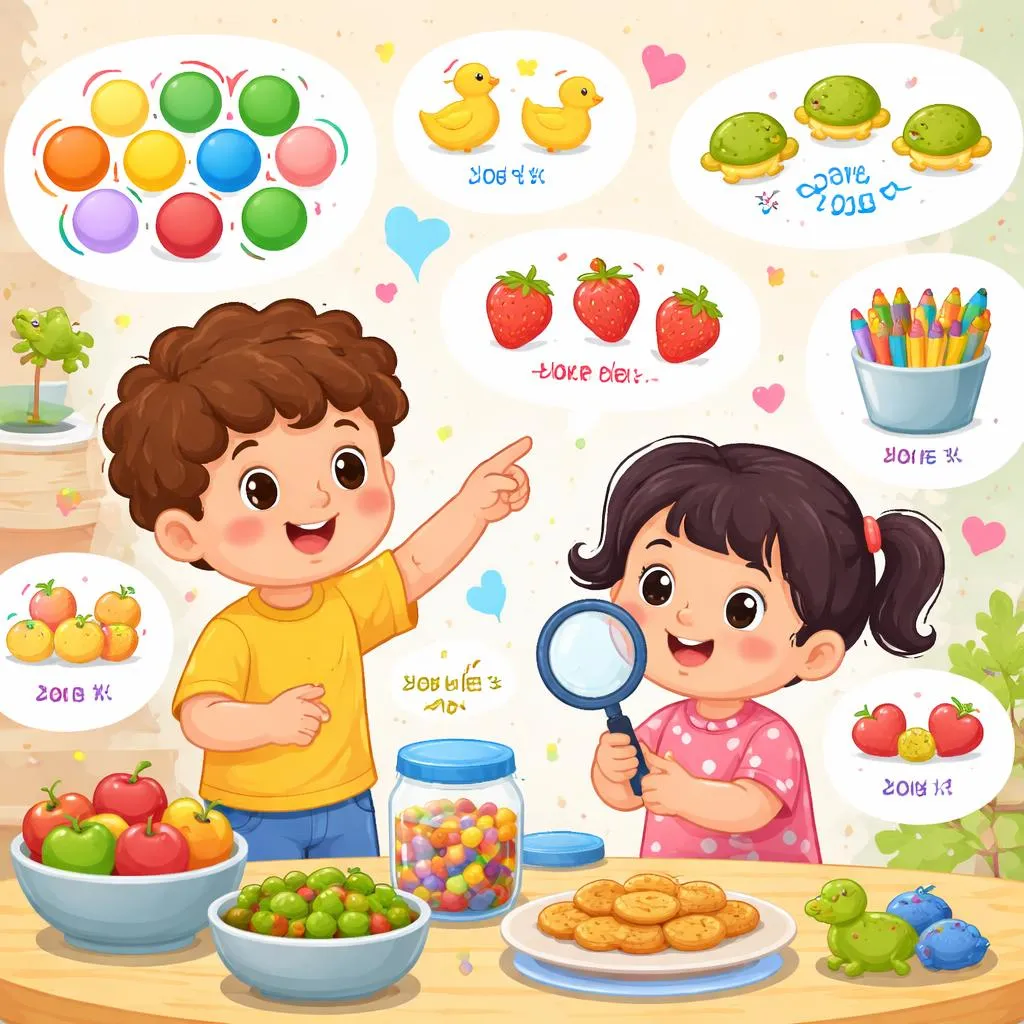

Quantifiers are words that tell us how much or how many of something we have. For a four-year-old, these words open up a whole new world of expression. Instead of just saying "I want milk," they can learn to say "I want some milk" or "I want more milk." This small change makes a big difference in how clearly they can communicate their needs and observations. Learning the 50 most common quantifiers for 4-year-olds helps children describe their world with greater accuracy. They can talk about how many cookies they have, how much juice is left, or if there are any toys to play with. These words give them power over their language and help them feel more understood.
What Are Quantifiers? Quantifiers are special words that come before nouns to give information about quantity. They answer questions like "How many?" or "How much?" Some quantifiers work with things we can count, like apples or toys. Others work with things we cannot count easily, like water or sand. For a young child, understanding this difference comes naturally through practice and everyday conversations.
Think about a typical snack time. Your child might look at a plate of grapes. They might say "grapes" to ask for some. But when they learn quantifiers, they can say "more grapes" or "some grapes." This makes their request much clearer. You can respond better because you understand exactly what they mean.
Quantifiers include common words like all, some, any, no, none, more, less, many, much, each, every, both, either, and neither. When we talk about the 50 most common quantifiers for 4-year-olds, we are really talking about using these key words in combination with familiar nouns that children use every day.
Meaning and Explanation of Key Quantifiers Let us explore the meaning of the most important quantifiers for your child to learn. Each one has a special job in helping us talk about amounts.
All: This means everything or everyone in a group. We use it when nothing is left out. For example, "I ate all my peas." Every single pea is gone.
Some: This means an amount that is not exact. It could be a few or a little. We use it when the exact number does not matter. For example, "I want some water please." We do not know exactly how much, but we know it is not all the water.
Any: We often use this in questions or when there is nothing. For example, "Do you have any crayons?" or "I do not have any juice left."
More: This means an additional amount. Your child probably already knows this word well. "Can I have more crackers?" It is one of the most useful quantifiers for young children.
No: This means not any or zero. For example, "There are no more cookies." It tells us the amount is nothing.
Many: We use this for things we can count when there is a large number. For example, "How many stars are in the sky?" or "I have so many toys."
Much: We use this for things we cannot count. For example, "How much milk do you want?" It asks about the amount of something you cannot count as individual pieces.
Categories or Lists: The 50 Most Common Quantifiers in Action Here is a practical list of the 50 most common quantifiers for 4-year-olds. Remember, the quantifier words themselves are a small set, but they become fifty when we pair them with nouns that children use daily. This list gives you a wonderful starting point for conversations and learning activities.
All + Noun
all the toys
all my friends
all the cookies
all the water
all day
all the animals
all the colors
all the books
all the blocks
all the family
Some + Noun 11. some juice 12. some crackers 13. some playtime 14. some help 15. some stickers 16. some sand 17. some paper 18. some crayons 19. some music 20. some sunshine
Any + Noun (for questions) 21. any milk 22. any toys 23. any friends 24. any apples 25. any paper 26. any glue 27. any tape 28. any time 29. any space 30. any bubbles
More + Noun 31. more food 32. more hugs 33. more stories 34. more songs 35. more paint 36. more playdough 37. more puzzles 38. more juice 39. more blankets 40. more kisses
No + Noun 41. no juice 42. no time 43. no problem 44. no noise 45. no mess 46. no shoes inside 47. no hitting 48. no running 49. no crying 50. no worries
Daily Life Examples with Quantifiers The best place to teach quantifiers is right in your own home during your normal daily activities. Children learn language best when it matters to them in the moment. Here are some ways to naturally use quantifiers throughout your day.
At breakfast time: You can ask questions that encourage quantifier use. "How much cereal do you want?" "Do you want some fruit?" "There is no more orange juice. Would you like some water instead?" When your child asks for something, you can model the answer. "Oh, you want more toast. Here is some more toast."
During play: When your child is playing with blocks, you can comment on what they are doing. "You used all the blue blocks. Can you find any red ones?" "There are so many cars in your garage." "Do you want more animals in your zoo?" This helps them hear quantifiers in a meaningful context.
Getting dressed: This is a perfect time for quantifier practice. "Which socks do you want? All your socks are in this drawer." "There are no clean pants left. We need to do laundry." "Do you have any pockets in your dress?"
At the grocery store: Shopping trips are full of quantifier opportunities. "We need some apples. Can you help me find them?" "Look, there are so many kinds of cereal." "We have all the things on our list. Let's go home."
Before bed: "Let's read one more story." "Do you have any energy left?" "I have so many hugs for you." "There is no more time for playing. It is time for sleep."
Printable Flashcards for Learning Quantifiers Flashcards are a simple and effective way to help your child remember quantifiers. You can make them together, which makes the learning experience even more meaningful. Here is how to create and use flashcards for the 50 most common quantifiers for 4-year-olds.
To make the flashcards, you will need some index cards or thick paper, markers or crayons, and maybe some old magazines for pictures. On one side of the card, write the quantifier phrase like "some crackers." On the other side, draw a simple picture or glue a magazine cutout that shows the idea. For "some crackers," you could draw a few crackers on a plate. For "all the cookies," you could draw an empty plate to show they are all gone.
Here are some fun ways to use your flashcards:
Name that card: Show your child the picture side and ask them to tell you what it shows. Encourage them to use the full phrase. "That is some crackers." If they just say "crackers," you can gently model the full phrase back to them. "Yes, some crackers."
Matching game: Make two sets of the same flashcards. Lay them all out face down and take turns flipping two cards over to find matches. When you find a match, say the phrase together.
Sorting game: Have your child sort the cards by the quantifier word. Put all the "some" cards in one pile and all the "more" cards in another pile. This helps them notice the pattern.
Storytelling with cards: Pick a few cards and use them to tell a silly story together. "Once upon a time, there was a bear who had some crackers. But then he wanted more crackers. He looked everywhere, but there were no crackers left."
Learning Activities or Games Games turn learning into play. When children are having fun, they absorb language without even trying. Here are some games that help teach the 50 most common quantifiers for 4-year-olds.
The Snack Time Game: During snack, give your child a small bowl of something like goldfish crackers or raisins. Then play a game where you ask for different amounts. "Can you give me some crackers?" "Now can you give me more crackers?" "Oh no, now there are no crackers left in my bowl." This physical experience with quantities helps the words stick.
The Treasure Hunt: Hide a few small toys or treats around a room. Then give your child clues using quantifiers. "You will find some toys in the kitchen." "There are no toys behind the sofa." "Look for more toys under the pillow." This gets them moving and listening carefully to the words.
The Clean-Up Game: Clean-up time is a perfect opportunity for quantifier practice. "Please put all the blocks in this bin." "Can you find any crayons under the table?" "We have so many books to put away." "There are no more cars on the floor. Good job."
The Shopping Game: Set up a little pretend store with some of your child's toys or play food. Take turns being the shopkeeper and the customer. The customer can say, "I would like some apples please." The shopkeeper can respond, "How many apples would you like?" or "I have so many apples today." This pretend play builds language skills naturally.
The "I Spy" Quantifier Game: Play I Spy, but focus on amounts. "I spy something that has many legs." (a caterpillar or a table) "I spy something that has no doors." (a ball) "I spy something that has some water in it." (a cup) This encourages your child to think about quantities in the world around them.
By weaving these words into your everyday conversations and play, you are giving your child a powerful tool for communication. Learning the 50 most common quantifiers for 4-year-olds happens naturally when children hear them often and get to use them in meaningful ways. There is no need for drills or pressure. Just talk, play, and enjoy watching your child's language grow. Every day brings new opportunities to explore how much and how many, and your child will surprise you with how quickly they pick up these useful words.