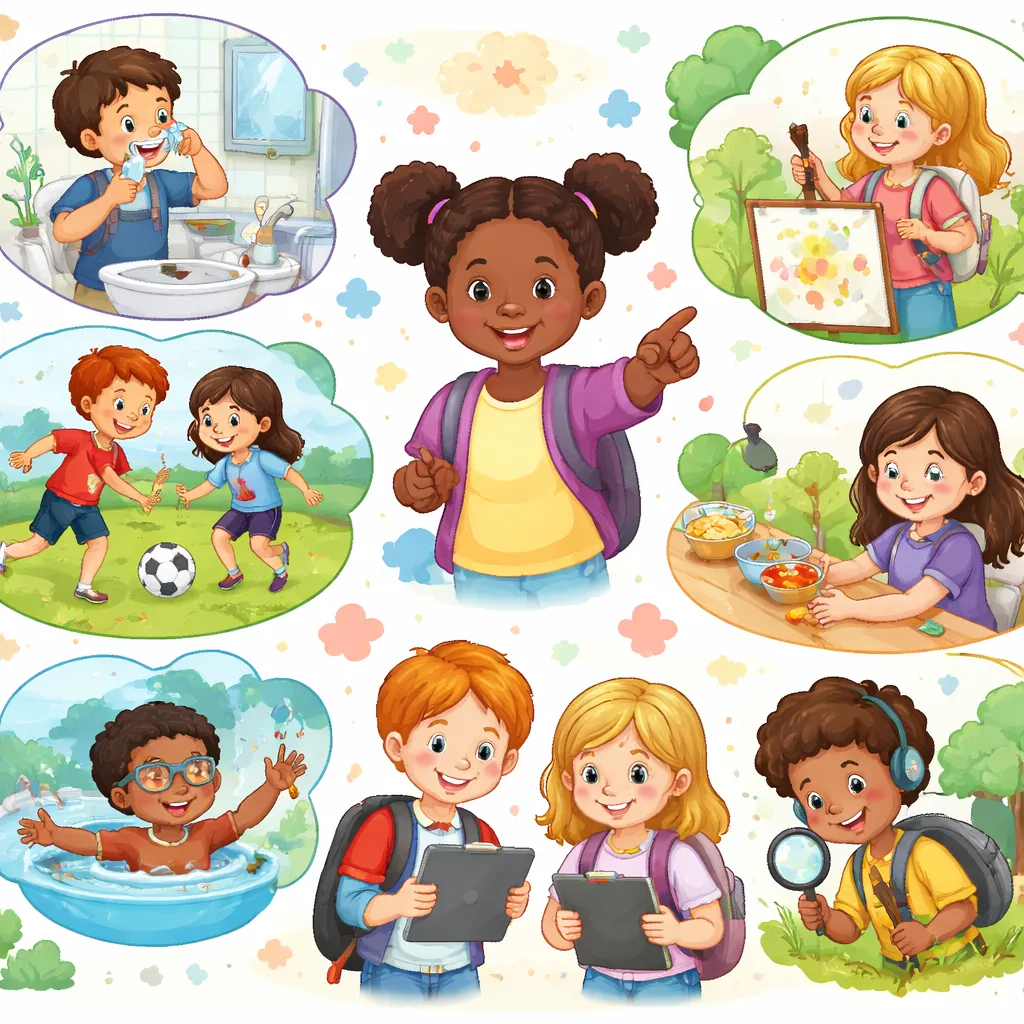

Your child loves to talk about what is happening right now. "I am playing!" "Mom is cooking!" "Look, it is raining!" These sentences use the present continuous tense. This tense describes actions happening at this very moment. Mastering the top 100 present continuous sentences for elementary students helps children describe current actions clearly and correctly. This guide will explain what present continuous is, list the most important examples, and show how to practice at home.
Meaning: What Is Present Continuous Tense? Present continuous tense describes actions that are happening right now, at this moment. It also describes temporary situations and future plans. The present continuous answers the question "What is happening now?"
Think about actions in progress. "I am eating dinner right now." "She is reading a book." "They are playing outside." These actions are happening at the moment of speaking.
Think about temporary situations. "I am living with my grandma this week." "He is staying home today." These are not permanent, just for now.
Think about future plans. "We are going to the park tomorrow." "She is coming to my party." These use present continuous to talk about arranged future events.
Present continuous uses the verb be plus the -ing form of the main verb. I am playing, you are playing, he is playing, they are playing. The top 100 present continuous sentences for elementary students cover all these uses.
Conjugation: How Present Continuous Works Present continuous follows a simple pattern. Use the correct form of be for the subject, then add the main verb with -ing.
For I: I am + verb-ing. "I am running." "I am eating."
For you: You are + verb-ing. "You are singing." "You are dancing."
For he, she, it: He is + verb-ing. "He is sleeping." "She is working." "It is raining."
For we, they: We are + verb-ing. "We are playing." "They are laughing."
Spelling rules for adding -ing: For most verbs, just add -ing. play becomes playing, eat becomes eating. For verbs ending in e, drop the e and add -ing. make becomes making, write becomes writing. For short verbs ending in consonant-vowel-consonant, double the last letter. run becomes running, swim becomes swimming.
The top 100 present continuous sentences for elementary students include practice with all these forms.
Categories or Lists: The Top 100 Present Continuous Sentences Here are the top 100 present continuous sentences for elementary students, grouped by category. These are the sentences children use and encounter most often.
Sentences About Myself (15): I am eating breakfast. I am brushing my teeth. I am getting dressed. I am going to school. I am playing outside. I am doing homework. I am watching TV. I am reading a book. I am drawing a picture. I am singing a song. I am dancing. I am running. I am jumping. I am laughing. I am thinking. These describe what the child is doing now.
Sentences About Family (15): Mom is cooking dinner. Dad is working. My brother is playing video games. My sister is reading. Grandma is baking cookies. Grandpa is sleeping. The baby is crying. My friend is coming over. Our dog is barking. The cat is sleeping. My aunt is visiting. My uncle is fixing the car. My cousin is laughing. My family is eating together. Everyone is having fun. These describe what family members are doing.
Sentences About School (10): The teacher is talking. The students are listening. We are learning math. I am writing my name. She is reading aloud. He is solving a problem. They are working together. The class is singing. The bell is ringing. We are lining up. These describe school activities.
Sentences About Weather (10): The sun is shining. The wind is blowing. The rain is falling. The snow is coming down. The clouds are moving. It is getting dark. The storm is approaching. The lightning is flashing. The thunder is booming. The weather is changing. These describe current weather.
Sentences About Location (10): I am sitting here. You are standing there. He is waiting outside. She is hiding under the bed. They are playing in the park. We are staying at home. The cat is lying on the couch. The dog is sitting by the door. The car is parking in the driveway. The bird is flying in the sky. These tell where people and things are.
Sentences About Feelings (10): I am feeling happy. I am feeling tired. She is feeling scared. He is feeling excited. They are feeling nervous. We are feeling proud. The baby is feeling sick. Everyone is feeling good. Nobody is feeling sad. I am feeling better. These describe current emotions.
Sentences About Future Plans (10): I am going to the park tomorrow. We are visiting Grandma on Sunday. She is coming to my party. He is starting school next week. They are having dinner with us. Mom is making pizza tonight. Dad is buying a new car. We are leaving soon. The movie is starting in five minutes. The store is closing at nine. These use present continuous for future.
Sentences About Temporary Situations (10): I am staying with my cousin this week. She is living in London for now. He is working at the store this summer. They are renting a house. We are using the spare room. Mom is helping Grandma today. Dad is taking a break. The store is offering a sale. The library is having a contest. Everyone is waiting for the bus. These describe temporary situations.
Questions in Present Continuous (10): What are you doing? Where are you going? Why is she crying? What is he eating? Are you listening? Is it raining? Are they coming? What is happening? Who is calling? How are you feeling? These are common questions.
The top 100 present continuous sentences for elementary students include these essential examples. Children will use them every day.
Daily Life Examples: Present Continuous All Around Us Present continuous sentences appear constantly in daily life. Pointing them out helps children see that this tense is part of the real world, not just schoolwork.
In morning routines, we use present continuous. "I am getting dressed." "Mom is making breakfast." "The sun is shining." "The birds are singing." "The bus is coming." Every action in progress uses this tense.
During activities, children describe what they are doing. "I am building a tower." "We are playing a game." "She is drawing a picture." "He is jumping on the bed." "They are laughing together."
In conversations, we ask about current actions. "What are you doing?" "Where are you going?" "Why is the baby crying?" "What is that noise?" These questions use present continuous.
When plans are made, we use present continuous for future. "We are going to the zoo tomorrow." "Grandma is coming for dinner." "The movie is starting soon." "I am having a party on Saturday."
When watching something, we describe what we see. "The dog is running." "The children are playing." "The water is flowing." "The leaves are falling." Present continuous brings scenes to life.
The top 100 present continuous sentences for elementary students help children notice and use these patterns.
Printable Flashcards: Visual Tools for Learning Flashcards make present continuous concrete. Creating and using them together turns learning into an activity. Here are some ways to use flashcards for present continuous practice.
Create cards with sentences on one side and pictures on the other. "I am eating" on front. A picture of someone eating on back. "She is running" on front. A picture of someone running on back. Your child reads the sentence and checks the picture.
Create subject-verb cards to practice be + -ing. Make cards with subjects: I, you, he, she, it, we, they. Make cards with actions: running, eating, sleeping, playing. Your child makes sentences: "I am running." "She is eating."
Create sentence cards with the verb missing. "I ___ breakfast." (am eating) "She ___ a book." (is reading) "They ___ outside." (are playing) "It ___." (is raining) Your child fills in the correct form.
Create question and answer cards. On one card: "What are you doing?" On another: "I am playing." Your child matches questions with answers.
Learning Activities or Games: Making Present Continuous Fun Games turn grammar into play. Here are some games that help children practice the top 100 present continuous sentences for elementary students in enjoyable ways.
What Are You Doing Game: Act out an action without speaking. Your child guesses using present continuous. "You are eating!" "You are sleeping!" "You are running!" Take turns being the actor and the guesser. This gets children moving while learning.
Present Continuous Bingo: Create bingo cards with present continuous sentences in each square. Call out subjects and actions. "He + run" Your child covers "He is running." "They + play" Your child covers "They are playing." First to get five in a row wins.
Picture Description Game: Show a busy picture with many things happening. A picture of a park with people playing, dogs running, birds flying. Your child describes what is happening using present continuous. "A boy is swinging. A dog is running. Birds are flying. A mother is pushing a stroller."
Interview Game: Pretend to be a reporter interviewing people about what they are doing right now. Ask questions using present continuous. "What are you doing?" "I am playing." "What is your mom doing?" "She is cooking." "What is your dad doing?" "He is working."
Simon Says with Present Continuous: Play Simon Says using present continuous. "Simon says, you are touching your nose." Players touch their nose. "You are jumping." If Simon didn't say it, don't do it. This practices listening and understanding.
Story Building with Present Continuous: Build a story together using only present continuous. "It is a sunny day. The sun is shining. Birds are singing. Children are playing in the park. A dog is chasing a ball. Everyone is having fun." The story grows while tense practice happens.
Future Plans Game: Practice using present continuous for future plans. Take turns saying what you are doing tomorrow. "Tomorrow, I am going to the park." "I am visiting my grandma." "We are having pizza for dinner." "I am playing with my friend."
Present Continuous Hunt: Look around and describe what is happening using present continuous. "You are reading a book. I am talking. The clock is ticking. The fan is spinning. The dog is sleeping." See how many sentences you can make.
As your child becomes familiar with the top 100 present continuous sentences for elementary students, their ability to describe current actions grows strong. They can say exactly what is happening now. They can ask about what others are doing. They can make future plans. Present continuous brings language to life in the moment. Keep practice connected to real activities. Describe what you are doing as you do it. Ask questions about current actions. Celebrate when your child uses present continuous correctly. These -ing sentences help them share the excitement of the present moment.