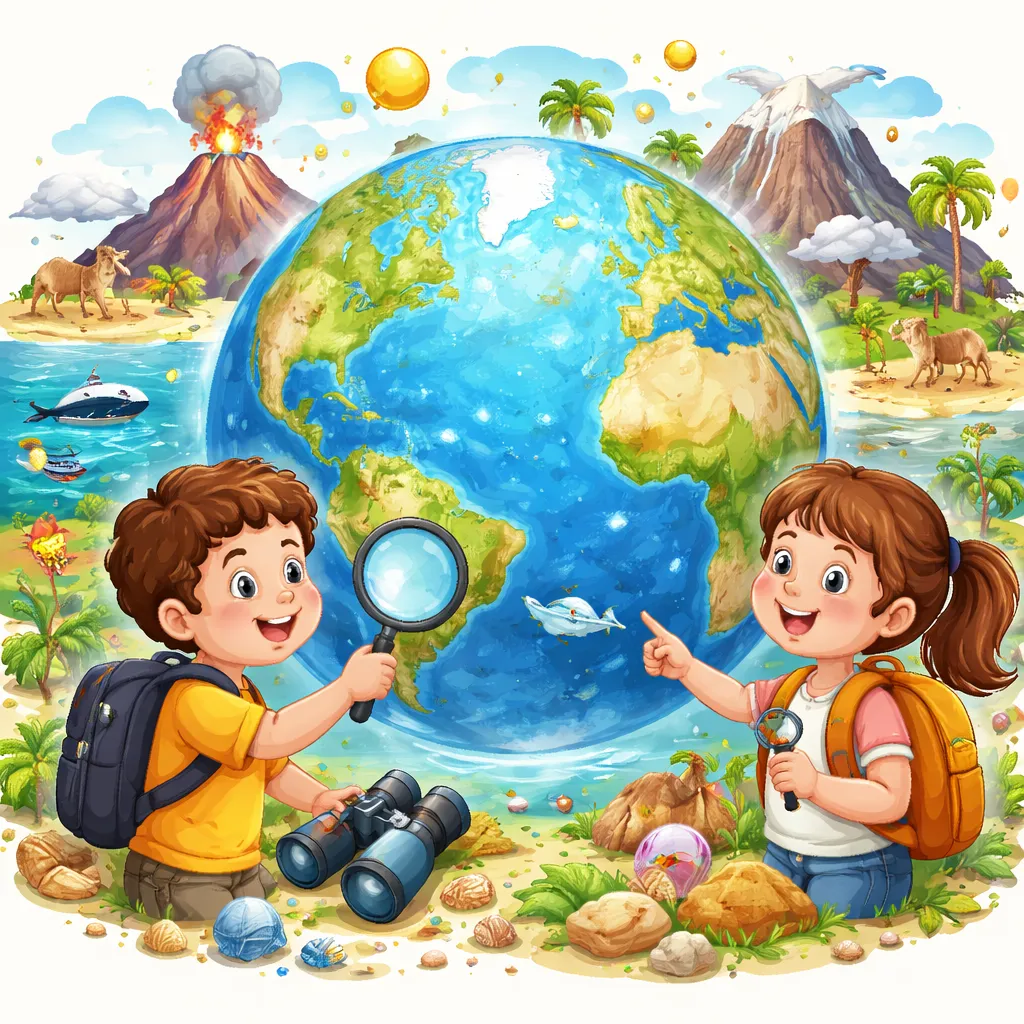

Young children ask many questions. They ask about mountains, oceans, and the sky. These questions connect to geography and Earth. Parents can use this natural curiosity. You do not need a classroom. You only need simple conversations. Learning about our planet feels like play. It feels like discovery. This article helps you guide your child. We will explore words and ideas. You will learn how to make big topics simple. Let us start this journey together.
Are Similar Words Really Interchangeable? Many parents use “geography” and “Earth science” as the same. But they are not exactly the same. Geography focuses on places and people. It looks at countries, cities, and cultures. Earth science studies rocks, weather, and oceans. Both relate to our planet. Yet each has a different focus. Knowing this helps you teach better. You can pick the right word for the right moment. Children learn faster with clear examples. Let us compare these two important terms.
Set 1: Geography vs Earth Science — Which One Is More Common? People use “geography” more often in daily life. We talk about locations and maps. We ask “What is the capital of France?” That is geography. Schools teach geography from an early age. “Earth science” appears less in casual talk. It sounds more technical. But both words are useful. For young kids, start with geography. Show them a world map. Point to your country. Then introduce Earth science. Talk about rain and volcanoes. This order feels natural. Your child will not feel confused.
Set 2: Geography vs Earth Science — Same Meaning, Different Contexts These two words share some space. A mountain belongs to geography and Earth science. Geography asks: Where is this mountain? Earth science asks: How did this mountain form? Geography looks at human use. Do people live near the mountain? Earth science looks at processes. Is the mountain still growing? Both answers matter. When your child sees a river, use both views. Say “This river is in our country” (geography). Then say “Water moves rocks here” (Earth science). This builds deep understanding.
Set 3: Geography vs Earth Science — Which Word Is “Bigger” or More Emphatic? Earth science feels bigger in one way. It covers many fields. Geology, meteorology, and oceanography live inside it. Geography also has two big parts. Physical geography studies landforms. Human geography studies cities and roads. Neither word is truly bigger. They overlap like circles. For a child, geography often feels more concrete. You can touch a map. You can visit a city. Earth science sometimes feels abstract. Wind and magma are harder to see. Start with the tangible. Move to the invisible later.
Set 4: Geography vs Earth Science — Concrete vs Abstract Geography gives you solid things to hold. A globe, a map, a photo of a desert. These are concrete. Earth science includes concrete items too. A rock, a cloud, a puddle. But Earth science also has abstract ideas. The water cycle is invisible. Erosion takes a long time. Gravity pulls without showing itself. Young minds love concrete examples. Show them soil and sand. Let them feel different rocks. Then explain the abstract. Use stories and pictures. Abstract ideas become clear with patience.
Set 5: Geography vs Earth Science — Verb or Noun? First Understand the Role Both words are nouns. You cannot “geography” something. You cannot “Earth science” something. But you can use related verbs. You can “map” a place (geography). You can “erode” a rock (Earth science). Teach your child action words first. Say “Let us map our backyard.” Say “Water shapes this stone.” Action words make learning active. After actions, introduce the big nouns. “Mapping is part of geography.” “Shaping stones is Earth science.” This sequence reduces confusion.
Set 6: Geography vs Earth Science — American English vs British English Both terms stay the same in American and British English. No spelling differences exist. But usage varies slightly. British schools often combine geography and Earth science. American schools sometimes separate them. Do not worry about these small differences. Your child will understand both. Focus on the ideas, not the region. If you travel or read international books, your child will adapt. Consistency at home matters more. Use the words you prefer. Your child will learn naturally.
Set 7: Geography vs Earth Science — Which Fits Formal Situations? Formal situations like school tests use both words. Geography appears in social studies. Earth science appears in science class. Each has its formal place. But for formal writing, be precise. Do not swap them. A geography essay discusses population. An Earth science report discusses fossils. Parents can help by reading textbooks together. Point out which word the school uses. This prepares your child for exams. It also builds academic confidence. Formal language becomes less scary with practice.
Set 8: Geography vs Earth Science — Which One Is Easier for Kids to Remember? Geography is easier for most kids. The word has familiar parts. “Graphy” means to write or draw. Kids draw maps and pictures. “Geo” means Earth. So geography is “writing about Earth.” That makes sense. Earth science has two common words. “Earth” is easy. “Science” is also familiar. But together, the phrase feels longer. Young children remember single words better. Start with “geography.” Add “Earth science” later. Use songs and rhymes. Repetition builds memory. Keep it light and fun.
Mini Exercise: Can You Spot the Differences Between These Similar Words? Try these simple questions with your child. Look at pictures together. Ask:
Is a map from geography or Earth science? (Geography)
Is a volcano from geography or Earth science? (Both)
Does weather belong to Earth science? (Yes)
Does a city belong to geography? (Yes)
Can a rock be in both subjects? (Yes)
Now play a game. Name an object. Your child points to “geography” or “Earth science.” Use a globe for geography. Use a rock for Earth science. Clap when they answer correctly. This game takes five minutes. It builds vocabulary fast. Repeat the game once a week. You will see improvement.
Parent Tips: How to Help Kids Learn and Remember Similar Words Read picture books about our planet. Choose books with maps and photos. Watch short videos of geysers and canyons. Pause and name what you see. Use the words “geography” and “Earth science” naturally. Do not drill. Do not test. Just talk.
Create a simple project. Draw a map of your home. That is geography. Then draw where sunlight hits your room. That is Earth science. Use crayons and stickers. Hang the drawings on the wall. Your child will feel proud.
Visit a park or a museum. Point to hills and streams. Say “Geography helps us find this stream.” Say “Earth science helps us understand the water.” Let your child touch leaves and soil. Hands-on learning works best for young kids.
Answer questions with excitement. If your child asks “Why is the sky blue?” start with Earth science. Give a short answer. Then ask a geography question: “What color is the sky in our country?” Keep the conversation going. Do not worry about perfect answers. Curiosity matters more.
Use a world map as a decoration. Let your child point to random places. Say one fact about each place. A fact about mountains (Earth science). A fact about language (geography). Mix both subjects daily. Your child will absorb the difference without effort.
Celebrate small discoveries. Did your child notice a puddle drying? That is Earth science. Did your child remember where grandma lives? That is geography. Praise the observation. Say “You are thinking like a scientist and a geographer.” This builds identity. Your child will see learning as part of who they are.
Keep lessons short. Five minutes a day is enough. Young attention spans tire quickly. Use meals or bath time for one fun fact. Tomorrow, add another fact. Over a month, your child will know many things. They will not feel overwhelmed. They will feel curious.
Finally, learn together. You do not need all the answers. Say “I do not know. Let us find out.” Open a book or a website together. Your child learns that asking questions is good. You model lifelong learning. That is the best lesson of all. Geography and Earth become not just subjects, but shared adventures.