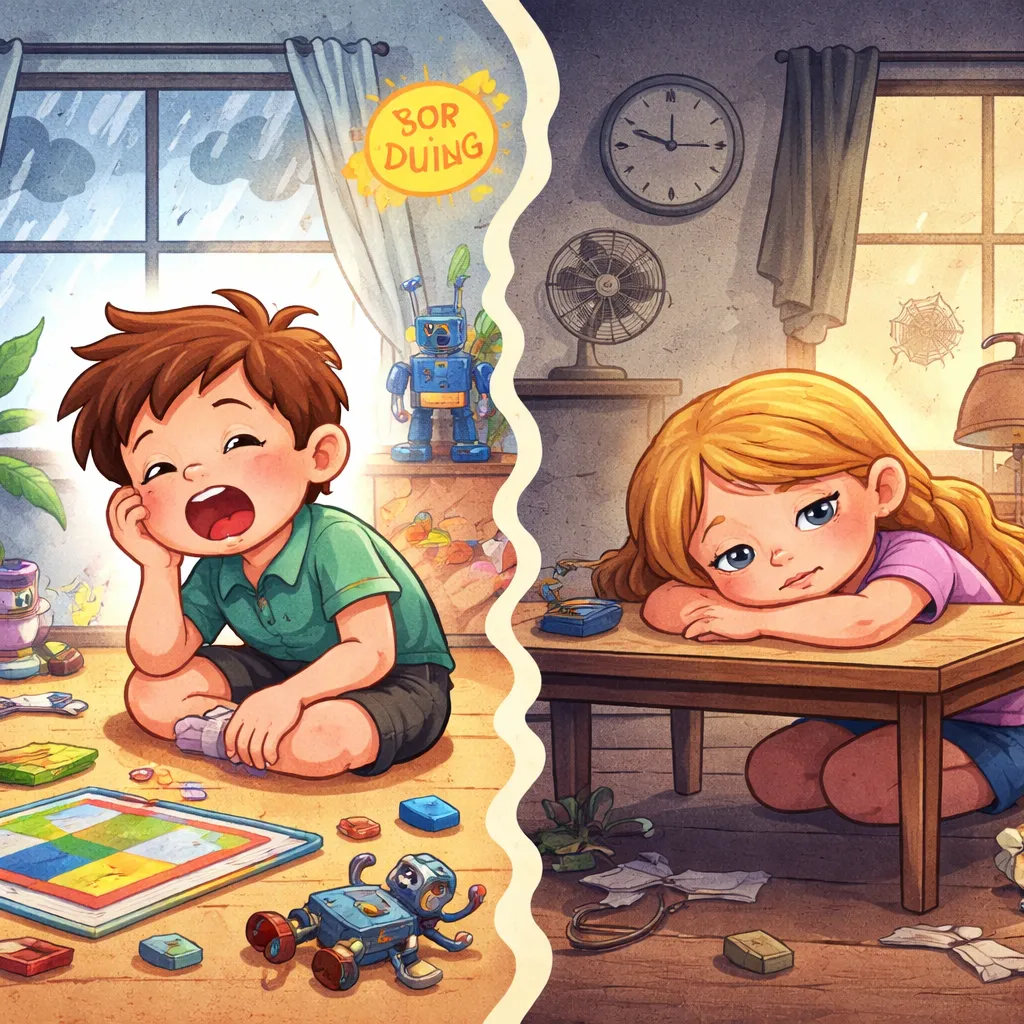

Hello, word explorer! Have you ever had to wait a long time? Or sat through a very slow movie? How do you describe that feeling? Do you say it is boring? Or do you say it is dull? They both mean not fun or interesting. But are they the same? They are like two shades of gray. One is a light, sleepy gray. One is a dark, flat gray. Let's find out! Today, we explore the word friends "boring" and "dull". Knowing their secret is a useful skill. It helps you describe your world accurately. Let's start our adventure!
First, let's be Word Detectives. Listen at home. Here are two sentences. "The long car ride was very boring." "The gray, cloudy sky looked dull." They both talk about something not exciting. A car ride. A sky. Do they sound the same? One feels like a lack of fun. One feels like a lack of color or life. Can you sense it? Great observation! Now, let's look closer with our word microscope.
Adventure! Inside the World of "Not Fun"
Welcome to the world of "not fun"! "Boring" and "dull" are two different kinds of gray. Think of "boring" as a slow, sleepy turtle. It makes you want to yawn. Think of "dull" as a faded, old photograph. It has lost its shine. Both are not exciting. But they are not exciting in different ways. Let's learn about each one.
The Sleepy Turtle vs. The Faded Photo Think about the word "boring". "Boring" feels like a slow, sleepy turtle. It is about your feelings. It describes something that fails to hold your interest. A boring lecture makes you want to sleep. A boring game is no fun. It causes a feeling of boredom. Now, think about "dull". "Dull" feels like a faded, old photo. It is about the thing itself. It describes something that lacks brightness, sharpness, or liveliness. A dull knife doesn't cut well. A dull color is not bright. "Boring" is about your mind's reaction. "Dull" is about the object's quality. One makes you sleepy. The other is simply not sharp or bright.
The Feeling of Boredom vs. The Lack of Shine Let's compare their focus. "Boring" is a very common word. It describes an experience that is not interesting. It is all about how you feel. Waiting is boring. That book is boring. The focus is on your boredom. "Dull" is a more descriptive word. It often describes how something looks, sounds, or feels. It means not sharp, not intense, or not lively. A dull pain is constant but not sharp. A dull sound is muffled. A dull person is not very smart or interesting. "Boring" causes a feeling. "Dull" describes a state.
Their Special Word Partners and Common Uses Words have best friends. "Boring" loves to team up with nouns about activities and experiences. A boring movie. A boring job. A boring person. It is used in everyday talk. "Dull" has its own special teams. It often describes physical objects or senses. A dull blade. Dull weather. A dull ache. It can also describe a person's mind. He has a dull mind. Note: We say "I'm bored" (feeling). We don't say "I'm dull" to mean bored. That would mean you are not an interesting person. They are different.
Let's visit a school scene. Your teacher talks for an hour about a topic you don't like. You watch the clock. The lesson is boring. This describes your feeling of disinterest. Now, imagine the classroom lights are old. They give a weak, yellow light. The light in the room is dull. This describes the quality of the light. Using "dull" for the lesson is possible, but "boring" is more common for the feeling. Using "boring" for the light is not right. The light isn't boring; it's just dim.
Now, let's go to the playground. You are playing a game that is too easy. You are not challenged. The game is boring. Later, you find an old, rusty swing. Its color is faded. The swing looks dull. The word "boring" paints the un-fun game. The word "dull" paints the faded swing.
Our Little Discovery So, what did we find? "Boring" and "dull" are both negative. But they are used differently. "Boring" is about a feeling. It describes something that fails to interest you. "Dull" is about a quality. It describes something that is not sharp, bright, or lively. A knife is dull, not boring. A lecture is boring, not dull (unless the speaker's voice is monotone, then it's both!). Knowing this helps you choose the right word.
Challenge! Become a Word Choice Champion
Ready for a fun test? Let's try your new skills!
"The Best Choice" Challenge Let's imagine a nature scene. A sloth moves very, very slowly in a tree. You watch it for ten minutes. It doesn't do much. Watching the sloth is... what? Boring or dull? Watching the sloth is boring. It fails to hold your interest. Now, imagine a rainy day in the forest. The leaves are wet and lack their usual bright green color. The colors look dull. This describes the lack of brightness. "Boring" wins for the slow sloth watch. "Dull" is the champion for the faded forest colors.
"My Sentence Show" Your turn to create! Here is your scene: A rainy Sunday afternoon. Can you make two sentences? Use "boring" in one. Use "dull" in the other. Try it! Here is an example: "With no friends over, the afternoon felt boring." This describes your feeling. "The dull gray light made the whole room seem sleepy." This describes the quality of the light. Your sentences will show two different ideas!
"Eagle Eyes" Search Look at this sentence. Can you find the word that could be better? Let's check a home context. "The edge of the dinner knife was very boring, so it couldn't cut the meat." Hmm. A knife that doesn't cut well lacks sharpness. The word "dull" is the correct term for a blade that isn't sharp. "The edge of the dinner knife was very dull, so it couldn't cut the meat." "Boring" describes an experience, not a blade's sharpness. Did you spot it? Excellent word work!
Harvest and Action! Turn Knowledge Into Your Superpower
Great exploring! We started thinking "boring" and "dull" were the same. Now we know they point to different things. We can feel the sleepy turtle of "boring". We can see the faded photo of "dull". You can now describe your experiences and the world around you with perfect accuracy. This is a great thinking skill.
What you can learn from this article: You can now feel that "boring" describes an experience that fails to interest you and makes you feel bored. You can feel that "dull" describes something that is not sharp, not bright, or not lively. You know that a long speech is "boring", but a cloudy day is "dull". You learned to match the word to what you mean: "boring" for feelings, "dull" for qualities.
Life practice application: Try your new skill today! Watch a TV show. If you don't like it, is it boring? Look at an old penny. Is its color dull? Tell a family member about one boring thing today. Describe one dull object in your room. Listen to how people use these words. You are now a master of descriptive words! Keep exploring the wonderful world of language.