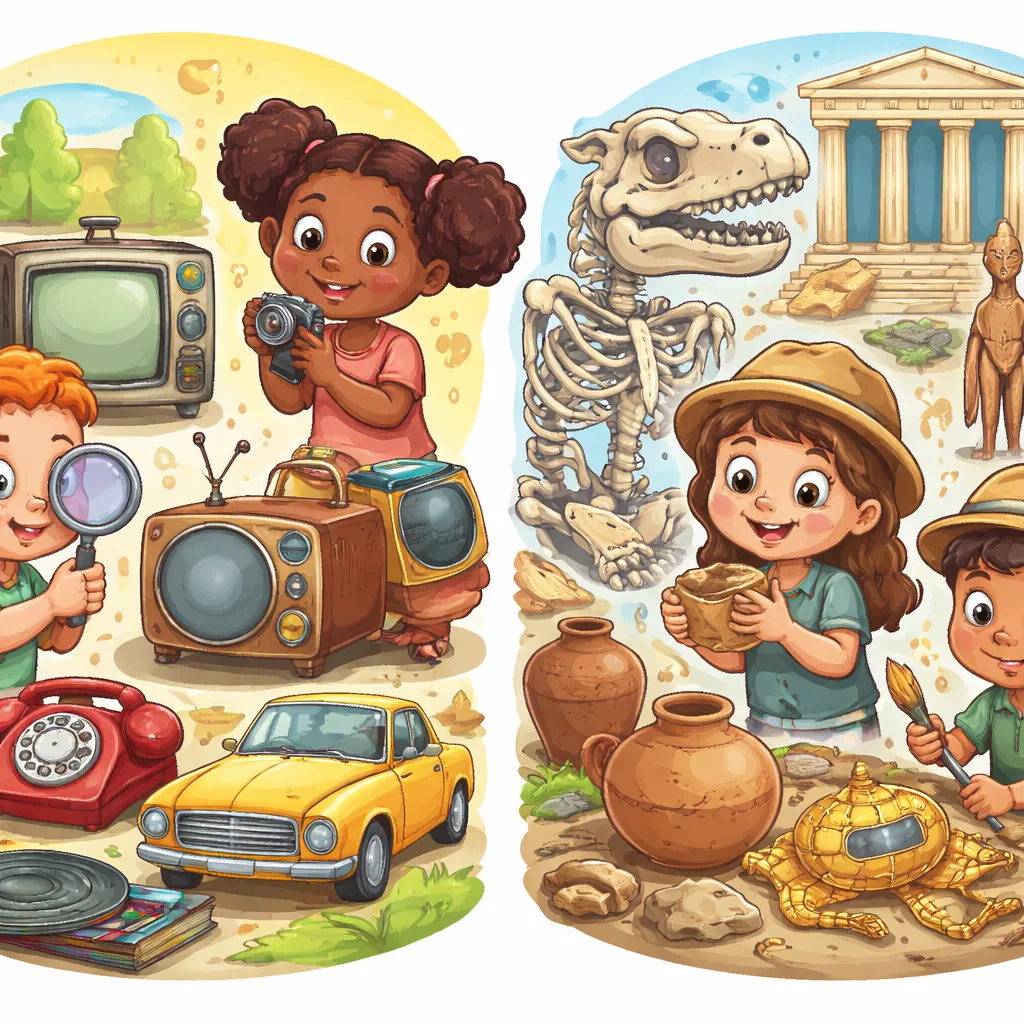

Hello, time traveler! Have you ever seen a wrinkled tree? Or a dusty castle in a book? How do you describe their age? You might say the tree is old. The castle is ancient. They both mean "not new". But are they the same? They are like two different layers of the past. One is your grandparent's story. One is a dinosaur's footprint. Let's find out! Today, we explore the word friends "old" and "ancient". Knowing their secret is a superpower. It helps you travel through time with words. Let's start our historical adventure!
First, let's be Time Detectives. Listen at home. Here are two sentences. "My grandmother has an old photo album." "We learned about ancient Egypt in school." They both talk about the past. A photo album. Egypt. Do they sound the same? One feels like a family memory. One feels like a lost world. Can you sense it? Great observation! Now, let's look closer with our word time machine.
Adventure! Into the World of Age Words
Welcome to the world of age! "Old" and "ancient" are two different time machines. Think of "old" as a family attic. It holds things from a few decades ago. Think of "ancient" as a deep, deep cave. It holds treasures from thousands of years ago. Both are about the past. But they travel to different times. Let's learn about each one.
The Family Attic vs. The Deep Cave Think about the word "old". "Old" feels like a family attic. It is about something that has existed for a long time, but not unimaginably long. An old sweater. An old song. An old friend. It is the opposite of new. Now, think about "ancient". "Ancient" feels like a deep, dark cave. It is about something from a very, very distant past. It often means from times before modern history. Ancient ruins. Ancient civilizations. Ancient forests. "Old" is the attic from your grandparents' time. "Ancient" is the cave from the time of pyramids and gladiators. One is relatively old. The other is extremely old.
The Common Past vs. The Distant Past Let's compare their time scales. "Old" is a common, flexible word. It can describe many things that are not young or new. An old car (20 years). An old person (80 years). An old joke (heard many times). It is used in daily life. "Ancient" is a much stronger word. It is reserved for things that are extremely old, often from centuries or millennia ago. Ancient history (thousands of years BC). Ancient artifacts. Ancient languages. "Old" is for a few decades. "Ancient" is for many centuries. One is ordinary aging. The other is historical aging.
Their Special Word Partners and Common Phrases Words have best friends. "Old" loves to team up with words about people, objects, and memories. An old man. Old times. Old habits. It is used in many common phrases. "Ancient" has its own special teams. It often pairs with words about history, civilizations, and the natural world. Ancient Greece. Ancient wisdom. Ancient monuments. Note: We say "old as the hills" (very old). We say "ancient history" (so old it's irrelevant now, or literally ancient). They are different teams.
Let's visit a school scene. Your teacher shows a black-and-white photo of your town from 1950. She says, "This is an old photograph of our city." This is correct. It is from the last century. Now, in history class, you see a picture of the Roman Colosseum. Your teacher says, "This is an ancient building from Rome." This is also correct. It is from over 2,000 years ago. Using "ancient" for the 1950 photo is an exaggeration. Using "old" for the Colosseum is an understatement. Each word fits a different time period.
Now, let's go to the playground. You find a toy car buried in the sand. It is rusty. It is an old toy. Later, you read a book about dinosaurs. You learn about the ancient creatures that lived millions of years ago. The word "old" paints the rusty toy. The word "ancient" paints the time of dinosaurs.
Our Little Discovery So, what did we find? "Old" and "ancient" both describe things from the past. But they are different levels of old. "Old" is a general word for something that has existed for a long time, like a person, a thing, or an idea. "Ancient" is a specific word for something extremely old, often from a historical or prehistoric period. Your shoes can be old. A pyramid is ancient. Knowing this helps you measure time with words.
Challenge! Become a Time Word Champion
Ready for a fun test? Let's try your new skills!
"The Best Choice" Challenge Let's imagine a nature scene. A giant tortoise lives on an island. It is 150 years old. For a tortoise, that is very, very old. This tortoise is... what? Old or ancient? The tortoise is very old. It is not from a historical civilization. Now, imagine you see a fossil of a trilobite in a museum. It is 500 million years old. That fossil is ancient. It is from a prehistoric era. "Old" wins for the very aged tortoise. "Ancient" is the champion for the prehistoric fossil.
"My Sentence Show" Your turn to create! Here is your scene: Visiting a museum with your class. Can you make two sentences? Use "old" in one. Use "ancient" in the other. Try it! Here is an example: "We saw an old train from the 1920s." This describes a machine from the last century. "We saw an ancient Greek vase from 500 BC." This describes an artifact from classical history. Your sentences will show two different time periods!
"Eagle Eyes" Search Look at this sentence. Can you find the word that could be better? Let's check a home context. "My mom found an ancient necklace in the drawer; it was from her high school years in the 1990s." Hmm. Something from the 1990s is only a few decades old. The word "ancient" is a huge exaggeration for humor, but for accuracy, "old" is better. "My mom found an old necklace in the drawer..." is more accurate for a 30-year-old item. Did you spot it? Excellent time detective work!
Harvest and Action! Turn Knowledge Into Your Superpower
Great exploring! We started thinking "old" and "ancient" were the same. Now we know they are two different chapters in the book of time. We can explore the family attic of "old". We can explore the deep cave of "ancient". You can now describe the past with perfect accuracy. This is a great skill for history and stories.
What you can learn from this article: You can now feel that "old" is a general word for something that has existed for a long time, like an old book or an old friend. You can feel that "ancient" is a specific word for something extremely old, often from history or prehistory, like an ancient pyramid or an ancient forest. You know that a 50-year-old car is "old", but a 5,000-year-old artifact is "ancient". You learned to match the word to the depth of time.
Life practice application: Try your new skill today! Look around your house. Find one old object. Read a book about ancient Rome or Egypt. Tell a family member about an old memory. Tell them one fact about an ancient civilization. Watch a documentary. Listen for the words "old" and "ancient". You are now a master of time words! Keep exploring the wonderful world of language and history.