
Opening Introduction
Ella loves poems. She likes how some words sound like music. "Cat, hat, mat," she says. They sound like friends. They sound the same at the end. She tells her dad, "These words are twins!" Dad smiles. "You found rhyming words," he says. "They are special sound twins."
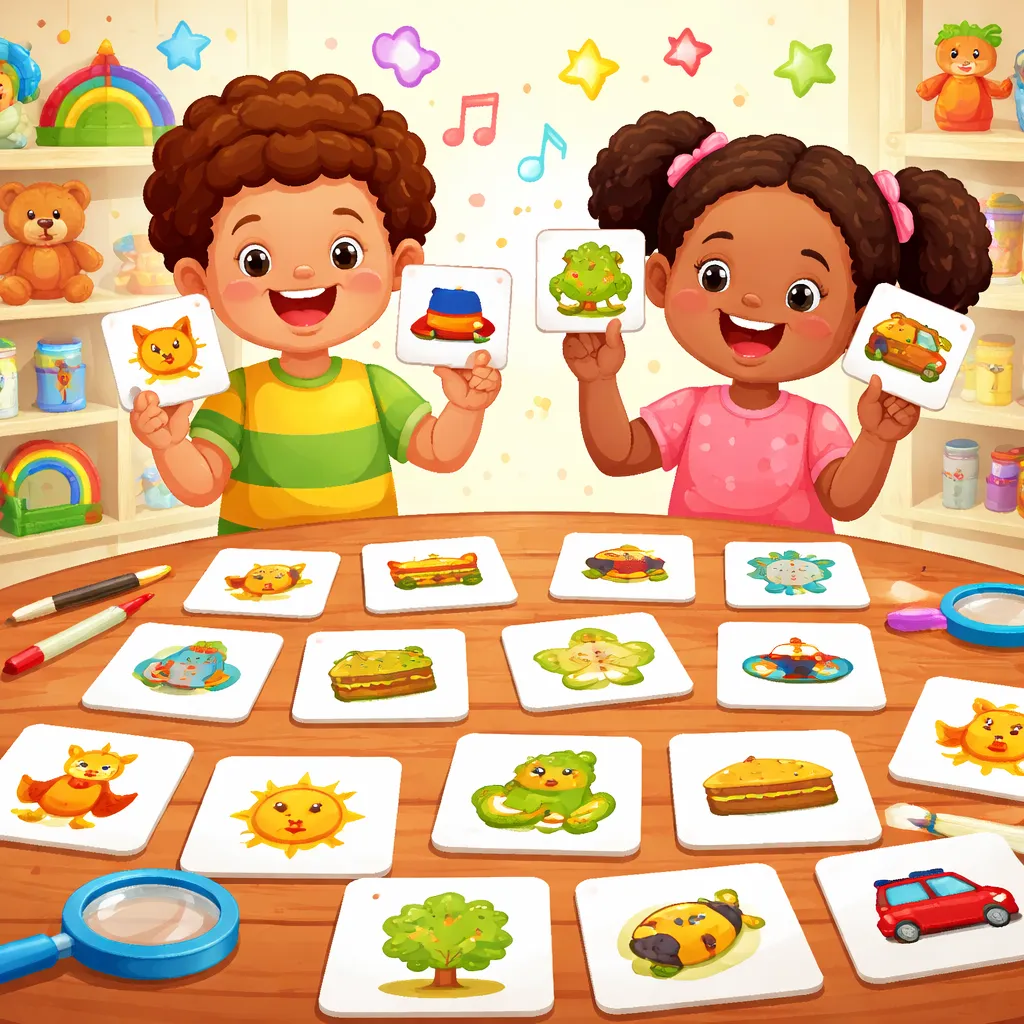
Dad has a surprise. He prints some paper and gets scissors. "Let's make a game to find more sound twins," he says. The paper has many cards. On one card is a picture of a sun. On another card is a picture of someone running. "Sun and run are sound twins," Dad says. "These are free rhyming words matching cards. We can play and learn many rhyming friends." Ella claps her hands. A matching game for sounds. This is exciting. Let's start our sound adventure.
Core Knowledge Explanation
What are rhyming words? Rhyming words are special word friends. They have the same ending sound. Listen: 'cat' and 'hat'. They both end with the 'at' sound. The beginning sound is different. C for cat. H for hat. But the end is the same. That is a rhyme. Rhymes are everywhere. In songs. In poems. In your favorite storybooks. They make language fun and musical.
Our game uses free rhyming words matching cards. 'Free' means you can get them without money. 'Printable' means you print them from a computer. 'Matching cards' are cards that go together. You find two cards that are a pair. In this game, a pair is two words that rhyme. For example, one card has a picture of a dog. The other card has a picture of a log. Dog and log rhyme. They are a matching pair.
Why is learning rhymes so important? Rhymes teach you about sounds. When you hear 'pin' and 'win', you hear the 'in' sound. Your ears are learning. This skill is called phonemic awareness. That is a big word. It just means you hear the small sounds in words. This is the most important skill for reading. If you know rhymes, you can guess new words. You see the word 'sit'. You know 'hit' and 'fit'. You can figure out 'sit'. Rhymes make you a reading detective.
Let's look at the cards. Each card has a picture. The picture tells you the word. You do not need to read the word yet. You just look at the picture. One card shows a star. You think, "Star." Another card shows a car. You think, "Car." Star... Car... They sound the same at the end. They are a match. This is brilliant. You are learning with your eyes and your ears. You are not stressed by spelling. You are playing with sounds.
You can have many rhyming families. A family is a group. The 'at' family has cat, hat, mat, bat, rat, sat. The 'en' family has hen, pen, ten, men. The 'op' family has mop, top, hop, pop. Your free rhyming words matching cards will have cards from these families. You mix them all up. Your job is to find the family members. Find the 'cat' card and the 'hat' card. They are from the 'at' family. Put them together.
This game helps your memory. You see a picture of a cake. You must remember the word 'cake'. Then you look for its sound twin. Is it a snake? A lake? A rake? You think of all the 'ake' words you know. You are searching your brain. This makes your memory strong. It is a brain exercise that feels like play.
You can play by yourself. Lay all the cards face up. Find one card. Let's pick the 'boat' card. Now look for its rhyme. Do you see a coat? A goat? Yes, there is a goat. Boat and goat are a pair. Connect them. Now find a pair for 'coat'. There is a 'goat'? No, that is with boat. Look for another. There is a 'note'? Coat and note? Do they rhyme? Coat... note... Yes, they do. Great. You can make a long chain of rhymes.
Fun Interactive Learning
Let's get our cards ready. First, print your free rhyming words matching cards. You will see many cards with pictures. There might be twenty cards. That makes ten rhyming pairs. Let's say the pairs are: star-car, dog-log, cake-snake, boat-goat, fan-man, bell-shell, house-mouse, fox-box, bee-tree, and rain-train. Great. Now, carefully cut out each card. Ask a grown-up to help with scissors.
Now, let's play a memory game. This is the best way to play. Mix all the cards. Lay them face down on the table. Make a neat grid. Now, it is your turn. Flip over two cards. Look at the pictures. Say the words. "Fan" and "Mouse". Do they rhyme? Fan... mouse. No. So, you flip them back over. Try to remember where they are. Now, your friend flips two cards. "Fox" and "Box". Fox... box. Yes. They rhyme. Your friend keeps that pair. The game goes on. You try to find all the rhyming pairs. The person with the most pairs wins.
You can also play a "Rhyming Fish" game. Give each player five cards. Keep your cards secret. The rest of the cards are in a pile. The goal is to make rhyming pairs in your hand. You ask a friend, "Do you have a card that rhymes with 'star'?" If your friend has the 'car' card, they must give it to you. Then you have a pair. Put the pair down. If they do not have it, they say, "Go fish." You take a card from the pile. The game is fun and full of talking.
Let's make a rhyming hunt. Take your cards. Do not cut them. Keep them as a full sheet. Get a crayon. Your job is to connect the rhyming pairs with a line. Draw a line from the 'bell' picture to the 'shell' picture. Use a different color for each pair. Soon, your paper will have a rainbow of lines connecting sound twins. It is a beautiful rhyming map.
Expanded Learning
Rhymes are very old. People have used rhymes for thousands of years. They helped people remember stories. Before writing, people sang songs with rhymes. The rhymes helped them remember the next line. Even today, the best songs and poems use rhymes. Rhymes make words stick in your head. That is why you can remember a nursery rhyme so easily.
Think about "Twinkle, Twinkle, Little Star". Star rhymes with are. High rhymes with sky. The rhyme gives the song its magic. Your free rhyming words matching cards are training you to hear this magic. You are learning the pattern. Pattern is a repeated design. Sound has patterns too. Rhyming is a sound pattern.
Let's make a silly rhyme chant. Chants are fun to say. Clap your hands while you say this.
I see a cat, wearing a hat, sitting on a mat, next to a rat! Rat-a-tat-tat! I see a dog, sitting on a log, talking to a frog, near a big fog! Ribbit, ribbit, blog!
You can make your own chant. Use the words from your matching cards. "I see a fox, inside a box, wearing odd socks!" Making silly rhymes is a super fun game. It makes you creative. You are a poet.
What You Will Learn
You are learning so many great things. You are learning word families. You know the 'at' family: cat, hat, mat, bat, sat. You know the 'og' family: dog, log, frog, fog. You know the 'ake' family: cake, snake, lake, rake. You are learning many new words through pictures. Words like shell, fox, goat, train, and fan.
You are learning useful sentences. You can say, "These words rhyme." You can ask, "Does 'house' rhyme with 'mouse'?" You can explain, "Yes, they sound the same at the end." You can declare, "I found a match. 'Star' and 'car' are a pair." This is the language of a word scientist.
You are building super skills. You are building phonological awareness. That is the big word for hearing sounds. You are building memory. You remember where cards are. You are building focus. You pay attention to sounds. You are building social skills. You take turns and play fair with friends.
You are forming an excellent habit. The habit is listening carefully. You listen to the ends of words. You listen for patterns. This habit will help you with spelling, reading, and even learning a new language. A good listener becomes a great learner. Your free rhyming words matching cards are training your ears to be superhero ears.
Using What You Learned in Life
You can find rhymes everywhere. In the car, look out the window. Say a word. "Car." Now, everyone finds a rhyme. "Star!" "Far!" "Bar!" It is a perfect travel game. At the park, look around. "Swing." What rhymes? "Ring!" "King!" "Thing!" The world is full of rhyming material.
At home, during clean-up, make it a rhyme game. "I will pick up the sock." "I will put away the block." Sock and block rhyme. See, cleaning is fun with rhymes. When you set the table, "Here is the spoon, under the moon." Spoon and moon rhyme. You are being funny and clever.
At school, you can be the rhyme helper. If your teacher says, "Who knows a word that rhymes with 'book'?" You can say, "Look! Cook! Hook!" You will know so many. You can help your friends. If a friend is stuck on a word, you can say, "Think of a rhyme. It helps." You are a kind and smart friend.
When you are bored, write a tiny poem. Just two lines. "My dog is big. He danced a jig." Big and jig rhyme. Show it to your family. They will love it. You are an author. Your rhyming skills make your stories and sentences joyful and musical. Always listen for the sound twins. They are hiding in everyday talk, waiting for you to find them.
Closing Encouragement
You did an amazing job. You are a master of sounds. You are a finder of word twins. You played games. You used your brain. You used your ears. I am so very proud of you. Your rhyming cards are keys. They are keys to a world of reading and singing.
Keep your cards. Play the games often. Make new cards. Draw your own pictures. Think of new rhyming pairs. You are in charge of your fun. You are the boss of this game. Your learning has no end.
Remember, language is music. Rhymes are the drumbeat. You now hear that beat. You can clap to it. You can sing to it. You can play with it. Keep listening. Keep matching. Keep creating. You are a wonderful word musician. Fantastic work, my brilliant rhyme finder.