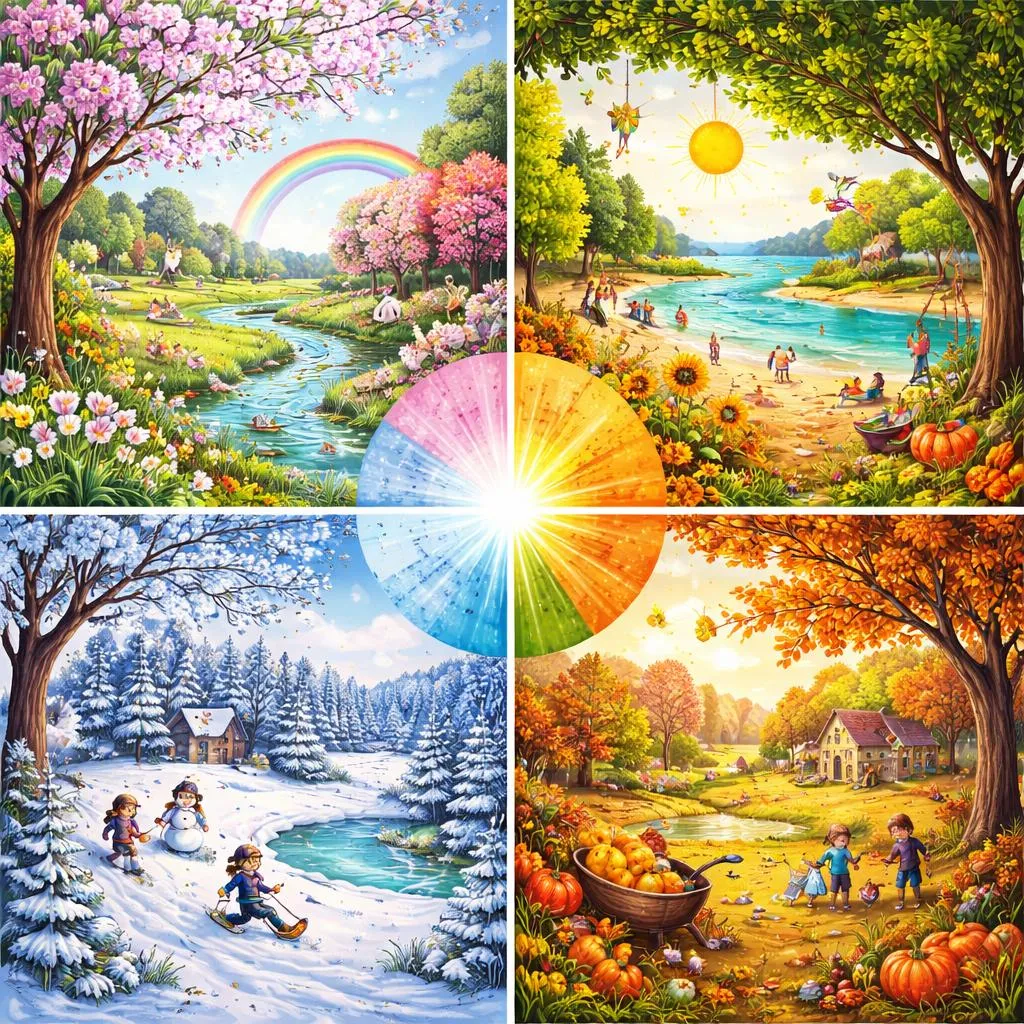

Hello, young explorers! Today we take a journey through time. Not a journey of minutes or hours. We will travel through months. We will watch the world change around us. The world outside our window looks different throughout the year. Sometimes it is hot and sunny. Sometimes it is cold and snowy. Flowers bloom. Leaves fall. These changes happen in a beautiful cycle. We call this cycle the seasons of the year. Learning about the seasons helps us understand the world. It also gives us wonderful words to describe what we see and feel. Let us open our eyes to the changing world. Let us discover the magic of spring, summer, autumn, and winter.
What Are the Seasons of the Year? The seasons are four special times of the year. Each season has its own weather. Each season has its own light. Each season brings changes to plants and animals. The Earth travels around the sun. As it travels, it tilts. This tilt causes the seasons. When one part of Earth tilts toward the sun, that part gets more sunlight. It becomes warmer. We call that summer. When that part tilts away, it gets less sunlight. It becomes colder. We call that winter.
The four seasons always come in the same order. They repeat every year. Spring comes first. Then summer. Then autumn. Many people call autumn "fall." Then winter comes. After winter, spring returns again. This cycle never stops. It is like a big, slow dance between the Earth and the sun. Understanding this dance helps us know what to expect. We know when to wear a coat. We know when to go swimming.
Meaning and Explanation of Each Season Let us look closely at each season. We will learn its name and its special features.
Spring is a time of new beginnings. The weather starts to get warmer. The snow melts. Rain falls often. Plants wake up. Tiny green leaves appear on trees. Flowers like tulips and daffodils bloom. Baby animals are born. We see chicks and lambs. The days become longer. Spring feels fresh and full of hope.
Summer is the warmest season. The sun shines brightly. The days are very long. School often ends for a holiday. People go to the beach. They swim and play outside. Ice cream tastes so good in summer. Fruits like watermelon and berries are ripe. The world feels alive and busy. Everything is green and growing.
Autumn brings a change. The air becomes cool and crisp. The days grow shorter. Leaves on trees turn beautiful colors. We see red, orange, and yellow leaves. Then the leaves fall to the ground. Farmers harvest their crops. We see pumpkins and apples. Animals prepare for winter. Autumn feels cozy and quiet.
Winter is the coldest season. The days are short. The nights are long. In many places, snow falls. The ground may turn white. Trees are bare without leaves. People wear warm coats, hats, and gloves. We might drink hot chocolate. Some animals sleep through winter. We call this hibernation. Winter feels still and peaceful.
Categories or Lists Within the Seasons We can organize many things by season. This helps build vocabulary. It connects words to specific times of the year.
First, let us think about weather words.
Spring: rainy, windy, mild, fresh
Summer: hot, sunny, dry, clear
Autumn: cool, windy, cloudy, crisp
Winter: cold, snowy, icy, freezing
Next, let us think about clothing we wear.
Spring: raincoat, boots, light jacket
Summer: shorts, t-shirt, sandals, hat
Autumn: sweater, jeans, scarf, jacket
Winter: coat, gloves, mittens, warm hat, boots
We can also think about activities we do.
Spring: fly a kite, plant flowers, jump in puddles
Summer: swim, have a picnic, go to the park
Autumn: rake leaves, pick apples, jump in leaf piles
Winter: build a snowman, make snow angels, drink hot cocoa
Making these lists helps children see the patterns. It shows how the whole world changes with the seasons. Everything connects. The weather decides the clothes. The clothes allow the activities.
Daily Life Examples of the Seasons Seasons touch our lives every day. We can point out these examples to make learning real.
In the morning, look outside. What does the sky look like? Is the sun bright? That feels like summer. Are there dark clouds? That might mean spring rain. Is it dark when we wake up? That often happens in winter. These daily observations connect the season name to a real feeling.
At mealtimes, we see seasons too. In summer, we might eat fresh berries and salad. In autumn, we might eat soup and pumpkin bread. In winter, we enjoy warm meals and hot drinks. In spring, we see fresh vegetables like peas and asparagus. Food changes with the seasons.
Even our feelings can connect to seasons. A sunny summer day might make us feel energetic and happy. A cold, gray winter day might make us feel calm and quiet. Talking about these feelings uses descriptive words. It deepens the child's understanding of each season's unique character.
Printable Flashcards for the Seasons Flashcards are excellent tools for learning season vocabulary. They provide a clear image with the word. This helps visual memory.
Create a set of four main cards. One for spring, summer, autumn, and winter. On each card, put a clear picture. The spring card could show flowers and a baby animal. The summer card could show a sunny beach. The autumn card could show colorful leaves. The winter card could show snow and a snowman.
Then, create smaller cards for the categories we discussed. Make cards for weather words. A picture of rain for "rainy." A sun for "sunny." Make cards for clothing. A picture of a coat for "coat." A picture of sandals for "sandals." Make cards for activities. A picture of a child swimming for "swim."
A fun game is to match the smaller cards to the main season card. Ask the child to place the "coat" card on the winter picture. Place the "swim" card on the summer picture. This activity builds connections. It shows why certain things belong to certain seasons. These cards can be used again and again. They are a simple, effective learning tool.
Learning Activities or Games About the Seasons Games bring the seasons to life. They turn knowledge into experience.
Season Sort: Gather a collection of small items or pictures. Include things like a small umbrella, a leaf, a flip-flop, a mitten, a flower, a sun hat, and a snowflake. Ask the child to sort them into four piles. One pile for each season. This requires thinking about when we use each item. It is a hands-on way to apply knowledge.
Season Drawing: Give the child a large piece of paper. Fold it into four boxes. Label each box with a season name. Ask the child to draw a picture in each box. The picture should show what that season looks like. They can draw the weather, the trees, and themselves doing an activity. This combines creativity with learning. It produces a beautiful piece of work they can be proud of.
What Am I? Guessing Game: Think of something connected to a season. Describe it without saying the name. "I am yellow and hot. I shine in the sky. You feel me most in summer. What am I?" The answer is the sun. "I am small and white. I fall from the sky in winter. I am very cold. What am I?" The answer is a snowflake. This game builds listening and reasoning skills.
Season Walk: This is the best activity of all. Go outside in each season. Walk around the neighborhood. Point out the signs of the season. Feel the air. Look at the trees. Listen to the sounds. In spring, listen for birds. In autumn, listen to leaves crunching underfoot. This real-world connection makes the learning deep and lasting. The seasons become not just words on a page, but a living, breathing part of the child's world. Through these activities, the cycle of the year becomes a familiar and beloved friend.