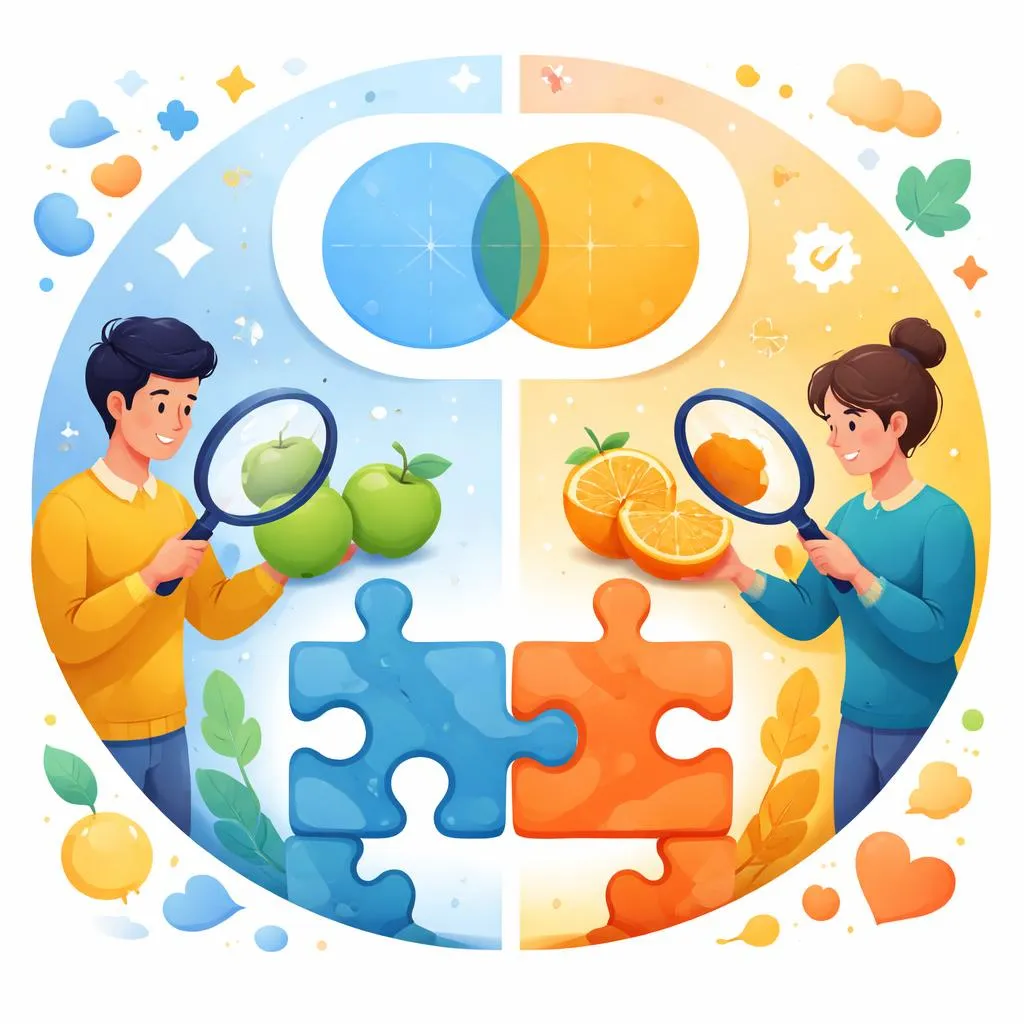

Hello, word detective! Your teacher asks a question. "Can you compare these two animals?" Then she asks another. "Now, can you contrast them?" They both seem to be about looking at two things. But are they the same task? They are like two sides of the same coin. One side is about finding friends. The other side is about finding rivals. Let's investigate! Today, we explore the word friends "compare" and "contrast". Knowing their secret makes you a super thinker. Let's begin our thinking adventure!
First, let's be Observation Detectives. Listen at home. Here are two sentences. "Let's compare these two toy cars. Which one is faster?" "Let's contrast your sunny room with my darker one." They both involve looking at two things. Toy cars. Rooms. Do they sound the same? One feels like looking for all kinds of details, good and bad. One feels like looking for the clear differences. Can you sense it? Great observation! Now, let's look closer.
Adventure! Into the World of Looking at Things
Welcome to the world of looking closely! "Compare" and "contrast" are about examining two or more things. But they are not the same action. Think of "compare" as finding friends. You look for how things are both similar AND different. Think of "contrast" as finding rivals. You look only for how things are different. Both are about looking. But one is about "finding all connections". One is about "spotting the clashes". Let's learn about each one.
Finding Friends vs. Finding Opposites Think about the word "compare". "Compare" feels like a friendly exploration. It means to look at two or more things to see both similarities and differences. We can compare two books. We see which is longer, which is funnier. It is a full picture. Now, think about "contrast". "Contrast" feels sharper, like a spotlight on difference. It means to look specifically for the differences between things. Let's contrast summer and winter weather. "Compare" is like looking at two pizzas to see all the toppings. "Contrast" is like pointing out that one is spicy, one is sweet. One is a full report. One is a difference report.
A Full Report vs. A Difference Highlight Let's compare their nature. "Compare" gives a balanced view. It often includes both sides. You compare movies to decide which to watch. You talk about the good and bad in each. "Contrast" focuses only on the differences. It highlights the opposing points. The report will contrast the old way with the new way. You compare two video games. You talk about graphics, story, and price. You contrast their main characters. You only talk about how they are not alike. One asks "how are they alike and different?" The other asks "how are they not alike?"
Their Special Word Partners and Common Uses Words have best friends. "Compare" loves words like "and", "with", and "to". Compare apples and oranges. Compare your answer with mine. Nothing compares to you. "Contrast" loves words like "with" and phrases about difference. Contrast this with that. In contrast to yesterday. A sharp contrast. Note: You often "compare and contrast" in school. This means first find similarities, then find differences. That is the full superpower!
Let's visit a school scene. Your teacher says, "Please compare the two main characters in the story." This means look at both. Are they both brave? Is one kinder? Is one older? Later, the teacher says, "Now, contrast their homes." This means focus only on the differences. One home is a castle. One home is a small cottage. The word "compare" fits the full look at the characters. The word "contrast" fits the specific look at their different homes. One is broad. One is specific.
Now, let's go to the playground. You and a friend look at two swing sets. You compare them. This one is taller. That one has stronger chains. Both are fun. Then you look at the games. You contrast a fast slide with a slow merry-go-round. The word "compare" fits looking at two similar things (swing sets) for all details. The word "contrast" fits looking at two very different things to highlight that difference. One is for similar items. One is for different items.
Our Little Discovery So, what did we find? "Compare" and "contrast" are about looking at things. But "compare" is wider. It means to look for both similarities and differences. "Contrast" is narrower. It means to look only for the differences. You compare two sports. You might find they both need a ball. You also find one is a team game. You contrast day and night. You focus only on light and dark, awake and asleep. "Compare" gives the whole story. "Contrast" shows the clash.
Challenge! Become a Comparison Champion
Ready for a nature test? Let's try your new skills!
"The Best Choice" Challenge Let's imagine a nature scene. Look at a dolphin and a shark. A scientist wants to study them. First, she will compare them. She looks at all things. Both live in the ocean. Both are swimmers. One is a mammal. One is a fish. This is the full "compare" report. Now, she wants to make one point very clear. She will contrast how they breathe. Dolphins breathe air. Sharks breathe underwater. This is the "contrast" focus. "Compare" wins for the full study of both animals. "Contrast" is the word for focusing only on their breathing difference. One is a full picture. One is a single difference.
"My Sentence Show" Your turn to create! Here is your scene: Looking at two different lunch boxes. Can you make two sentences? Use "compare" in one. Use "contrast" in one. Try it! Here is an example: "Let's compare our lunch boxes. Yours has more fruit. Mine has a bigger sandwich. Both have a drink." This looks at all aspects. "Let's contrast the main color. Yours is bright blue. Mine is deep red." This focuses on one clear difference. Your sentences will show a full look versus a single difference!
"Eagle Eyes" Search Look at this sentence. Can you find the word that could be better? Let's check a home context. "My mom asked me to contrast the price and the quality of two cereals." Hmm. This is about looking at two aspects of the cereals. The goal is to look at both price AND quality to decide. The word "contrast" is only for finding differences. The word "compare" is the better choice. It includes looking at all parts. A better sentence is: "My mom asked me to compare the price and the quality of two cereals." Using "contrast" here sounds like she only wants the differences, not the full picture! "Compare" is the champion for a full review. Did you spot it? Super thinking!
Harvest and Action! Turn Knowledge Into Your Superpower
Great exploring! We started thinking "compare" and "contrast" were similar. Now we know they are two different thinking tools. "Compare" is the word for looking at two or more things to see both similarities and differences. "Contrast" is the word for looking specifically at the differences between things. You can now follow instructions and share your thoughts with perfect clarity. This is a great skill for a smart student.
What you can learn from this article: You can now see that to "compare" things means to look at them to find ways they are similar AND different, like comparing two movies, two games, or two friends. It gives a complete picture. You can now understand that to "contrast" things means to look specifically for how they are different, like contrasting summer and winter, or your ideas with a friend's ideas. It highlights the opposites. You know that a book report might ask you to compare two characters. It might also ask you to contrast their goals. You learned to match the word to the task: "compare" for the full report; "contrast" for the difference spotlight.
Life practice application: Try your new skill today! Be a thinking expert. Look at two snacks. Can you compare them? Look at two pets. Can you contrast them? Next time you read, compare two chapters. Contrast the hero and the villain. In a store, compare two toys. Contrast their colors. You are now a master of these words! Use "compare" for a full look. Use "contrast" to spot clashes. Your mind is now a super-tool for seeing the world clearly!