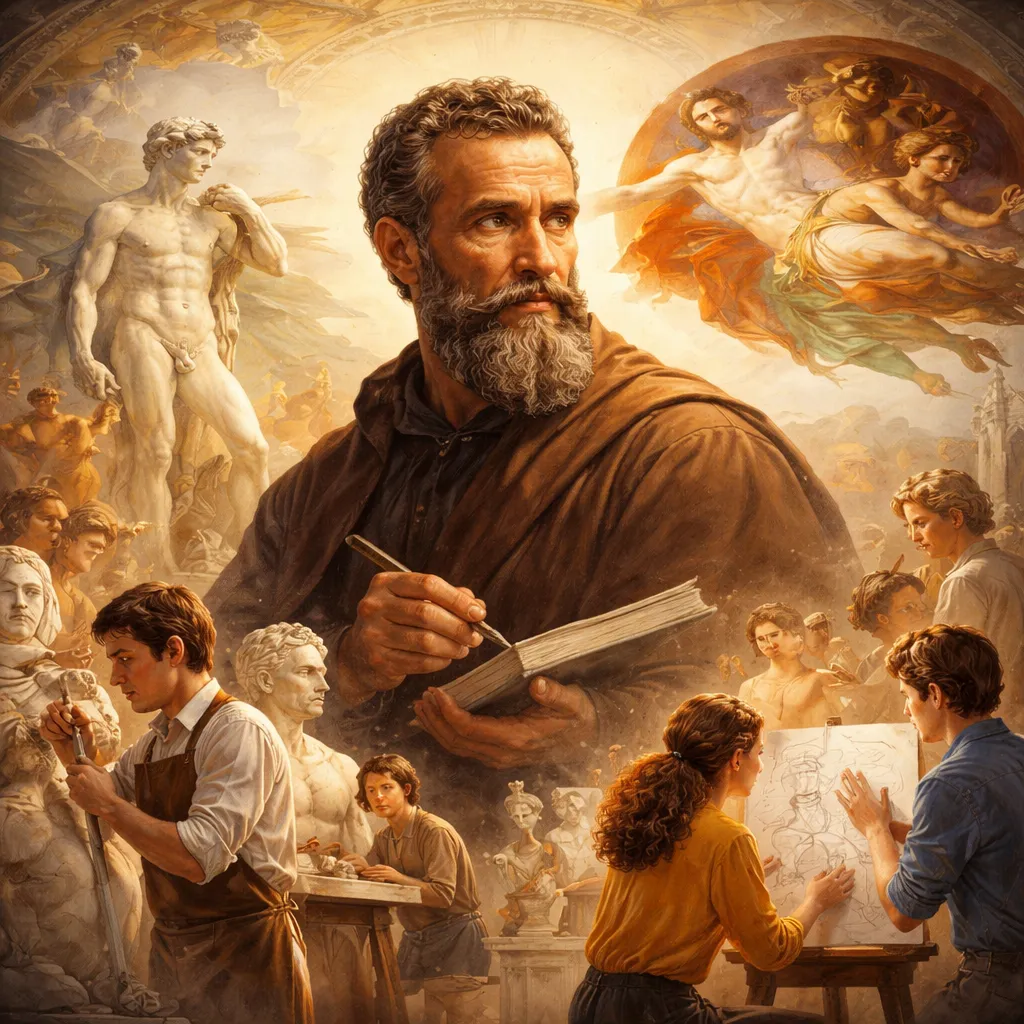

Introduction to Michelangelo
Michelangelo di Lodovico Buonarroti Simoni, commonly known simply as Michelangelo, was born on March 6, 1475, in Caprese, Italy. He was one of the most influential figures of the Renaissance, celebrated for his extraordinary skills in sculpture, painting, and architecture. His work has left an indelible mark on the world, making him one of the most famous artists in history.
Why is Michelangelo worth knowing? His masterpieces are still studied and admired today for their beauty, creativity, and technical brilliance. He embodied the Renaissance ideal, blending artistic skill with deep philosophical and religious themes. Michelangelo’s work, particularly the Sistine Chapel ceiling and the statue of David, has inspired countless generations of artists, architects, and thinkers across the world.
Early Life and Background
Michelangelo was born into a family of minor nobility in the Tuscany region of Italy. His father, Ludovico di Leonardo di Buonarroti Simoni, was a government official, but the family faced financial difficulties. Michelangelo’s mother passed away when he was just six years old, and he was sent to live with a stonecutter’s family. This early exposure to the world of stone carving would play a significant role in shaping his future.
As a child, Michelangelo showed a strong inclination toward art. His early education was focused on grammar and rhetoric, but his passion for art led him to study under the guidance of the renowned painter Domenico Ghirlandaio at the age of 13. He later moved to the workshop of the famous sculptor Bertoldo di Giovanni, where his skills in carving marble flourished.
Career Highlights and Achievements
Michelangelo’s career spanned more than six decades, during which he achieved monumental success. One of his first major works was the statue of Pietà, a marble sculpture he completed when he was only 24 years old. It depicts the Virgin Mary holding the body of Jesus Christ after his crucifixion and is widely regarded as one of the most beautiful sculptures ever made.
Michelangelo was also commissioned to paint the ceiling of the Sistine Chapel in the Vatican, a task that would define his career. The work, completed between 1508 and 1512, contains some of the most iconic images in art history, including the famous scene of The Creation of Adam. The ceiling’s vibrant frescoes showcase Michelangelo’s mastery in both art and storytelling.
Later in life, Michelangelo became involved in architecture, designing parts of St. Peter’s Basilica in Vatican City. His design of the dome of St. Peter’s remains one of his most significant contributions to the field of architecture.
Michelangelo’s contributions to the arts were recognized in his lifetime, earning him the admiration of both the public and his peers. He received numerous commissions from powerful patrons, including popes, kings, and wealthy merchants.
Famous Works or Performances
Michelangelo’s body of work includes some of the most well-known pieces of art in history.
David: One of his early sculptures, David, created from a single block of marble, is a masterpiece of Renaissance sculpture. Standing at 17 feet tall, the statue represents the biblical hero David just before his battle with Goliath. Michelangelo’s portrayal of David is celebrated for its stunning realism and expressive detail. Sistine Chapel Ceiling: As mentioned earlier, the Sistine Chapel ceiling is perhaps Michelangelo’s most famous work. The frescoes cover more than 5,000 square feet and depict scenes from the Book of Genesis, including The Creation of Adam, one of the most recognized images in the world. The Last Judgment: Painted on the altar wall of the Sistine Chapel, this monumental fresco depicts the Second Coming of Christ and the final judgment of souls. The painting, completed in the 1540s, is both awe-inspiring and terrifying, demonstrating Michelangelo’s ability to blend emotion with divine themes. Personal Life and Fun Facts
While Michelangelo was known for his intense focus on his work, his personal life was also interesting. He never married and was known to have a very solitary lifestyle. His passion for art often meant that he spent long hours alone, working tirelessly on his sculptures and paintings.
Despite his reclusive nature, Michelangelo was deeply connected to the intellectual and artistic circles of his time. He was known to have had close relationships with some of the greatest thinkers of the Renaissance, including the artist Raphael and the philosopher Pietro Aretino. He was also known for his witty and sometimes combative personality, which led to many disagreements with patrons and fellow artists.
One fun fact about Michelangelo is that he was not always pleased with the final results of his works. For example, after completing the Sistine Chapel ceiling, he complained that the commission had caused him significant physical strain, leading him to declare that he would never again take on such a large-scale project. Nevertheless, his artistic legacy remains unparalleled.
Legacy and Influence
Michelangelo’s influence on art, architecture, and culture cannot be overstated. His work marked a pivotal moment in the Renaissance, a period of great cultural and intellectual flourishing. His sculptures, paintings, and architectural designs continue to be studied and revered by artists and students worldwide.
Michelangelo’s innovative approach to human anatomy in sculpture and painting revolutionized the way the human body was represented in art. His work influenced generations of artists, including his contemporaries Raphael and Leonardo da Vinci, as well as later artists like Caravaggio and even modern creators.
His works have been preserved in major museums and churches, and his influence can be seen in art and architecture around the world. The Sistine Chapel, St. Peter’s Basilica, and the Galleria dell'Accademia in Florence, which houses the David, all stand as testaments to his genius.
How to Learn from Michelangelo
Michelangelo’s life and work offer valuable lessons for young people and aspiring artists. His dedication to his craft, his relentless pursuit of perfection, and his ability to convey deep emotion through his work are qualities that can inspire anyone, not just in art, but in all areas of life.
Michelangelo’s work ethic is one of his most admirable qualities. He often pushed the boundaries of what was considered possible, both in terms of scale and complexity. His ability to work with such intensity and focus shows that greatness requires dedication and hard work, even when faced with challenges or doubts.
Moreover, Michelangelo's persistence in the face of criticism and adversity is a key aspect of his legacy. He faced many obstacles during his career, including periods of financial hardship and clashes with his patrons. Yet he never compromised on the quality of his work, continuing to innovate and push the limits of artistic expression.
For young readers and budding artists, Michelangelo’s story teaches that success is not only about talent but also about perseverance, passion, and the willingness to learn from mistakes. His achievements, though completed centuries ago, continue to encourage us to strive for greatness and to approach our work with dedication and love.
By learning about Michelangelo’s life, we not only gain insight into the development of art and culture during the Renaissance but also discover timeless lessons about creativity, resilience, and the power of artistic expression.