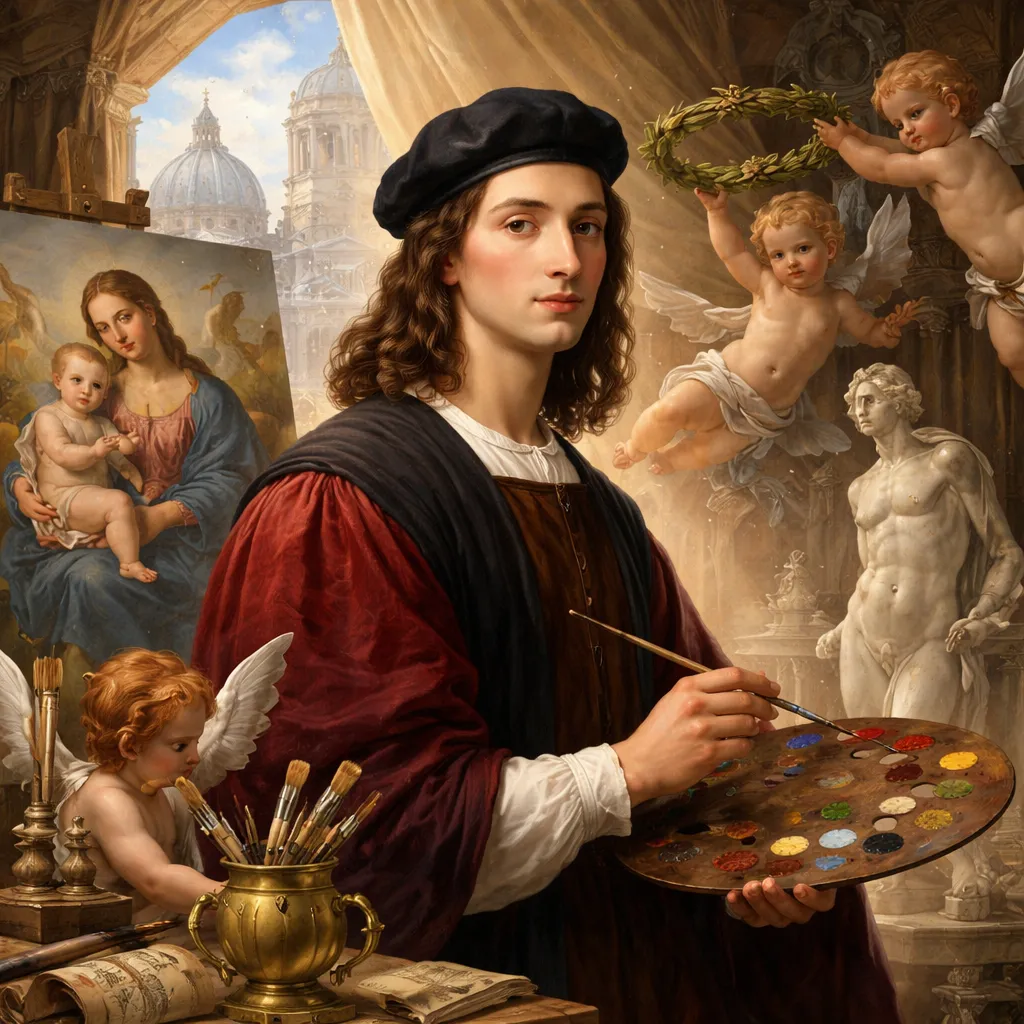

Introduction to Raphael
Raffaello Sanzio, known simply as Raphael, was born on April 6, 1483, in Urbino, Italy. He is widely regarded as one of the greatest painters of the Renaissance period, renowned for his harmonious compositions and delicate style. Raphael’s ability to capture the beauty and grace of the human form in both religious and mythological subjects made him a master of his craft.
Why is Raphael worth knowing? His work has inspired generations of artists and continues to influence art to this day. Known for his balanced compositions, gentle figures, and brilliant use of color, Raphael’s masterpieces reflect the ideals of the Renaissance and still serve as a guide to aspiring artists. His art is celebrated for its perfect harmony, and his legacy as a teacher and innovator continues to shine through in art history.
Early Life and Background
Raphael was born into a family of artists. His father, Giovanni Santi, was a painter who worked for the Duke of Urbino. Raphael’s early exposure to art was largely shaped by his father’s influence. Tragically, Giovanni passed away when Raphael was only 11 years old, but by that time, Raphael had already begun to show promise as an artist.
Growing up in Urbino, a cultural hub of the Renaissance, Raphael had access to a rich artistic environment. He trained under various masters, including the well-known painter Pietro Perugino, whose style had a lasting influence on Raphael’s early work. By his late teens, Raphael had already begun to attract attention for his talent, and he was soon invited to work in the cities of Florence and Rome.
Career Highlights and Achievements
Raphael’s career spanned just over two decades, but during this time, he achieved extraordinary success. One of the pivotal moments in his career was his move to Rome in 1508, where he was invited by Pope Julius II to decorate the rooms of the Vatican Palace. This commission set the stage for some of his most famous works.
One of Raphael’s greatest achievements is the decoration of the Stanze di Raffaello (Raphael Rooms) in the Vatican. These rooms, particularly the Room of the Segnatura, feature some of Raphael’s most iconic frescoes, including The School of Athens. This fresco, which portrays an assembly of great philosophers from ancient Greece, is considered one of Raphael’s finest works, demonstrating his ability to blend intellectual themes with artistic beauty.
Raphael’s contributions to the field of art were widely recognized in his lifetime. He was appointed as the chief architect of St. Peter’s Basilica in Vatican City, a position that allowed him to influence the design of one of the most important buildings in Christianity. His work as a painter and architect continues to be celebrated today.
Famous Works or Performances
Raphael’s body of work includes many masterpieces that have become essential parts of art history. His paintings are known for their calm, serene quality and for the way they reflect the intellectual spirit of the Renaissance. Here are some of his most famous works:
The School of Athens: Located in the Vatican’s Room of the Segnatura, this fresco depicts a gathering of ancient philosophers, including Plato and Aristotle. The painting is a symbol of knowledge, reason, and the pursuit of truth, capturing the essence of the Renaissance’s focus on humanism. The perspective, composition, and figures in The School of Athens are a testament to Raphael’s mastery of space and human anatomy. The Transfiguration: One of Raphael’s final works before his death, this painting is often considered his last great masterpiece. The Transfiguration shows the moment when Christ is transfigured on a mountaintop, flanked by Moses and Elijah. The work demonstrates Raphael’s ability to blend emotion with religious symbolism, using light and color to create a sense of divine transformation. The Madonna of the Goldfinch: This painting is a prime example of Raphael’s skill in creating intimate, tender images of the Virgin Mary and the Christ Child. In this work, the Virgin is depicted holding the infant Jesus while he plays with a goldfinch, a symbol of Christ’s future suffering. The painting showcases Raphael’s ability to create emotional depth in religious themes. Personal Life and Fun Facts
Raphael’s life, though short, was filled with artistic achievements and fascinating anecdotes. Unlike many artists of his time, Raphael was known for his charm and social grace. He was not just a masterful painter, but also a diplomat and a scholar. His ability to navigate the complex relationships of the papal court in Rome helped him gain numerous commissions.
One interesting aspect of Raphael’s life was his reputation as a womanizer. He is believed to have had several romantic relationships, but his love life has often been overshadowed by his artistic genius. Despite his social engagements, Raphael was also deeply focused on his work, spending long hours in his studio.
Raphael’s death at the age of 37 was sudden and mysterious. He died on April 6, 1520, which happened to be his 37th birthday. His early death was mourned by many, and he was buried in the Pantheon in Rome, a testament to the high regard in which he was held.
Legacy and Influence
Raphael’s legacy is immense, and his impact on the art world continues to be felt today. His work helped to shape the direction of Western art, influencing not only his contemporaries but also generations of artists who came after him. His idealized depictions of beauty, his mastery of perspective, and his innovative use of color have made him a model for artists throughout history.
Raphael’s influence can be seen in the work of later artists like Michelangelo, Leonardo da Vinci, and even modern painters such as Edgar Degas and John Singer Sargent. His emphasis on harmonious composition and balanced proportions has made his style timeless.
In addition to his paintings, Raphael’s role as an architect and his contributions to the design of St. Peter’s Basilica remain key elements of his legacy. His ability to bridge the worlds of painting and architecture set him apart as one of the Renaissance’s greatest polymaths.
How to Learn from Raphael
Raphael’s life and work offer valuable lessons that extend beyond the world of art. His dedication to his craft, his ability to innovate while respecting tradition, and his skill in balancing beauty with intellectual depth are qualities that can inspire anyone, regardless of their field.
One of the most important lessons to learn from Raphael is the value of balance. Whether it was his perfect proportions in painting or his ability to balance his social life with his work, Raphael demonstrated that harmony is key to success. This can apply to many areas of life, from schoolwork to personal relationships.
Raphael’s ability to remain focused and dedicated to his art, even in the face of fame and the distractions of court life, teaches the importance of perseverance. He was never satisfied with simply repeating what others had done before him. Instead, he constantly sought to improve, innovate, and create works that would inspire generations to come.
For young readers and aspiring artists, Raphael’s story shows that success comes from hard work, a willingness to learn, and a dedication to mastering your craft. His life reminds us that greatness is not just about talent, but about the determination to continue growing and pushing boundaries.
Through his works and his life, Raphael continues to be a shining example of what it means to pursue artistic excellence. His contributions to the world of art have had a lasting impact, and his legacy will continue to inspire artists and thinkers for generations to come.