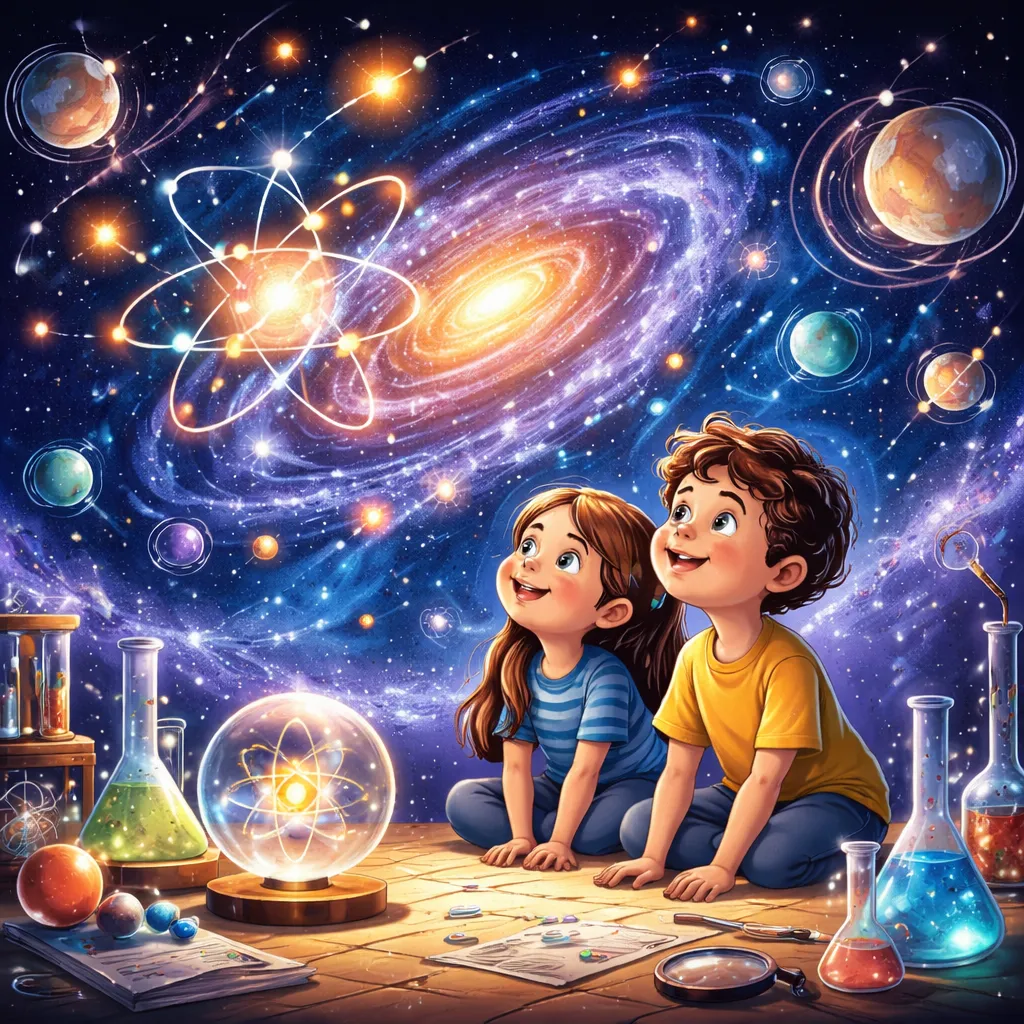

Are Similar Words Really Interchangeable? Many students and parents encounter the words physics and matter early in their scientific journey. While these terms often appear in the same book, they describe different parts of our world. Using them interchangeably can lead to confusion when children try to explain scientific observations. Understanding the specific meaning of each term creates a stronger foundation for critical thinking.
Physics represents the study of how things move and interact through forces and energy. Matter represents the actual "stuff" that makes up everything we can see, touch, or feel. One is the study of the rules, while the other is the study of the objects. Distinguishing between them helps young learners organize their thoughts about the physical world more effectively.
When we teach children these terms, we give them a professional vocabulary to describe their curiosity. A child might notice a ball rolling down a hill and wonder about the science behind it. Is it the ball itself they are curious about, or the way it moves? Knowing the difference between these concepts allows them to ask better, more specific questions.
Set 1: Physics vs Matter — Which One Is More Common? The word matter is incredibly common because it describes every physical object in a child's life. From a favorite stuffed animal to the water in a swimming pool, everything is made of matter. Parents use this word frequently when explaining that even invisible things, like air, take up space. It is a fundamental noun that children learn very early in their primary science lessons.
Physics is a word that often sounds more "academic" or "serious" to a young learner. Children might hear it in the context of famous scientists like Isaac Newton or Albert Einstein. While it is a common school subject, it feels like a specialized field of study rather than an object. It describes a broad category of knowledge rather than a specific physical item you can hold.
In daily conversation, we might say "the laws of physics" to explain why we cannot fly. We rarely say "the laws of matter," because matter follows the rules that physics defines. Both words are high-frequency terms in STEM education, but matter is the more "tangible" word. It appears in basic descriptions of the world, while physics appears in explanations of how it functions.
Set 2: Physics vs Matter — Same Meaning, Different Contexts We use the term matter when we focus on the composition and state of an object. For instance, we talk about whether a substance is a solid, a liquid, or a gas. In this context, we are looking at the density, mass, and volume of the material itself. Matter is the star of the show when we are identifying what an object is made of.
We switch to the term physics when we want to discuss movement, light, sound, or heat. If a child asks why a mirror reflects their image, they are asking a question about physics. The mirror itself is made of matter, but the way light bounces off it is a physical process. The context changes from "what is this?" to "how does this happen?"
Think of a bicycle sitting in a garage compared to a bicycle racing down a street. The metal, rubber, and plastic of the bike are all examples of matter in a stationary state. The speed, the friction of the tires, and the force of the pedals involve the principles of physics. Using both words correctly helps children describe both the object and the action accurately.
Set 3: Physics vs Matter — Which Word Is “Bigger” or More Emphatic? Physics is the "bigger" word because it encompasses a vast range of different scientific topics. It includes the study of the smallest atoms and the largest galaxies in the distant universe. When a student says they love physics, they are expressing an interest in the fundamental laws of nature. It is a powerful, all-encompassing term that suggests a high level of curiosity and intellect.
Matter is an emphatic word because it asserts the physical reality of something in our environment. When scientists say "matter matters," they are emphasizing that physical substance is the basis of our existence. It is a more focused term that deals specifically with mass and the space an object occupies. It feels more grounded because it refers to the physical "building blocks" of our reality.
For a child, physics feels like a grand adventure into the unknown and the invisible forces of life. Matter feels like the reliable collection of things they can interact with every single day. One word represents the infinite rules of the cosmos, while the other represents the tangible items we use. Both carry significant weight in the language of science and help children feel like experts.
Set 4: Physics vs Matter — Concrete vs Abstract Matter is a very concrete concept because it has mass and takes up physical space in the room. You can weigh matter on a scale, measure its height with a ruler, or feel its texture. Even though some matter, like gas, is hard to see, we can still trap it in a balloon. This physical presence makes it a very easy concept for children to grasp through their senses.
Physics often involves abstract concepts that we cannot see or touch directly, like gravity or magnetism. We can see the effects of gravity when an apple falls, but we cannot see gravity itself. Physics requires a child to use their imagination to visualize invisible forces pushing and pulling on objects. It moves the learner from simple observation into the world of theoretical thinking and logic.
Connecting the concrete nature of matter with the abstract ideas of physics is a key educational goal. When a child drops a rock into a pond, they see the concrete matter of the rock creating ripples. The ripples themselves and the way the energy moves through the water are the abstract parts of physics. This balance helps children develop a sophisticated way of looking at their surroundings and natural events.
Set 5: Physics vs Matter — Verb or Noun? First Understand the Role Both physics and matter function as nouns in the English language, but they behave differently in sentences. Matter often acts as the subject or the direct object because it represents a physical thing. You might say, "The matter in this rock is very dense," or "All matter is made of tiny atoms." It identifies a specific group of substances that have physical properties.
Physics often functions as the name of a system or a specific area of human knowledge. You might say, "The physics of flight allows airplanes to stay in the air for long periods." In this case, the word describes the rules and forces that are being applied to an object. It acts as a framework for understanding how different things interact with each other in a system.
Teaching kids to use these nouns correctly helps them structure their scientific explanations more clearly. They learn that they can "study physics" but they "observe matter" in their daily lives or experiments. This distinction prevents "word salad" where scientific terms are used without a clear understanding of their function. It makes their spoken and written English sound much more professional and organized.
Set 6: Physics vs Matter — American English vs British English In both American and British English, the core definitions of physics and matter are identical. However, the way these subjects are integrated into the school curriculum can differ slightly. In the United States, "Physics" is often a dedicated course taken by older students after they learn biology. Younger students might explore these concepts under the broader label of "Physical Science" in elementary school.
In the United Kingdom, "Physics" is frequently introduced as one of the three core sciences along with Chemistry and Biology. Students might start using the word "Physics" to describe their lessons at a much younger age. Despite these curriculum differences, the terminology used by scientists remains a global standard across all borders. A student in London and a student in New York will both use the word matter to describe a solid.
There are no major spelling differences for these two specific words, unlike "color" and "colour." This makes physics and matter very stable "bridge words" for international students learning English through science. It shows children that science is a universal language that allows people from everywhere to share ideas. Learning these terms helps them join a global community of young thinkers and future innovators.
Set 7: Physics vs Matter — Which Fits Formal Situations? Physics is the formal term used in academic settings, research papers, and professional science careers. If a child is preparing a presentation for a science fair, using the word "physics" shows they are serious. It is the appropriate word for discussing energy, motion, mechanics, and the mathematical laws of the universe. It sounds authoritative and signals that the speaker has a deep understanding of the topic.
Matter is the formal scientific term used to replace informal words like "stuff," "things," or "materials." In a formal lab report, a student should write about "states of matter" rather than "types of things." Using this precise word demonstrates that the student respects the accuracy required in scientific communication. It shows they can categorize the world according to established scientific principles and definitions.
Encouraging children to use these formal terms at home prepares them for the expectations of higher education. When they use "physics" and "matter" instead of vague language, they begin to think more like professionals. It builds their academic confidence and helps them transition smoothly into more challenging school environments. Formal language is a powerful tool for any young person who wants to be heard.
Set 8: Physics vs Matter — Which One Is Easier for Kids to Remember? Matter is often easier for children to remember because it can be linked to the popular phrase "It matters!" You can tell a child that everything that "matters" is made of "matter." This simple wordplay creates a strong memory hook that connects the word to its physical meaning. Since matter is something they can touch, it feels very "real" and simple to define in their minds.
Physics can be slightly more challenging to remember because of its unique spelling and the "ph" sound. However, it can be associated with "Physical Education" or "Physical Activity," which kids already know as "P.E." You can explain that physics is just the science of how things get "physical" and move around. This connection to their own bodies and movement makes the word much more relatable and fun.
To help a child remember both, use the "Building and Playing" analogy to illustrate the difference. The blocks used to build a tall tower are the matter, the physical pieces you can hold in your hand. The reason the tower falls over when it gets too high is because of the laws of physics. This visual and hands-on comparison ensures that both concepts are locked into their long-term memory.
Mini Exercise: Can You Spot the Differences Between These Similar Words? Let's put your scientific vocabulary to the test with a quick and interactive challenge! Read the sentences below and decide if the missing word should be physics or matter. This is a great way for parents and kids to practice together while having a bit of fun. Good luck, young scientist!
Every star, planet, and moon in the sky is made of a different kind of ______.
My teacher explained that ______ is the study of why things fall down instead of up.
Ice is just the solid state of ______, while steam is the gas state of the same thing.
I want to learn more about ______ so I can understand how magnets pull on metal.
How did you do on the quiz? For sentences one and three, the correct answer is "matter" because we are describing physical substances. For sentences two and four, the answer is "physics" because we are talking about the study of forces and rules. If you got them all right, you are ready to explain these concepts to your friends!
Parent Tips: How to Help Kids Learn and Remember Similar Words Supporting your child's scientific vocabulary doesn't require a lab coat or expensive equipment. You can start by playing "Matter Hunt" around the house to find solids, liquids, and gases. Ask your child to identify if the milk in the fridge or the air in their bike tires is matter. This makes the word a natural part of their daily vocabulary and reinforces its concrete meaning.
Explore physics together by doing simple activities like rolling cars down ramps or playing with magnets. Instead of just playing, use the word "physics" to describe the forces you are seeing in action. You might say, "The physics of this ramp makes the car go faster when it is steeper!" This connects the academic word to a fun, positive experience that stays with them.
Create a "Science Word Wall" in a common area where you can post new terms like "mass" or "gravity." Seeing the words physics and matter alongside their definitions helps with spelling and long-term recognition. Most importantly, stay curious yourself and model the behavior of a lifelong learner for your child. Your excitement about science is the best way to inspire their own passion for discovery and language.
The world around us is full of wonders that are waiting to be explained through the lens of science. By understanding the relationship between physics and matter, children gain a clearer view of how the universe operates. These words are not just for textbooks; they are keys that unlock a deeper appreciation for every object and every movement. Keep exploring, keep asking "how" and "what," and enjoy the amazing journey of learning together as a family.