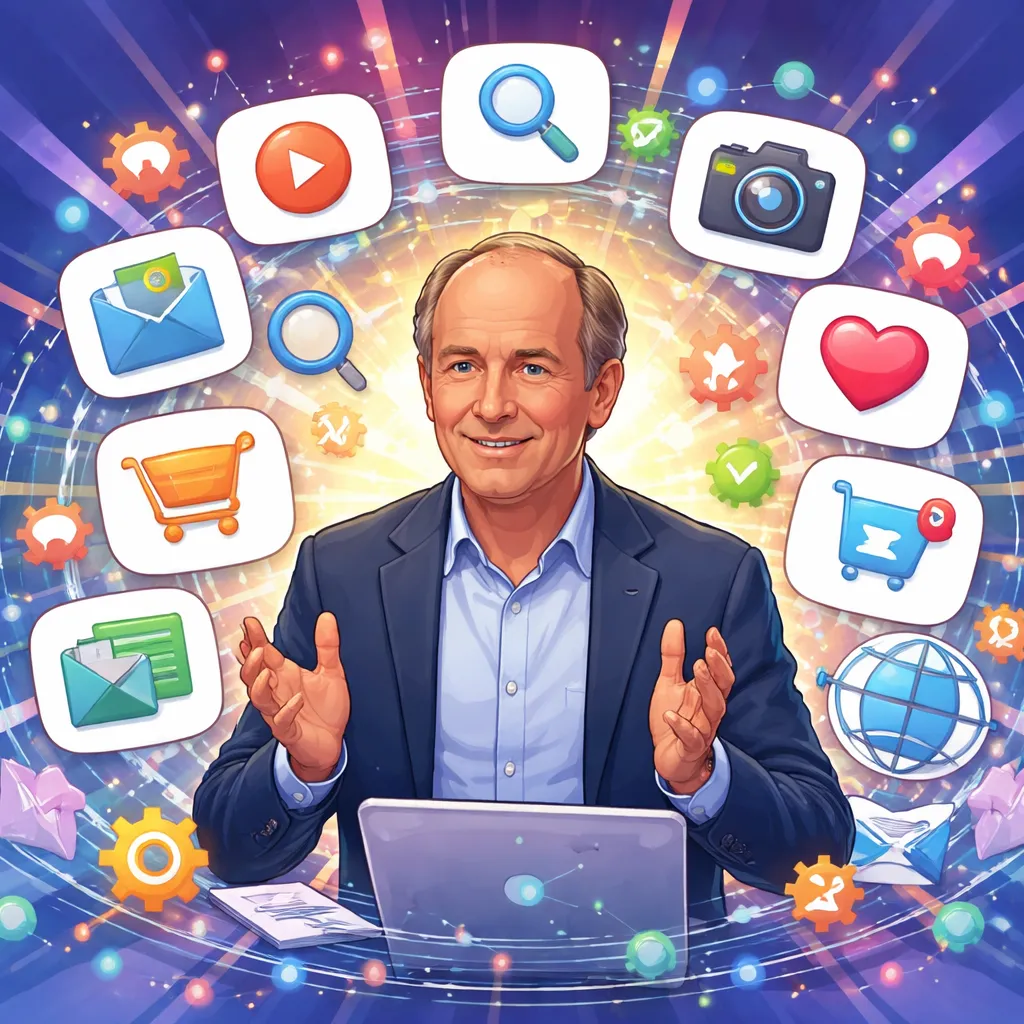

Introduction to Tim Berners-Lee
Tim Berners-Lee is a British computer scientist and professor. He invented the World Wide Web in 1989. This celebrity story: Tim Berners-Lee shows that one person's simple idea can connect the whole planet. Berners-Lee did not become rich from his invention. He gave it away for free. Children can learn that sharing knowledge is more important than keeping it secret. Parents can use his story to teach generosity and problem-solving. Before Berners-Lee, the internet existed but was hard to use. Only experts could find information. He created web pages, links, and browsers. Now anyone with a screen can visit almost any website. His life proves that a quiet, patient person can build something that changes everything.
Early Life and Background
Timothy John Berners-Lee was born on June 8, 1955, in London, England. His parents, Mary Lee Woods and Conway Berners-Lee, were both computer scientists. They worked on the Ferranti Mark I, one of the first commercial computers. Young Tim grew up surrounded by conversations about computing. He loved playing with cardboard boxes. He imagined they were computers. He also loved electronics. He built a model computer out of an old television set. He attended Emanuel School in London. He was good at math and science. He also loved trains. He kept a notebook of train numbers and schedules. That notebook was like a database. He later said that train spotting taught him how to organize information. He studied physics at The Queen's College, Oxford. He graduated with first-class honors in 1976. At Oxford, he built his own computer. He used a soldering iron, a microprocessor, and an old television. He called it the "CERN box." After university, he worked for several technology companies. He wrote software and built networks. He enjoyed solving problems but wanted to do something bigger.
Career Highlights and Achievements
In 1980, Tim Berners-Lee worked as a consultant at CERN, the European particle physics laboratory in Switzerland. He saw a big problem. Scientists from around the world came to CERN. They brought different computers with different systems. Sharing information was very hard. Berners-Lee wrote a simple program called ENQUIRE. It let him link pieces of information together. It was a small prototype of the web. He left CERN but returned in 1984 as a fellow. The problem was worse. More scientists, more computers, more confusion. In March 1989, Berners-Lee wrote a proposal. He called it "Information Management: A Proposal." It described a global hypertext system. His boss wrote "vague but exciting" on the cover. Berners-Lee got permission to work on the idea. He built three things. First, HTML, a language to create web pages. Second, URI, a way to name every page with an address. Third, HTTP, a protocol to send pages between computers. By December 1990, he built the first web browser and web server. He put up the first website at info.cern.ch. The website explained what the web was and how to use it.
Famous Works or Performances
Tim Berners-Lee's most famous work is the World Wide Web itself. But the web consists of three specific inventions. HTML stands for HyperText Markup Language. HTML uses tags like <h1> for headings and <p> for paragraphs. Every website you visit uses HTML. HTTP stands for HyperText Transfer Protocol. HTTP tells computers how to request and send web pages. When you type a web address, your browser uses HTTP to fetch the page. URL stands for Uniform Resource Locator. That is the web address you type, like www.example.com. Every page has a unique URL. Berners-Lee also built the first web browser. He called it WorldWideWeb. It ran on a NeXT computer. The browser could show pages and edit them. He built the first web server on the same machine. The first website explained the web project. It described how to set up a server and create pages. That website still exists today. You can visit it at its original address. Berners-Lee also started the World Wide Web Consortium in 1994. The W3C makes rules for the web so all browsers work the same way.
Personal Life and Fun Facts
Tim Berners-Lee has many interesting personal habits. He is quiet and does not like fame. He still uses an old laptop without a touchscreen. A fun fact is that he never patented the web. He could have become one of the richest people in the world. He chose to give it away for free. He said, "If I had kept it private, it would have died." Another fun fact is that he married Nancy Carlson, an American programmer, in 1990. They met while she was working at CERN. They have two children. He later married Rosemary Leith, a Canadian banker. Berners-Lee loves long-distance walking. He walks for hours to think. He also loves sailing. He sails on the Charles River in Boston. He is a professor at MIT and the University of Oxford. He still writes code. In 2017, he won the Turing Award, the highest honor in computing. He donated the $1 million prize money to his foundation. He wears his hair long and speaks softly. People who meet him say he is kind and patient. He answers emails from strangers. He believes the web belongs to everyone.
Legacy and Influence
Tim Berners-Lee changed the world more than almost anyone alive. Before the web, the internet was a place for experts and academics. After the web, anyone could share and find information. As of 2024, over five billion people use the web. That is more than 60 percent of the world's population. The web created new industries. Google, Amazon, Facebook, YouTube, and Wikipedia all depend on Berners-Lee's inventions. The web changed how we learn, work, shop, date, and communicate. Berners-Lee received many honors. Queen Elizabeth II knighted him in 2004. He became Sir Tim Berners-Lee. He received the Order of Merit in 2007, one of the highest honors in the United Kingdom. The ACM gave him the Turing Award in 2017. He has received over 20 honorary doctorates. He started the Web Foundation to fight for a free and open web. He also launched Solid, a project to give people control of their own data. He worries about how big companies use personal information. He says the web is not finished. We need to make it safer and fairer. His legacy proves that giving away a great idea can make you richer than keeping it. Not richer in money. Richer in impact.
Quotes or Famous Sayings
Tim Berners-Lee has spoken many wise words. One famous quote is, "The web is more a social creation than a technical one." Another powerful saying is, "We need diversity of thought in the world to face the new challenges." He also said, "You affect the world by what you browse." Children might like this one: "Anyone can change the web. You don't have to be a genius." Families can read these quotes together. Ask children, "What does it mean that the web is social?" It means people make the web, not machines. Parents can help children see that Berners-Lee could have been a billionaire. He chose to be a teacher. His quotes remind us that success is not just about money. It is about helping others. Write a Berners-Lee quote on a whiteboard. Change it each week. Ask children how they can change the web today.
How to Learn from Tim Berners-Lee
Children can learn several lessons from Tim Berners-Lee. First, solve real problems. He saw that sharing information was hard. He did not complain. He built a solution. Second, share your work. He gave the web away. He did not charge for it. That is why the web grew so fast. Third, protect what you build. He now fights for a free and open web. He does not want big companies to control it. Parents can encourage young children to make their own simple web page. Use a free tool like Glitch or CodePen. Write a heading and a paragraph. Add a link to a favorite website. Older children can learn basic HTML. Tags like <html>, <body>, and <a> are easy to learn. Families can also visit the first website at its original address. Type info.cern.ch into a browser. See how simple the first web page was. Another activity is to discuss web safety. Ask children, "Who owns your data?" Berners-Lee believes you should own it. Tim Berners-Lee did not invent the internet. He invented the web. That small difference changed billions of lives. He did it alone in a small office. He did it without asking for permission. He did it without wanting money. Every child can be like Tim. See a problem. Build a solution. Share it freely. The world is waiting for your idea. Go make it.