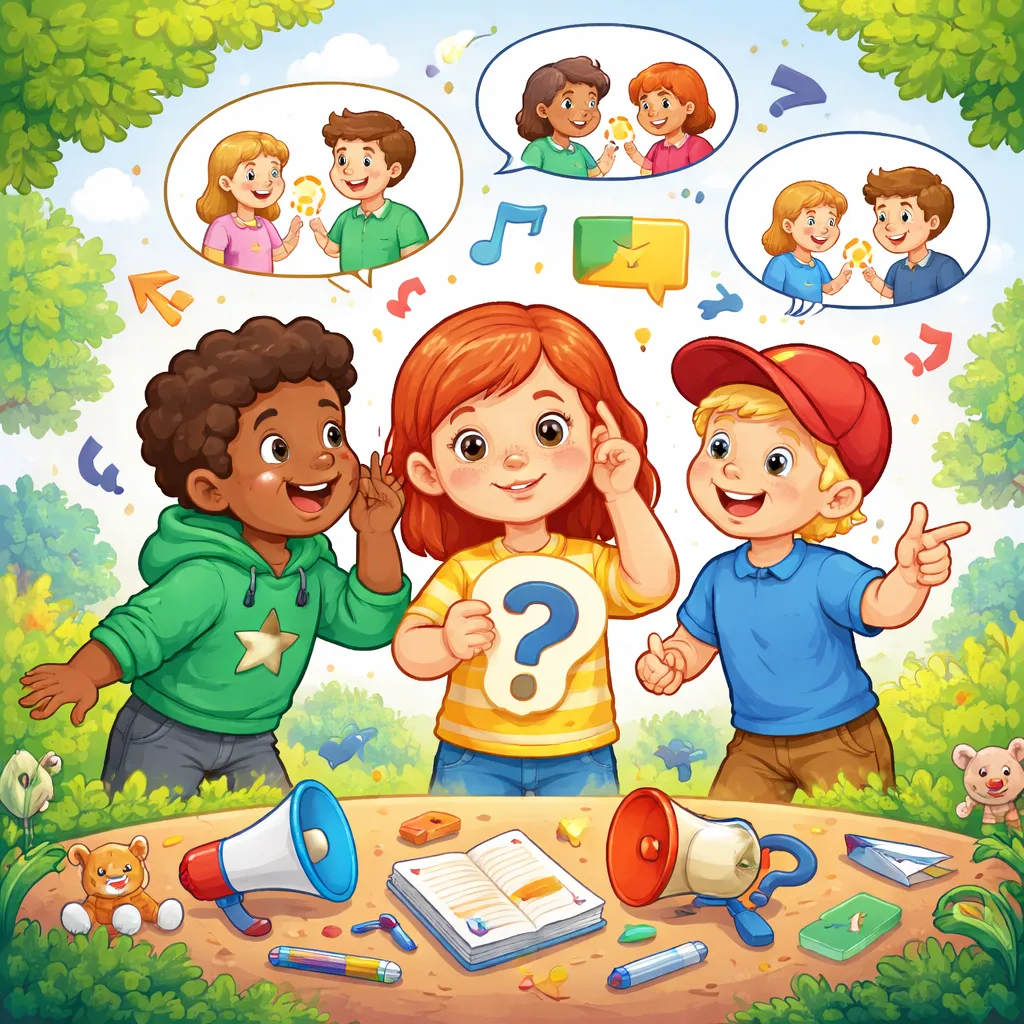

Hello, word reporter! Do you like to tell stories? Have you ever played a game of telephone? You hear a message. Then you pass it on. We do that with words all the time! There are two ways to share what someone said. You can copy their exact words. Or you can tell the message in your own words. The first way is direct speech. The second way is indirect speech. Today, you will learn to master both. We will practice with eighty must-master sentences. Your guide is Tilly the Telephone. She loves to pass on messages. She will show us at home, the playground, school, and the park. Let's start talking!
What Are Direct and Indirect Speech? Think of it like a message game. Direct speech is like being a parrot. You repeat the exact words someone said. You use quotation marks (" ") like little word bubbles. Mom said, "Please clean your room." Those are her exact words inside the bubbles. Indirect speech is like being a news reporter. You tell the idea of what someone said, in your own words. You do not use bubbles. Mom said that I should clean my room. Both ways share the same message, but differently. "Tilly's line is busy with eighty must-master examples for you to try."
Why Is This Message Skill So Useful? It helps you be a great story-teller and listener. It helps your ears listen. You can hear the difference between exact words and the main idea. It helps your mouth speak. You can tell friends what someone else told you. "Leo said he has a new bike." It helps your eyes read. You will see "talking bubbles" in storybooks. It helps your hand write. You can write fun stories with characters who talk. Using both ways makes you a super communicator.
What Are the Two Ways to Share Words? Tilly the Telephone shows us the two paths a message can take.
Direct Speech (The Exact Copy): This is the "parrot" way. You copy the words perfectly. You put them inside quotation marks (" "). A speaking word like 'said', 'shouted', or 'asked' comes before or after. The message is exactly the same. Tom said, "I am happy." "I am hungry," said Mia.
Indirect Speech (The Reporter's Way): This is the "news reporter" way. You tell the idea. You do not use quotation marks. You often use the word 'that' after the speaking word. Some small words inside the message might change. Tom said that he was happy. Mia said that she was hungry. See how 'I' became 'he' or 'she'? That's because you are reporting it now.
How Can You Tell Which Is Which? Be a message detective. Look for these clues.
Look for the "talking bubbles". Those quotation marks (" ") mean direct speech. The words inside are the exact words.
Listen for the speaker's tag. Words like 'said', 'asked', 'yelled'. In direct speech, there is often a comma before the bubbles. Mom said, "Come here." In indirect speech, there is no comma. Mom said that I should go there.
Check the pronouns. In direct speech, people say "I", "me", "my", "you". In indirect speech, those often change. "I" might become "he" or "she". "You" might become "me" or "him".
Tilly gives us a message. Lily said, "I like cats." This is direct. Exact words in bubbles. Now report it. Change 'I' to 'she' and 'like' to 'liked'. Lily said that she liked cats. This is indirect. Great reporting!
What Are the Message Formulas? Here is how to build your sentences.
Direct Speech Formula: [Speaker] + [speaking verb] + , + "[Exact Words]." Or: "[Exact Words], " + [speaking verb] + [speaker]. Dad said, "Dinner is ready." "Dinner is ready," said Dad.
Indirect Speech Formula: [Speaker] + [speaking verb] + (that) + [Changed Message]. Dad said that dinner was ready. Notice 'is' became 'was'. Sometimes the tense changes a little.
Let's Fix Some Mixed-Up Messages. Sometimes we get the wires crossed. Let's fix the line.
Mixing the two ways. Mom said that, "I am tired." This mixes 'that' (indirect) with bubbles (direct). Choose one! Direct: Mom said, "I am tired." Indirect: Mom said that she was tired.
Forgetting to change the pronoun. Ben said, "You are my friend." If I tell Max what Ben said about him, I report: Ben said that you are his friend. If I tell someone else what Ben said about Max, I report: Ben said that Max was his friend. The 'you' must change to the right name.
Wrong punctuation. Sam said "hello". In direct speech, we need a comma before the bubbles. Sam said, "hello." Also, the period goes inside the bubbles.
Forgetting the comma. She whispered "goodnight". Add the comma. She whispered, "goodnight."
Can You Pass the Message Correctly? You are a great message helper! Let's practice. Direct speech: The teacher said, "Class is fun." Now you tell your mom. Use indirect speech. Change 'Class' to 'class' and 'is' to 'was'. The teacher said that class was fun. Good! Harder one. Your friend Leo says to you, "I have your ball." You tell your sister. Leo said that he had your ball. Perfect message passing!
Tilly's Telephone Line: 80 Must-Master Message Examples. Let's practice eighty messages. We'll see direct speech and then indirect speech for each scene.
At Home Messages (20). Direct: Mom said, "Please set the table." Indirect: Mom said to set the table. Direct: "I am hungry," said my brother. Indirect: My brother said that he was hungry. Direct: Dad yelled, "Dinner is ready!" Indirect: Dad yelled that dinner was ready. Direct: My sister whispered, "I am scared." Indirect: My sister whispered that she was scared. Direct: The baby cried, "I want milk." Indirect: The baby cried for milk. Direct: Grandma said, "You are a good helper." Indirect: Grandma said that I was a good helper. Direct: "I love you," said my mom. Indirect: My mom said that she loved me. Direct: My dad asked, "Is your room clean?" Indirect: My dad asked if my room was clean. Direct: The cat meowed, "Feed me." Indirect: The cat meowed to be fed. Direct: I said, "I will clean up." Indirect: I said that I would clean up.
Playground Messages (20). Direct: Leo shouted, "I won the race!" Indirect: Leo shouted that he had won the race. Direct: "Wait for me!" said Mia. Indirect: Mia said to wait for her. Direct: The coach said, "Good job, team!" Indirect: The coach said that the team did a good job. Direct: My friend asked, "Can you play?" Indirect: My friend asked if I could play. Direct: I said, "This is fun!" Indirect: I said that it was fun. Direct: Sam yelled, "Catch the ball!" Indirect: Sam yelled for me to catch the ball. Direct: "It is my turn," said the girl. Indirect: The girl said that it was her turn. Direct: The boy cried, "I fell down!" Indirect: The boy cried that he had fallen down. Direct: My friend whispered, "I have a secret." Indirect: My friend whispered that she had a secret. Direct: The teacher said, "Time to go in." Indirect: The teacher said it was time to go in.
School Messages (20). Direct: The teacher said, "Open your books." Indirect: The teacher told us to open our books. Direct: "I know the answer," said Ben. Indirect: Ben said that he knew the answer. Direct: Emma asked, "What page are we on?" Indirect: Emma asked what page we were on. Direct: The principal said, "Be kind to others." Indirect: The principal said to be kind to others. Direct: I said, "I need a pencil." Indirect: I said that I needed a pencil. Direct: My friend said, "Your drawing is nice." Indirect: My friend said that my drawing was nice. Direct: The librarian said, "Please be quiet." Indirect: The librarian asked us to be quiet. Direct: "I finished my work," said Lily. Indirect: Lily said that she had finished her work. Direct: The boy asked, "Can I go to the bathroom?" Indirect: The boy asked if he could go to the bathroom. Direct: The bell rang, "Ding dong!" Indirect: The bell rang to signal break time.
Nature Messages (20). Direct: The guide said, "Do not feed the animals." Indirect: The guide told us not to feed the animals. Direct: "Look at that bird!" said my dad. Indirect: My dad said to look at that bird. Direct: My mom said, "The sky is so blue." Indirect: My mom said that the sky was so blue. Direct: I shouted, "I see a rabbit!" Indirect: I shouted that I saw a rabbit. Direct: The sign said, "Stay on the path." Indirect: The sign said to stay on the path. Direct: My sister said, "I hear the ocean." Indirect: My sister said that she heard the ocean. Direct: "It is going to rain," said Grandpa. Indirect: Grandpa said that it was going to rain. Direct: The gardener said, "These flowers need water." Indirect: The gardener said that those flowers needed water. Direct: I whispered, "The deer is beautiful." Indirect: I whispered that the deer was beautiful. Direct: My brother said, "Let's climb the hill." Indirect: My brother suggested that we climb the hill.
You Are Now a Master Messenger! You did it! You are now a direct and indirect speech expert. You know direct speech uses "talking bubbles" for exact words. You know indirect speech reports the idea without bubbles. You know how to change small words like "I" to "he" or "she". Tilly the Telephone is proud. You can now share messages both ways clearly. You have practiced eighty must-master examples.
Here is what you can learn from our message game. You will know the difference between direct and indirect speech. You can write sentences with direct speech and quotation marks. You can change a direct message into an indirect one. You remember to change pronouns like 'I' to 'he/she' and 'you' to 'me/him/her'. You have a big list of eighty examples to learn from.
Now, let's do some life practice! Your mission is today. Listen to what a family member says at dinner. Repeat it to someone else using indirect speech. For example, if Dad says, "This soup is hot," you can tell your sister: "Dad said that the soup was hot." Try it! Also, try writing down something you said today using direct speech. Put it in "bubbles". Say: I said, "I am a great messenger!" Keep playing the message game every day