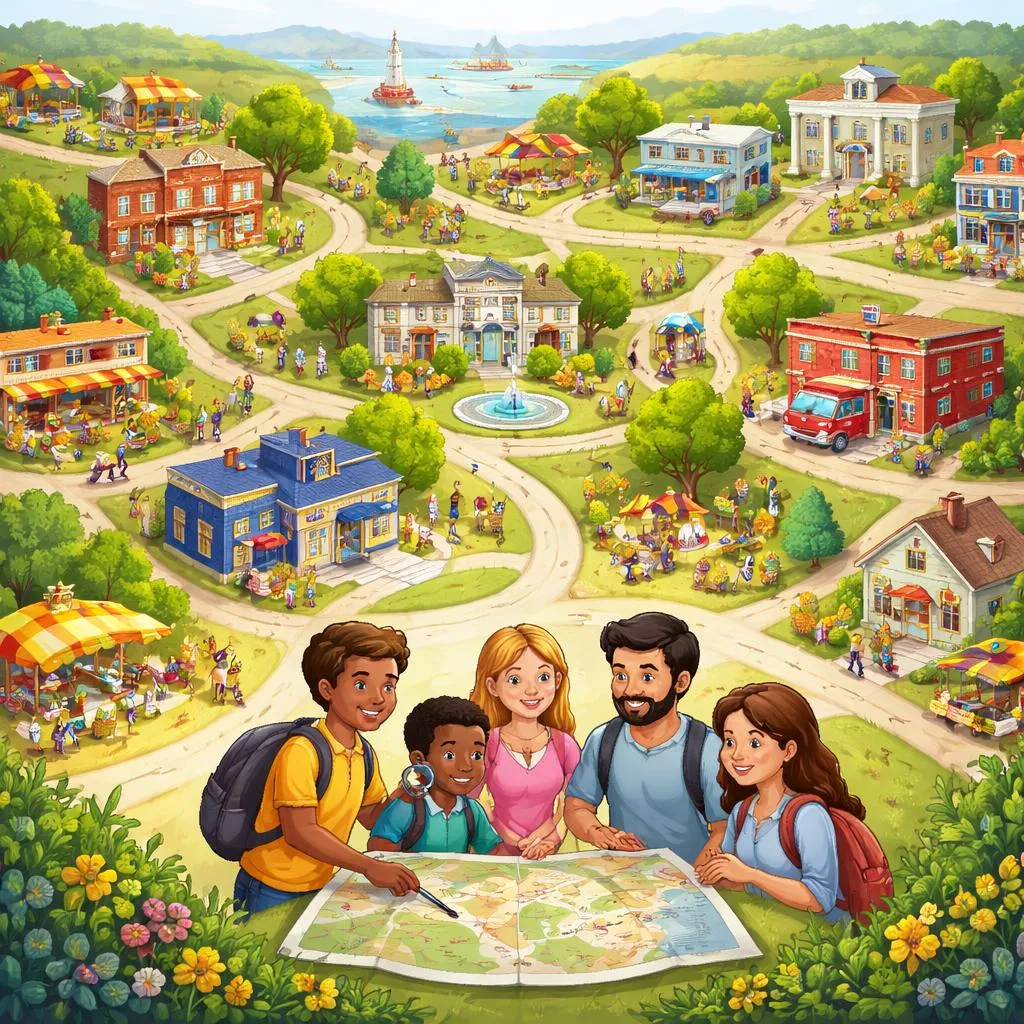

Hello, young explorers and wonderful teachers! Today we take a walk through a town. We will discover all the places that make a community work. People live in houses and apartments. They learn in schools. They shop in stores. They play in parks. Learning about town and places helps children understand their world. It helps them talk about where they go. It builds vocabulary for real conversations. Let us explore together. Let us visit all the important places in a town.
What Are Town and Places? Town and places are the locations people visit in a community. Some are buildings where people live. Some are where people work. Some are where people learn. Some are where people have fun. All these places together make a town complete.
Think about a typical day in a town. A child wakes up at home. They walk to school. After school, they go to the park. They stop at the supermarket with a parent. They visit the library for story time. Each of these is a place in the town. Each has a name and a purpose.
Learning place names helps children talk about their daily life. It helps them tell stories about where they went. It helps them ask for directions. It helps them understand their community.
Meaning and Explanation of Town Places Town places have different purposes. Understanding these purposes helps children use the words correctly.
Residential places are where people live. Houses, apartments, condos, townhouses. These are homes. People sleep, eat, and spend time with family in these places.
Educational places are where people learn. Schools, libraries, museums, colleges. Children go to school to learn reading and math. Libraries have books to borrow. Museums have interesting things to see.
Commercial places are where people buy things. Supermarkets, clothing stores, toy stores, bakeries. People go to these places to shop for what they need and want.
Medical places are where people get healthy. Hospitals, doctor's offices, dentist offices, pharmacies. These places help people when they are sick or hurt.
Community service places help the public. Fire stations, police stations, post offices, town halls. People who work here help keep the community safe and running.
Recreational places are for fun and play. Parks, playgrounds, swimming pools, sports fields, movie theaters. Children love these places.
Food places are where people eat. Restaurants, cafes, ice cream shops, pizza places. Families go here for meals and treats.
Categories or Lists of Town and Places Organizing town places into categories helps learning. Here are common place groups.
Places Where People Live: House, apartment building, townhouse, cottage, farmhouse
Places Where People Learn: School, library, museum, preschool, college, art studio, music school
Places Where People Shop: Supermarket, grocery store, bakery, bookstore, toy store, clothing store, shoe store, pharmacy, shopping mall
Places Where People Get Help: Hospital, doctor's office, dentist office, fire station, police station, post office, bank
Places Where People Have Fun: Park, playground, zoo, aquarium, movie theater, swimming pool, sports field, ice skating rink, arcade
Places Where People Eat: Restaurant, cafe, pizza place, ice cream shop, fast food restaurant, bakery
Transportation Places: Bus stop, train station, airport, taxi stand, gas station
Places of Worship: Church, temple, mosque, synagogue
Daily Life Examples of Town and Places Place words appear throughout daily conversation. Pointing them out helps children learn naturally.
Morning routines involve place words. "Time to go to school." "We will meet at the bus stop." "After school, we go to the park." These simple phrases teach place names in context.
Weekend outings offer many examples. "We are going to the zoo." "Let's visit the library." "Do you want to go to the movies?" Children hear and use these words during fun activities.
Errands teach community places. "First we go to the bank." "Then we stop at the supermarket." "After that, we go to the post office." Children learn the names of places where families do business.
Stories and books are full of place words. Reading together, we can point to places in pictures. "Look, the children are at the playground." "The family is eating at a restaurant." This connects reading to real-world vocabulary.
Special events introduce new places. "We are going to the museum for the dinosaur exhibit." "Your cousin's birthday party is at the swimming pool." These exciting experiences create strong memory connections.
Printable Flashcards for Town and Places Flashcards help children learn place vocabulary visually. They provide clear images with words.
Building Flashcards: Create cards showing different town buildings. School, hospital, library, fire station, police station, supermarket. Each card has a clear picture and the word.
Fun Place Flashcards: Create cards showing entertainment places. Park, playground, zoo, movie theater, swimming pool. These are places children love to visit.
Shop Flashcards: Create cards showing different stores. Bakery, bookstore, toy store, clothing store, pharmacy. Children learn to name places where people buy things.
Community Helper Places: Create cards showing where helpers work. Fire station, police station, hospital, post office. Connect each place to the people who work there.
Use the cards for games. Hold up a card and name the place. Ask children to find the card for a place you name. Play memory match with two sets.
Learning Activities or Games for Town and Places Games make learning place vocabulary active and fun.
Where Am I? Guessing Game: Describe a place without naming it. "In this place, you can borrow books. You can read stories. You can sit quietly. Where am I?" Children guess "the library." This builds listening and reasoning skills.
Build a Town: Use blocks or boxes to build a town. Add paper signs for different places. School, hospital, fire station, supermarket, park. As children build, they name each place. This hands-on activity makes place words concrete.
Town Map Drawing: Give children a large piece of paper. Ask them to draw a map of their town. They can include their home, their school, and other places they know. They label each place. This builds spatial awareness and vocabulary.
I Spy Town Places: Look at a picture book or a busy town scene. Play I Spy with places. "I spy a place where people buy food." Children look for a supermarket or bakery. "I spy a place where sick people get help." They look for a hospital.
Place Sorting: Create cards with different town places. Also create cards with activities. "Borrow books" matches with library. "Buy food" matches with supermarket. "See animals" matches with zoo. Children match each activity to the correct place.
Printable Materials for Town and Places Printable resources support learning about town places. They provide visual structure.
Town Map Template: Create a simple map outline. Children add their own places. They draw and label the school, park, and other important locations. This builds planning and writing skills.
Place Coloring Pages: Create coloring pages for different town places. A school with children playing outside. A fire station with a truck. A library with books. Coloring reinforces vocabulary quietly.
Place Matching Worksheets: Create pages where children match the place picture to its name. Draw a line from the fire station to the words "fire station."
My Town Book: Create a small booklet with a page for each type of place. "Places where I learn" page with school and library. "Places where I play" page with park and playground. Children draw and label.
Educational Games for Town and Places Games extend place vocabulary learning in joyful ways.
Town Bingo: Create bingo cards with place pictures. Call out place names or descriptions. "The place where firefighters work." Children cover the fire station. "The place where you borrow books." Children cover the library.
Place Memory: Place place picture cards face down. Children flip two trying to find matches. When they find a match, they name the place and say one thing people do there.
Town Charades: Act out something that happens in a place. Pretend to read a book for library. Pretend to swim for pool. Others guess the place. This builds observation and vocabulary.
What's Missing from Town?: Show a picture of a town with several places. Ask children to name all the places they see. Then show a second picture with one place removed. Children guess which place is missing.
Field Trip Discussion: Before a field trip to a town place, talk about it. What will we see there? What do people do there? After the trip, talk about what happened. Use the place vocabulary naturally.
Through learning about town and places, children understand their community better. They know where to go for different needs. They can describe their neighborhood to others. They feel more connected to the world around them. Every place has a name and a purpose. Knowing them helps children feel at home in their town.