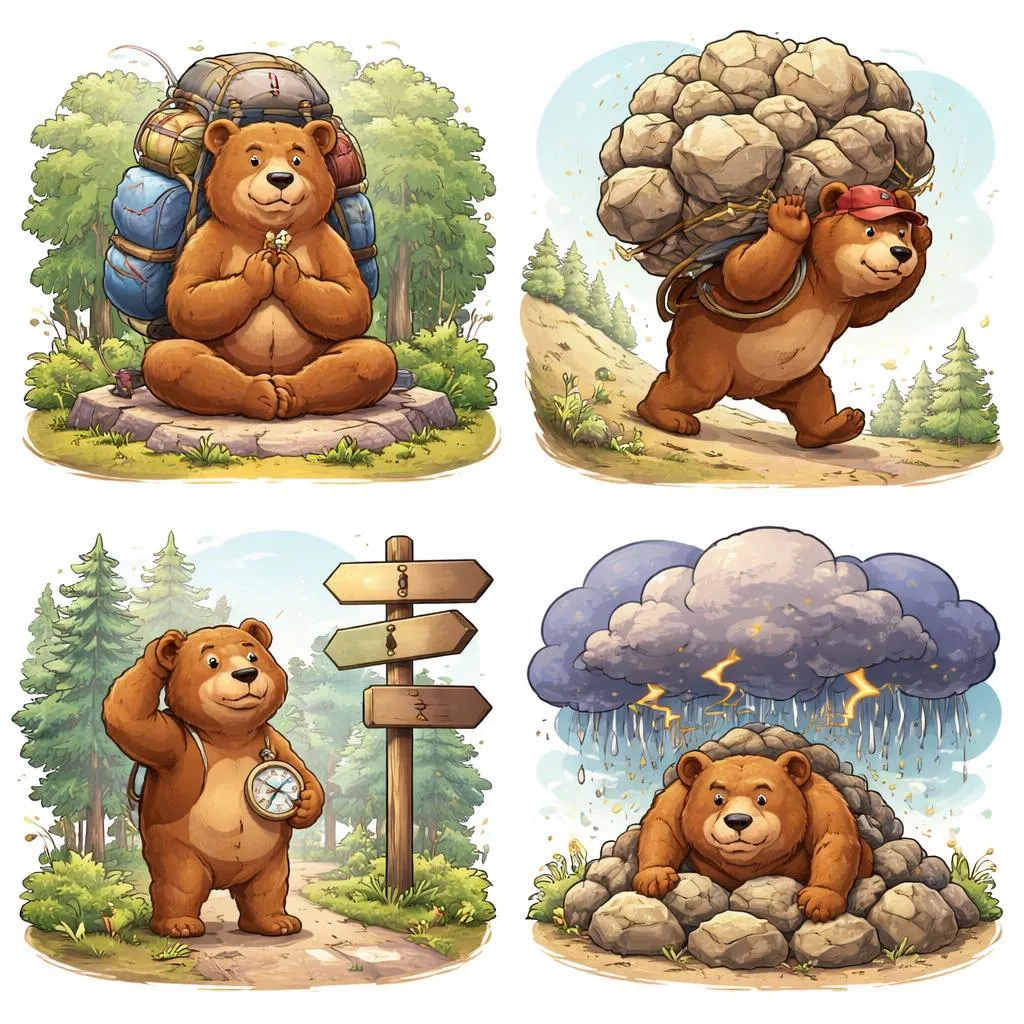

You bear a heavy load with strong arms. A bearer carries a flag in a parade. The words “bear, bearer, bearing, unbearable” all come from one family. Each word talks about carrying or enduring. But each one has a different job in a sentence. Learning this family helps children talk about responsibility and difficult feelings. Let us explore these four words together.
What Does “Same Word, Different Forms” Mean? One core idea can grow into many word shapes. The meaning stays the same at the heart. But the word changes its ending or adds a prefix for a new role. For example, “bear” is a verb or a noun. “Bearer” is a noun. “Bearing” is a noun. “Unbearable” is an adjective. Knowing these four forms helps a child talk about carrying and tolerance.
Personal Pronouns Change Their Form Pronouns change from “he” to “him” or “his”. Our word family changes by adding suffixes and a prefix. Think of “bear” as the core action of carrying or enduring. “Bearer” turns that action into a person. “Bearing” turns the action into a posture or relevance. “Unbearable” adds “un-” to mean too hard to endure. Each form answers a simple question. What action? Bear. Who carries? Bearer. What is posture or connection? Bearing. What is too hard to handle? Unbearable.
From Verb to Noun to Adjective to Adverb – One Family, Many Words This family has a verb, nouns, and an adjective. Let us start with the verb “bear”. Verb: The donkey will bear the heavy packs. “Bear” means to carry or to endure.
“Bear” can also be a noun. Noun: A brown bear catches salmon in the river. “Bear” means the large furry animal. (Different meaning.)
Next is the noun “bearer”. Noun: The bearer of the good news was cheered. “Bearer” means a person who carries something.
Then the noun “bearing”. Noun: Her confident bearing made her look like a leader. “Bearing” means posture or direction. “Bearing” can also mean relevance. Example: That fact has no bearing on the problem.
Finally the adjective “unbearable”. Adjective: The heat was unbearable without air conditioning. “Unbearable” means impossible to tolerate.
One Root, Many Roles – How Words Grow from Actions to Qualities The Old English word “beran” meant to carry. From this root, we built a family about carrying and enduring. “Bear” kept the main verb and noun meanings. Adding -er made “bearer” (the person). Adding -ing made “bearing” (the posture or relevance). Adding the prefix “un-” + able made “unbearable” (not able to be endured). Children can see the same pattern in other families. For example, “carry, carrier, carrying, uncarryable (rare)”. Learning the prefix “un-” helps kids describe overwhelming things.
Same Meaning, Different Jobs – Is It a Verb or a Noun? Look at each word’s job carefully. “Bear” can be a verb or a noun. Verb example: Bear the tray carefully. Noun example: The bear hibernates in winter.
“Bearer” is a noun. Example: The bearer of the torch ran proudly.
“Bearing” is a noun. Example: Her serious bearing showed she was worried.
“Unbearable” is an adjective. Example: The pain was unbearable for the injured bird. Each form has a clear job.
Adjectives and Adverbs – When Do We Add -ly? We can make an adverb from “unbearable”. Add -ly to get “unbearably”. Example: The room was unbearably hot. We can also make “bearably” from “bearable.” For young learners, focus on the verb “bear” and the adjective “unbearable.” A simple reminder: “Bear means to carry or endure. Bearer is the carrier. Bearing is posture or relevance. Unbearable means too hard to stand.”
Watch Out for Tricky Spelling Changes (Double Letters, y to i, and More) “Bear” has no double letters. Add -er to make “bearer”. Bear + er = bearer (no changes). Add -ing to make “bearing”. Bear + ing = bearing (no changes). Add the prefix “un-” and the suffix “-able” to make “unbearable”. Un + bear + able = unbearable (no changes). A common mistake is writing “bear” as “bare” (which means naked). Say “Bear is the animal or to carry. Bare is uncovered.” Another mistake is “bearer” spelled “bearer” (correct) but some write “bareer” (wrong). Say “Bearer has bear, not bare.” Another mistake is “bearing” spelled “baring” (which means uncovering). Say “Bearing is posture. Baring is revealing.” Another mistake is “unbearable” spelled “unbearible” (with i). Say “Unbearable has a, like bearable.”
Let’s Practice – Can You Choose the Right Form? Try these sentences with your child. Read each one aloud. Pick the correct word from the family.
The strong horse will ______ the rider up the hill. Answer: bear (verb)
The ______ of the flag smiled at the crowd. Answer: bearer (noun)
Her confident ______ showed she was ready. Answer: bearing (noun)
The pain in my tooth was ______ until the dentist helped. Answer: unbearable (adjective)
A polar ______ is white and lives in the Arctic. Answer: bear (noun)
The ______ of the bad news left the room in silence. Answer: bearer (noun)
His ______ toward the school was north. Answer: bearing (noun)
The noise from the construction was ______. Answer: unbearable (adjective)
You must ______ the responsibility for your actions. Answer: bear (verb)
The news has no ______ on our decision. Answer: bearing (noun)
After the practice, ask your child one question. Is this word an action of carrying, a person who carries, a posture or relevance, or too hard to endure? That simple question teaches grammar through strength and tolerance.
Tips for Parents – Help Your Child Learn Word Families in a Fun Way Use a backpack to teach “bear”. Say “Can you bear the weight of that backpack?”
Use a news carrier to teach “bearer”. Say “The bearer of the message shouted ‘The king is coming!’”
Use a statue to teach “bearing”. Say “The statue has a proud and noble bearing.”
Use a hot day to teach “unbearable”. Say “Without shade, the heat is unbearable.”
Play “fill in the blank” during car rides. Say “The donkey will ______ the supplies.” (bear) Say “The ______ of the trophy lifted it high.” (bearer) Say “Her ______ was calm even under pressure.” (bearing) Say “The itch from the mosquito bite was ______.” (unbearable)
Read a story about a messenger or a strong character. Ask “What does the character bear?” Ask “What unbearable thing happens in the story?”
Turn a drawing activity into a word lesson. Draw a person carrying a stack of books. Label “bear”. Draw a person with a flag. Label “bearer”. Draw a straight-backed person. Label “proud bearing”. Draw a sweating person with a crossed-out sun. Label “unbearable heat”.
When your child makes a mistake, stay calm. If they say “I can’t bear it,” that is correct. “I can’t bare it” is wrong. If they say “His bearing is bad,” for attitude, say “Yes, bearing can mean how someone stands or acts.”
Write the four words on sticky notes. Put them on a wall near a coat rack or a mirror. Each time you carry something, point to “bear”.
Remember that we bear many things. Use these words to build resilience. “You can bear small troubles. You will grow stronger.” “A dignified bearing earns respect.” Soon your child will bear responsibilities. They will be a bearer of good news. They will have a confident bearing. And they will know that some things are unbearable, but they can ask for help. That is the enduring power of learning one small word family together.