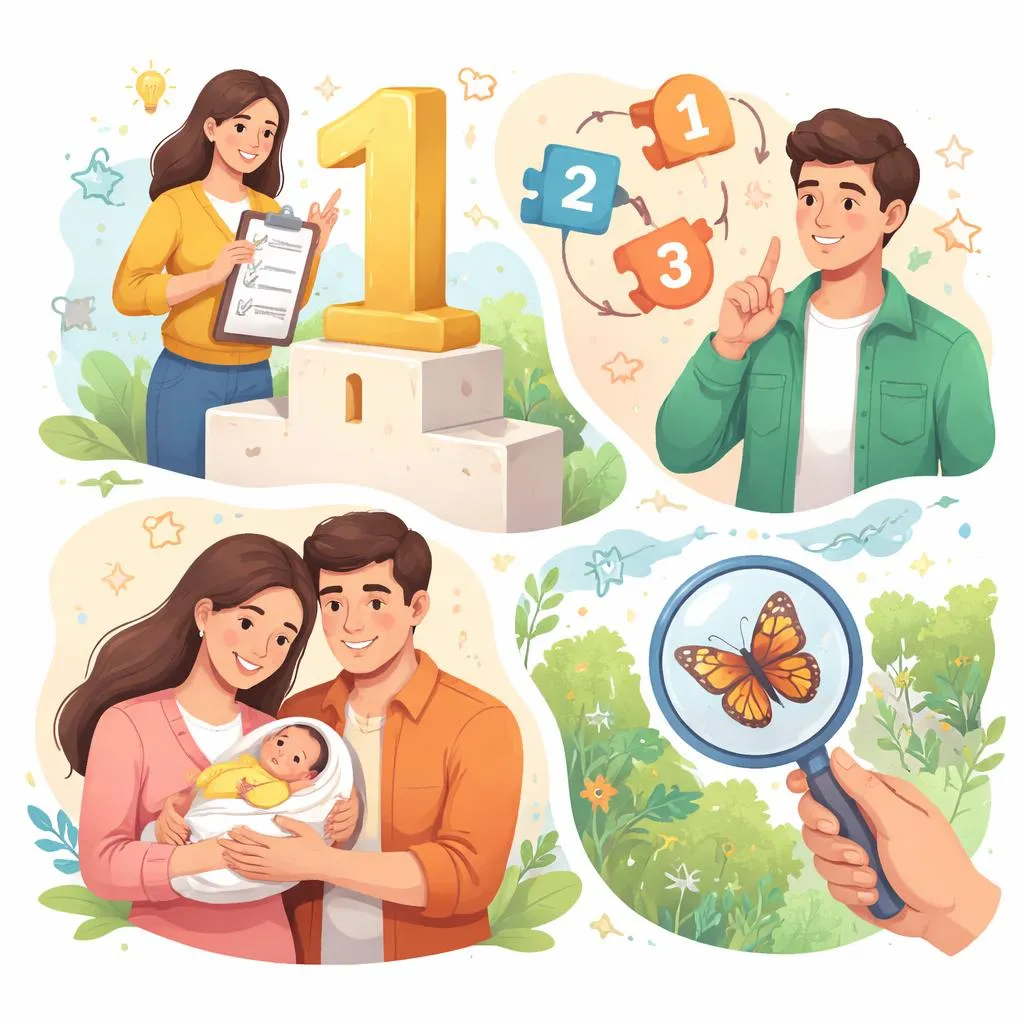

Hello, word explorer! Have you ever been in a race? The winner comes in first. In a speech, you might say "firstly". In a family, the oldest child is the firstborn. An explorer shares a firsthand story. They all have "first" in them. But they are not the same! The words first, firstly, firstborn, and firsthand are a "Word Race Team". They all connect to being at the beginning. Each team member has a special lane. Your job is to learn their lanes. Let's see a quick example at home.
At home, you might say: "I am first in line for dessert." That shows your position. But you could also say: "I have firsthand experience baking cookies." That means you baked them yourself. Which one is right? They both are! You need the right runner for your sentence race. Let's start our word race!
Adventure! Decoding the Race Team
Welcome to the word stadium! Our four race words are here. They share a root idea. But they are different. Meet First. It is an adjective or adverb for position. Meet Firstly. It is an adverb for listing points. Meet Firstborn. It is a noun or adjective for family order. Meet Firsthand. It is an adjective or adverb for direct experience. Let's learn their race strategies.
Dimension One: The Order Show – What Kind of First is It?
These words show different types of "first". One is about sequence. One is about listing. One is about birth. One is about experience. Let's look at the order.
First: The Position or Sequence Word. This word shows the initial position in a sequence. It can be about time, place, or rank. Look at "school" and "playground" examples.
School example: "First, we will read the story." This shows the initial step in a sequence of actions.
Playground example: "She was the first to reach the swing." This shows her rank in a race to the swing.
Firstly: The Listing Adverb. This word is used to introduce the first point in a list. It is more formal. It is common in writing and speeches.
School example: "Firstly, let me welcome our guest." This is the first point in a welcome speech.
Playground example: Not common in casual playground talk, but in a presentation about games: "Firstly, the rules are simple."
Firstborn: The Birth Order Noun/Adjective. This word refers to the first child born in a family. It is about the order of birth.
Home example: "My brother is the firstborn in our family." This tells his birth order.
Animal example: "The firstborn puppy is often the largest." This tells the birth order of the puppy.
Firsthand: The Direct Experience Word. This word means directly from the source. It is not from someone else. It is personal experience.
School example: "We heard a firsthand account of the historical event." This means a direct account from a witness.
Nature example: "The ranger has firsthand knowledge of the forest." This means the ranger's personal experience.
Dimension Two: The Role Reveal – Adjective, Adverb, or Noun?
Every word has a role. Is it a describing word? Is it a word that describes an action? Or is it a thing?
First: The Double-Role Runner. This word has two common roles. First, as an adjective. It describes a noun's position. Second, as an adverb. It describes the order of an action.
As an adjective: "This is my first day of school." Here, "first" describes the noun "day". As an adverb: "I arrived first." Here, "first" describes the verb "arrived".
Firstly: The Listing Adverb. This word is an adverb. It is used to list points in a sequence. It often starts a sentence.
Firstborn: The Family Noun/Adjective. This word can be a noun or an adjective. As a noun, it names the first child. As an adjective, it describes the child.
As a noun: "The firstborn gets the oldest toys." It names the child. As an adjective: "She is the firstborn daughter." It describes the daughter.
Firsthand: The Experience Adjective/Adverb. This word can be an adjective or an adverb. As an adjective, it describes a noun. As an adverb, it describes a verb.
As an adjective: "She has firsthand experience." It describes the noun "experience". As an adverb: "I saw it firsthand." It describes the verb "saw".
Dimension Three: The Team-Up – What Words Do They Like?
These runners have favorite partners. Knowing their common "teammates" helps us use them correctly.
First (Adjective): It often comes before a noun. "The first prize", "my first attempt". It can be used with "the" or "my".
First (Adverb): It can be used alone or in phrases. "First come, first served." "At first, I was nervous."
Firstly (Adverb): It is often followed by a comma. It is paired with "secondly", "thirdly". "Firstly, we will plan. Secondly, we will act."
Firstborn (Noun/Adjective): It is often used with "the" or a possessive. "The firstborn", "my firstborn", "the firstborn son".
Firsthand (Adjective): It often comes before nouns like "experience", "knowledge", "account". "Firsthand information".
Firsthand (Adverb): It often comes after verbs like "see", "learn", "experience". "I learned it firsthand."
Our Discovery Map: The Race Team Guide
Our race guide is clear. Do you want to talk about the initial position in a sequence or rank? Use first as an adjective or adverb. Do you want to introduce the first point in a formal list? Use the adverb firstly. Do you want to talk about the oldest child in a family? Use the noun or adjective firstborn. Do you want to talk about direct, personal experience? Use firsthand as an adjective or adverb. Remember, first is for general sequence. Firstly is for formal lists. Firstborn is for family order. Firsthand is for direct experience.
Challenge! Become a Word Race Master
-
Best Word Choice: Read the scene. Pick the best word. (Nature/Animal Scene) A lioness has three cubs. The cub that was born before the others is the largest and strongest. a) The firstly cub is the largest. b) The firstborn cub is the largest. Which one correctly identifies the cub based on its birth order? (Answer: b)
-
Two-Word Sentence Showdown: (Home/Cooking Scene) Imagine learning to make pancakes with a parent. First, use "first" as an adverb to give the initial step. Example: "First, we mix the flour and milk." Now, use "firsthand" as an adjective to describe the knowledge you gain. Example: "Now I have firsthand knowledge of making pancakes."
-
Eagle Eye! Find the Glitch: Look at this sentence. One word is not quite right for the meaning. Can you fix it? (School/Presentation Scene) "In my report, I will talk about three things. First, the habitat. Secondly, the diet. Thirdly, the behavior." What's wrong? Actually, this is acceptable. But let's create a clear error: "I have a firstly edition of that book." Fixed sentence: "I have a first edition of that book."
Your Takeaway and Mission! Make Your Sentences Clear
Great race, word champion! You learned the special roles of each word. You can now choose the right word for any situation. Your English will be precise and clear.
What you can learn from this article:
You now see that first, firstly, firstborn, and firsthand are a team. But they have different functions. You learned to use "first" for sequence or rank. You use "firstly" to list points formally. You use "firstborn" for the oldest child. You use "firsthand" for direct experience. You know that "first" is an adjective or adverb. "Firstly" is an adverb. "Firstborn" is a noun or adjective. "Firsthand" is an adjective or adverb.
Live Practice Application:
Try this today! List your chores: "First, I will clean my room." Write a formal note: "Firstly, I want to thank you." Talk about your family: "My cousin is the firstborn." Share an experience: "I saw the rainbow firsthand." When you write or speak, think: Is it a sequence? Use first. Is it a formal list? Use firstly. Is it birth order? Use firstborn. Is it direct experience? Use firsthand. Choosing the right word makes your language accurate. You are now a master of the race team. Well done!