
Opening Introduction
Leo looked at the big clock on the kitchen wall. The big hand was on the twelve. The little hand was on the seven. "Is it time for my cartoon?" he asked. His sister Mia smiled. "Yes! When the big hand is on the twelve, we say 'o'clock'. It's seven o'clock! But sometimes, the big hand points to the six. That's 'half past'. Let's learn about time telling o'clock and half past. It's like learning the secret language of the clock, so you always know what time it is!" Leo was excited. A secret language? He watched the clock closely. Let's learn this language together.
Core Knowledge Explanation
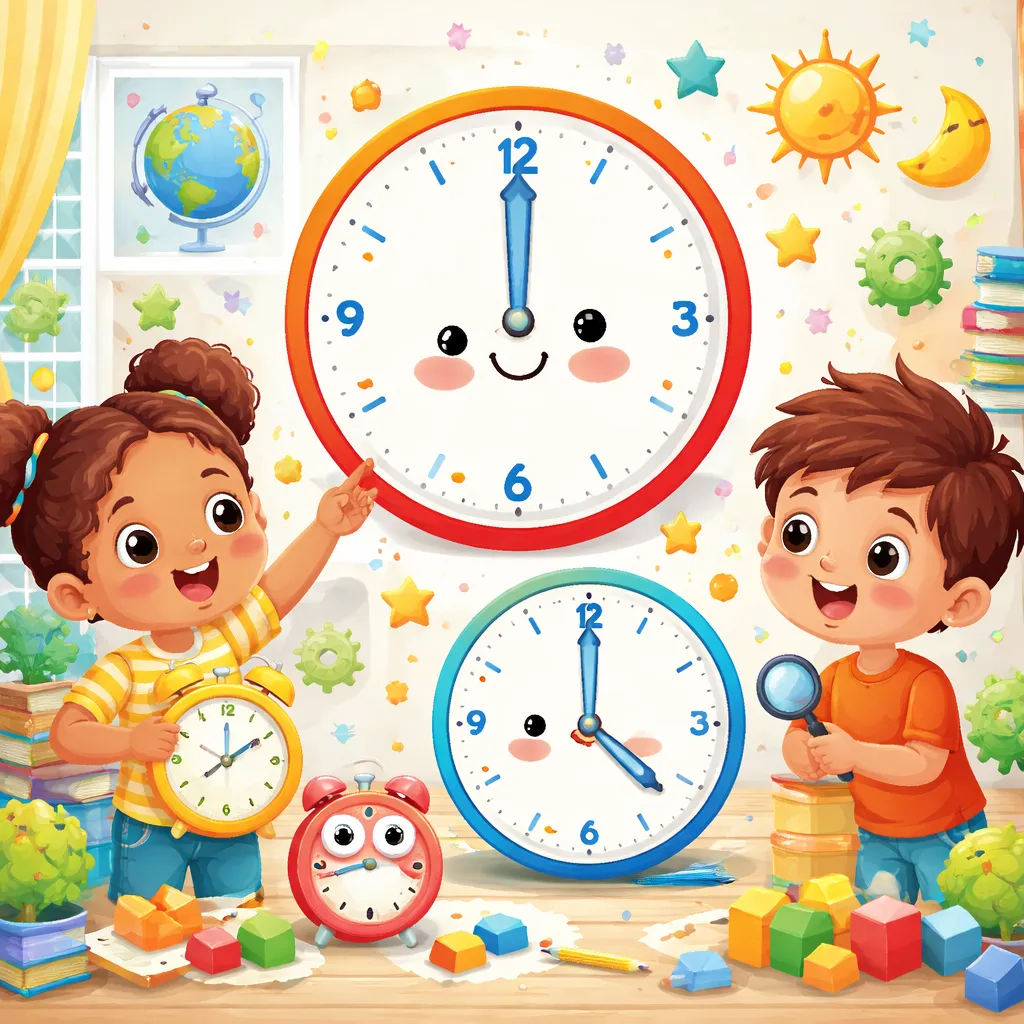
A clock helps us measure time. It tells us when to wake up, eat, play, and sleep. Most clocks have a face, two hands, and numbers. The short hand is the hour hand. It points to the hour. The long hand is the minute hand. It points to the minutes. Learning about time telling o'clock and half past is the first step to becoming a time expert. Let's start with 'o'clock'. 'O'clock' means exactly on the hour. Look at the minute hand. Is it pointing straight up to the number twelve? Good! Now, look at the hour hand. Which number is it pointing to? If the hour hand points to three, and the minute hand points to twelve, it is three o'clock. We write 3:00. This is the easiest time to read. Every time the minute hand is on the twelve, we say "o'clock" after the number.
Now, let's learn 'half past'. This is a fun one! 'Half past' means thirty minutes have passed after the hour. Look at the minute hand. Is it pointing straight down to the number six? The six stands for thirty minutes. Good! Now, look at the hour hand. Here is a secret: when it is 'half past', the hour hand is not exactly on a number. It has moved halfway to the next number. If the minute hand is on the six, and the hour hand is halfway between three and four, it is half past three. We say "half past three". We write 3:30. It means thirty minutes after three o'clock. This is the key to time telling o'clock and half past. You must look at both hands. The minute hand tells you if it's 'o'clock' (on 12) or 'half past' (on 6). The hour hand tells you which hour it is.
Fun Interactive Learning
Let's make a learning clock! This is the best way to practice. Get a paper plate. Draw numbers like a clock face. Atticate two paper hands with a brass fastener in the center. Now, you can move the hands! Ask a grown-up to say a time. "Show me four o'clock." Move the minute hand to twelve and the hour hand to four. "Now show me half past seven." Move the minute hand to six and the hour hand halfway between seven and eight. This hands-on activity makes time telling o'clock and half past real and fun. You are the boss of the clock!
Another game is "What's the Time, Mr. Wolf?" One person is Mr. Wolf, standing with their back to the others. The others ask, "What's the time, Mr. Wolf?" Mr. Wolf looks at a picture of a clock (or their paper clock) and says a time, like "It's half past two!" The others take that many steps forward (two steps). The game continues until Mr. Wolf says "Dinner time!" and chases them. This game uses the time words in a playful, active way. You can also play a matching game. Draw clocks showing different 'o'clock' and 'half past' times. On separate cards, write the times. Mix them up and try to match the clock picture to the correct time card.
Expanded Learning
People have used clocks for hundreds of years. Long ago, they used sundials. Today, we have digital clocks that show numbers. But the analog clock with hands is still very important to learn. The idea of time telling o'clock and half past is the same all over the world. In some countries, they use a 24-hour clock, but for your day, the 12-hour clock is perfect. Knowing how to read an analog clock is a skill that helps you in cars, on buildings, and in classrooms.
When you say "half past three," you are saying that half of the hour between three and four o'clock has passed. Time is always moving forward, just like the clock hands. Learning about time telling o'clock and half past helps you understand schedules and be on time, which is a very grown-up and polite thing to do. Let's make a time telling chant. Chants are rhythmic and help you remember.
When the big hand points to the sky, to number twelve up high! Look at the small hand, what do you see? It's __ o'clock, as plain as can be! When the big hand points to the ground, to number six, a half is found! The small hand is between, you see, it's half past __, for you and me! O'clock and half past, learn them well, the time they have a story to tell!
What You Will Learn
You are learning about time measurement, numbers, and daily structure. You are learning the core concepts of time telling o'clock and half past. You are learning to identify the hour hand and the minute hand, and to read times like 1:00, 2:30, 5:00, and 7:30. You are also learning the vocabulary: o'clock, half past, hour hand, minute hand, clock face, analog clock.
You are learning to make clear time statements. You can say, "It is nine o'clock." You can explain, "The time is half past four." You can ask, "Is it half past eleven yet?" You are using English to communicate about a fundamental part of daily life. This builds practical language and math skills.
You are building foundational skills. You are building number recognition. You read numbers 1-12. You are building spatial awareness. You see the positions of the clock hands. You are building sequencing skills. You understand the order of hours. You are building responsibility. You learn to be aware of time. You are building confidence. You can answer the question, "What time is it?"
Using What You Learned in Life
Use your new skill all day long. In the morning, look at the clock. "It's seven o'clock, time to get up!" At school, check the classroom clock. "It's half past ten, time for recess!" When you have an activity, ask a grown-up, "At what o'clock does soccer start?" Help your family by being the time keeper. "Mom, it's half past five. Time to start making dinner!" You can also make a simple picture schedule for your day. Draw a clock showing 8:00 and a picture of breakfast. Draw a clock showing 3:30 and a picture of playtime.
At school, you can volunteer to tell the teacher the time. You can help friends who are still learning. When you read stories, look for mentions of time. "The story says Cinderella left at midnight. That's twelve o'clock!" The more you practice time telling o'clock and half past, the faster you will get. Soon, you'll glance at a clock and know the time instantly.
Closing Encouragement
You are a time teller. You are a clock reader. You are a responsible and observant learner. I am so proud of you. Learning to tell time for o'clock and half past shows you have a sharp mind and an awareness of the world around you.
May you always be on time for fun, for learning, and for all your adventures. Remember, time is a gift, and now you can read its label. You are learning the language of time, and that is a language that helps you every single day.
You are attentive, you are precise, and you are ready to master the clock. Great work, my wonderful timekeeper.